As an established pioneer in heavy industrial fabrication, Nordstone specializes in the custom design and manufacturing of high-performance waste heat boilers and advanced thermal systems engineered for harnessing industrial energy loss for high-value steam generation across Italy.
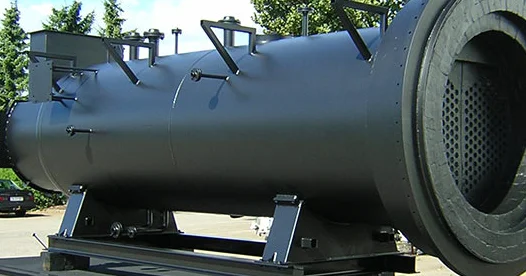
Designed to recover thermal energy from high-temperature exhaust streams, our industrial waste heat recovery packages provide critical utility lines with zero-fuel steam or hot water for sectors where energy efficiency is paramount—including Oil & Gas refineries, chemical processing plants, incinerators, and glass or steel manufacturing facilities.
Drawing on over 20 years of expert engineering experience, our team specializes in the precise thermal and mechanical design of smoke-tube and water-tube configurations optimized to operate safely behind gas turbines, heavy industrial furnaces, and diesel generator exhausts.
Our state-of-the-art manufacturing facility combines advanced welding automation with premium metallurgy to construct robust waste heat recovery boiler (WHRB) bodies that withstand severe flue-gas corrosion, particulate abrasion, and extreme thermal cycling. Every system is engineered as a fully integrated modular package featuring automated bypass dampers, custom soot-blowing configurations, and smart control panels designed for rapid, seamless integration into your existing exhaust infrastructure.
By strictly maintaining compliance with critical international and European engineering benchmarks—including ASME Section VIII/I, EN 12953, CE marking, and the European Pressure Equipment Directive (PED 2014/68/EU)—Nordstone guarantees unmatched operational safety, rapid carbon footprint reduction, and structural longevity for Italy’s advanced industrial operations.
To collaborate with our senior thermodynamic engineering team on your custom waste heat recovery specifications or to request a detailed technical proposal, please visit our contact page.
Technical FAQ (Top 15)
Q1: What is a waste heat boiler and how does it optimize an industrial facility?
A waste heat boiler (or WHRB) is an industrial energy-recovery system that captures hot exhaust gases generated by primary processes—such as gas turbines, incinerators, or furnaces—and redirects that energy through a heat exchanger loop. This thermal energy is utilized to generate high-value steam or hot water without consuming any additional fossil fuel, drastically lowering utility overhead and carbon footprints.
Q2: What major manufacturing codes and safety certifications do your waste heat boilers carry?
All Nordstone recovery systems are manufactured to rigid global safety mandates. For projects in Italy and across Europe, our equipment carries the CE marking in strict compliance with the Pressure Equipment Directive (PED 2014/68/EU) and European standard EN 12953. We are also fully certified to apply ASME Section I (Power Boilers) or ASME Section VIII stamps for international configurations.
Q3: What types of industrial exhaust streams are suitable for your recovery systems?
Our waste heat boilers are engineered to process a diverse range of exhaust sources, including clean gas turbine exhaust, soot-laden diesel engine exhaust, aggressive chemical flue gases, and high-temperature waste streams from metallurgical furnaces or municipal waste incineration plants.
Q4: How does Nordstone handle corrosive or particulate-heavy flue gases?
Material selection and gas-path architecture are critical. For abrasive or chemically aggressive flue gases containing sulfur, chlorine, or ash, we utilize specialized metallurgy—including high-alloy stainless steels or clad tubes—and incorporate automated soot-blowing systems and wide tube-pitch designs to eliminate particulate accumulation and corrosive fouling.
Q5: What is the typical thermodynamic efficiency increase when installing a waste heat boiler?
By capturing exhaust streams that would otherwise be vented directly into the atmosphere, a waste heat boiler can recover up to 70-80% of the energy loss contained in the flue gas. This directly boosts the overall thermodynamic efficiency of the entire industrial plant by 15% to 30%, depending on the baseline process configuration.
Q6: Can Nordstone design boilers with an integrated auxiliary firing system?
Yes. To ensure a steady supply of high-value steam when the primary process exhaust fluctuates or drops, we can equip our waste heat boilers with auxiliary duct burners. This dual-source configuration seamlessly transitions to active fuel firing (natural gas or oil) to maintain consistent steam output parameters.
Q7: Are your waste heat recovery boilers delivered as fully integrated modular skids?
Yes. Every boiler package is engineered and shipped as a highly integrated modular unit. This includes the heat exchanger pressure core, automated flue-gas bypass and isolation dampers, feed-water pumps, safety valves, and a centralized control system, minimizing on-site construction work and plant downtime.
Q8: Are your thermal recovery systems certified for deployment in explosive or ATEX-rated zones?
Absolutely. Drawing on our deep engineering history in the defense and petrochemical sectors, we routinely manufacture fully ATEX-certified waste heat boiler components for Zone 1 and Zone 2 hazardous locations. This includes integrating explosion-proof electrical enclosures (Ex d), intrinsically safe loops (Ex i), and flameproof instrumentation.
Q9: Can these recovery systems operate continuously without manual intervention?
Yes. We engineer our automation and safety arrays to comply with European safety norms for 24-hour or 48-hour continuous operation without constant manual supervision. The system automatically regulates feed-water flow, monitors flue-gas pressure drops, and adjusts bypass dampers to maintain safe operation.
Q10: What non-destructive testing (NDT) protocols are implemented during fabrication?
In strict adherence to our ISO 9001 quality systems, all pressure welds and structural seams undergo exhaustive NDT tracking. This includes 100% Radiographic Testing (RT), Ultrasonic Testing (UT), and Magnetic Particle Testing (MT). Every completed boiler undergoes a witnessed hydrostatic pressure test up to 1.5 times its design pressure.
Q11: How do your control systems interface with an existing plant-wide SCADA or DCS network?
Our automated control panels are engineered with open-architecture PLCs (such as Siemens or Rockwell Automation platforms). We configure the communication layers to native industrial protocols like Modbus TCP, Profinet, or Ethernet/IP, providing your central control room with full real-time telemetry, energy recovery metrics, and safety alarm logging.
Q12: Do you offer Factory Acceptance Testing (FAT) at your facility in Italy?
Yes. Every waste heat boiler undergoes rigid Factory Acceptance Testing prior to shipment. Your engineering representatives or designated third-party inspection bodies are given complete facility access to witness electrical loop testing, logic validation, and hydrostatic integrity checks.
Q13: Which third-party inspection and classification societies do you regularly partner with?
We regularly coordinate our materials traceability, weld validation records, and safety compliance logs with premier classification bodies active in the European market, including RINA, Bureau Veritas, TÜV, and Lloyd’s Register.
Q14: What baseline data does your team require to draft a precise recovery proposal?
To compile an accurate engineering proposal, please supply the exhaust gas mass flow rate (kg/h), flue-gas inlet temperature, chemical composition of the exhaust gas, allowable backpressure on the primary equipment, and your target steam pressure and output requirements.
Q15: How can a facility engineer or procurement manager initiate a waste heat boiler project?
You can securely upload your request for proposal (RFP), piping and instrumentation diagrams (P&IDs), or technical equipment data sheets through our secure corporate interface. To establish an initial technical consultation with our senior thermal engineers, please connect with us directly via our contact page.