As a premier choice among Fluidized-Bed Reactors manufacturers in Italy, Nordstone combines more than 20 years of experience with custom engineering to supply top-tier multiphase processing units.
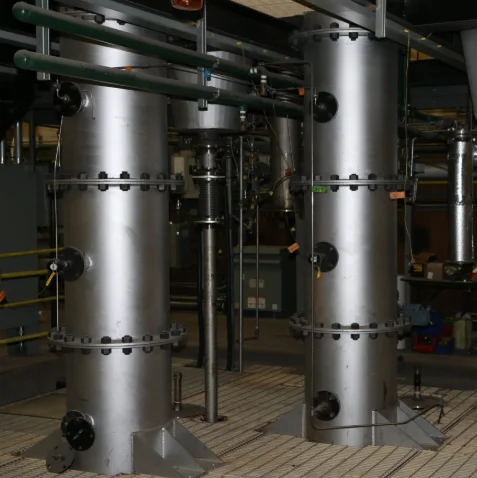
We specialize in designing and manufacturing high-performance industrial Fluidized-Bed Reactors (FBRs) engineered to survive volatile conditions. Utilizing advanced computational fluid dynamics (CFD) alongside rigorous thermal-mechanical modeling, our expert engineering team manufactures customized solutions built for supreme heat and mass transfer efficiency.
Whether you require a Bubbling Fluidized-Bed Reactor (BFBR) or a Circulating Fluidized-Bed Reactor (CFBR), our systems maintain uniform temperature fields, preventing local hot spots in exothermic catalytic cracking or gasification lines. We construct our vessels with corrosion-resistant alloys, including Stainless Steel (SS316L), Hastelloy, and Inconel, allowing them to safely handle working pressures up to 50 bar and temperatures ranging from -50°C to 1000°C.
Fully compliant with international pressure vessel regulations, Nordstone provides fully certified equipment holding ASME Section VIII, API, and ISO stamps. From initial mechanical design to non-destructive testing (NDT), we deliver industrial reactors built for maximum operational uptime across the chemical, energy, and petrochemical sectors in Italy.
To discuss your custom technical specifications or to request a detailed engineering proposal for your next project, please visit our dedicated page to contact us.
Frequently Asked Questions (FAQ)
1. What types of Fluidized-Bed Reactors (FBR) does Nordstone manufacture for the Italian market?
We design and fabricate multiple variations, primarily focusing on Bubbling Fluidized-Bed Reactors (BFBR) for steady-state gasification or pyrolysis, Circulating Fluidized-Bed Reactors (CFBR) for intensive gas-solid contact with active cyclone recovery, and specialized Spouted Bed Reactors designed to process irregular or cohesive solid materials without channeling.
2. Which industrial sectors in Italy do your fluidized-bed systems serve?
Our custom systems support the chemical and petrochemical industries (catalytic cracking, polymer production), the energy sector (biomass gasification, waste-to-energy setups), environmental engineering (CO₂ capture, flue gas treatment), and the pharmaceutical or food sectors for precision granulation and drying.
3. What pressure and temperature limits can Nordstone reactors withstand?
Our heavy-wall industrial reactors are engineered for extreme environments. We routinely build units capable of managing internal process pressures up to 50 bar and extreme operational temperature spectrums ranging from -50°C up to 1000°C, utilizing specialized thermal insulation liners or cooling jackets.
4. Are your reactors compliant with European and Italian pressure equipment directives?
Yes. Beyond holding international ASME Section VIII (Div. 1 & 2) and API certificates, all process vessels destined for European installations strictly adhere to local Italian regulations and comply with the PED (Pressure Equipment Directive) 2014/68/EU framework, including EN 13445 standards.
5. What materials do you use to combat high corrosion and abrasion inside the bed?
Depending on your process chemistry, we select metallurgy tailored for longevity. This includes standard SS304 and SS316L stainless steel for standard corrosive services, alongside high-nickel superalloys such as Inconel and Hastelloy for extreme thermal and corrosive demands, or specialized ceramic linings to prevent mechanical wear from abrasive catalyst beds.
6. Do you utilize modern modeling tools during the design phase?
Absolutely. Our engineering team conducts detailed Finite Element Analysis (FEA) via ANSYS and applies advanced thermal rating programs like ASPEN B-JAC and X-Designer. This ensures that the gas distributor plates, nozzles, and structural supports resist mechanical fatigue and cyclic thermal expansion stresses.
7. How does Nordstone optimize heat transfer within the fluid bed?
We integrate optimized internal heat exchange bundles, immersed coil configurations, or external cooling/heating jackets directly into the structural design. The chaotic, fluid-like movement of the solid particles against these heat transfer surfaces yields thermal efficiencies up to 10 times greater than traditional fixed-bed configurations.
8. Can Nordstone provide modular, skid-mounted reactor packages?
Yes. We specialize in executing fully integrated, pre-tested process modular skid packages. We assemble the fluidized-bed reactor, cyclone separators, piping manifolds, structural steel frames, and associated instrumentation at our factory to minimize your on-site installation timelines and commissioning costs in Italy.
9. What quality control testing procedures do your vessels undergo?
Every reactor undergoes a strict QA/QC testing matrix before dispatch. This includes hydrostatic and pneumatic pressure testing, pressure cycling endurance checks, and comprehensive Non-Destructive Testing (NDT) such as Ultrasonic Testing (UT) and Radiographic Testing (RT) on all critical pressure-retaining weld seams.
10. How does the distributor plate design prevent particle weeping or channeling?
The gas distributor plate is the heart of a fluid bed. We custom-engineer the perforation grid, bubble cap geometry, and pressure drop ratios based on your specific fluidizing gas velocity and catalyst particle size distribution. This prevents solid particles from sifting downward (weeping) and avoids gas channeling.
11. What particle size ranges can your fluidized-bed systems successfully handle?
Our systems are mechanically optimized to process solid materials spanning from fine micro-sized powders up to coarse granules measuring several millimeters. We customize the gas velocity parameters to maintain clean fluidization regimes without triggering unwanted particle attrition or excessive elutriation.
12. Are your systems equipped for continuous catalyst addition and withdrawal?
Yes, we can equip our FBR designs with automated solids feeding systems and continuous bottom-ash or spent-catalyst withdrawal valves. This allows your plant to achieve steady-state operations and run automated catalyst regeneration cycles without shutting down the main process stream.
13. What is the typical physical sizing capacity available for your custom builds?
Because we build completely to order, our structural manufacturing capacity accommodates internal vessel diameters ranging from compact pilot-scale units of 0.3 meters up to massive industrial diameters of 8 meters, with total volumetric capacities handling up to 500 cubic meters.
14. Do you provide validation documentation for pharmaceutical or fine chemical installations?
Yes, we deliver comprehensive QA/QC documentation packages. This includes complete material traceability logs (MTRs), welding log books, NDT reports, hydro-test certificates, and required documentation to support your plant’s internal validation protocols.
15. How can Italian industrial procurement teams request a formal quote from Nordstone?
To submit process requirements, process conditions, or mechanical datasheets, you can quickly reach out to our global sales and engineering office through our contact page to receive a comprehensive technical proposal.