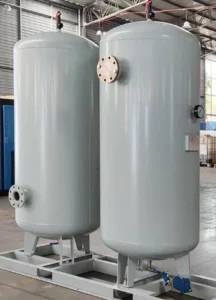
For over three decades, Nordstone has established an international benchmark in designing and manufacturing high-performance, certified industrial vessels tailored for the most demanding operating environments.
Expanding our technical footprint to serve critical infrastructure needs, Nordstone operates as an elite tier among Nitrogen Receiver manufacturers in Italy, delivering bespoke pressure storage units engineered specifically for high-pressure gas containment, chemical blanketing, and industrial process stability.
Utilizing state-of-the-art automation and advanced computational fluid dynamics (CFD) modeling, our European and regional operations engineer heavy-duty nitrogen buffer tanks that mitigate downstream pressure drops, optimize gas generator lifecycles, and withstand severe thermal and corrosive stress. With 20 years of specialized manufacturing experience, our custom-built vertical and horizontal nitrogen receiver vessels adhere rigorously to ASME Section VIII Div. 1/Div. 2, API, and European PED/CE marking standards.
Whether deploying solutions for the intense offshore environments of the Oil & Gas sector or supporting precise safety networks in Defense and aerospace, Nordstone ensures absolute integrity through meticulous non-destructive testing (NDT), zero-tolerance QA/QC protocols, and total material traceability.
Frequently Asked Questions
1. What is the primary function of a Nitrogen Receiver vessel?
A Nitrogen Receiver functions as a high-pressure buffer and storage vessel within an industrial gas distribution or PSA (Pressure Swing Adsorption) generation network. It accumulates compressed nitrogen gas during periods of low consumption and discharges it during peak demand intervals. This buffering mechanism maintains stable downstream pressure headers, prevents rapid cycling of gas generators, and guarantees a continuous, uninterrupted supply of inert gas for processes like tank blanketing or pipeline purging.
2. What design codes and certifications do Nordstone Nitrogen Receivers follow in Italy and Europe?
Every vessel manufactured for the European and global markets complies strictly with international pressure equipment directives. This includes the ASME Section VIII Division 1 and Division 2 (with U-Stamp authorization) and the European Pressure Equipment Directive (PED) 2014/68/EU / CE marking. Additionally, our facilities maintain compliance with ISO 9001, ISO 14001, and ISO 45001 management standards, alongside industry-specific mandates such as API 12J and NACE MR0175 for sour gas environments.
3. Which materials are utilized to withstand corrosive and extreme temperature environments?
Material selection is dictated precisely by the process temperature, external environmental exposure, and gas purity demands. Nordstone utilizes high-strength carbon steels (such as SA 516 Gr. 60/70) for standard, dry nitrogen applications. For cryogenic, low-temperature, or highly corrosive maritime environments, we leverage Low-Temperature Carbon Steel (LTCS), premium Stainless Steel grades (SS304/304L, SS316/316L), Duplex, Super Duplex, and high-nickel alloys like Inconel or Hastelloy.
4. Can Nordstone customize the orientation and nozzle configuration of the receiver?
Yes. Our dedicated engineering team custom-tailors every pressure vessel to fit the spatial constraints and structural footprint of your facility. We offer both vertical configurations (ideal for minimizing floor space) and horizontal orientations (frequently utilized in skid-mounted process assemblies). Nozzle sizes, orientations, instrument connections, manways, and lifting lugs are entirely customized via advanced 3D CAD and mechanical calculations.
5. What pressure and temperature limits can your Nitrogen Receivers accommodate?
Nordstone’s engineering scope covers extreme operating ranges. We regularly manufacture vessels designed for conditions ranging from full vacuum up to 200 bar (approx. 3,000 psi) working pressure. Our thermal design envelopes span from cryogenic levels (–50°C) up to high-temperature process conditions (+400°C), ensuring reliable mechanical performance without stress-induced deformation.
6. How does a nitrogen receiver improve the efficiency of a PSA generation system?
Because gas generation in a PSA plant operates on alternating adsorption cycles rather than a perfectly continuous stream, flow and pressure fluctuations naturally occur. The nitrogen receiver acts as a baseline stabilizer. By storing a massive volume of gas at peak purity, it prevents the generation system from overworking or cycling too frequently, directly reducing energy consumption, protecting downstream equipment, and extending the operational lifespan of the molecular sieves.
7. What standard quality control and testing procedures are performed on each vessel?
We operate under a zero-defect philosophy. Before shipment, every nitrogen receiver undergoes a rigorous array of quality checks, including:
- 100% Hydrostatic and Pneumatic pressure testing (typically 25% to 50% above maximum design pressure). harsiddhiairsolution.com
- Non-Destructive Testing (NDT) including Radiographic Testing (RT), Ultrasonic Testing (UT), Dye Penetrant Inspection (DPI), and Magnetic Particle Inspection (MPI). nordstoneng.com
- Positive Material Identification (PMI) and complete material traceability documentation (MTCs).
8. Are Nordstone vessels suitable for offshore maritime or explosive environments?
Absolutely. Our pressure vessels are robustly engineered to face the most hostile offshore conditions, such as those found on FPSO (Floating Production Storage and Offloading) units or drilling platforms. We provide advanced external coatings—such as offshore-grade multi-layer epoxy, glass flake, or phenolic linings—alongside certified structural fireproofing and specialized seismic/cyclic stress designs to counter high-vibration and saline environments.
9. What standard accessories and instrumentation options are included with the receiver?
While configurations depend entirely on client specifications, a standard high-performance nitrogen receiver package can be delivered fully dressed with:
- Calibrated Safety Relief Valves (SRVs) sized for maximum thermal expansion or filling rates.
- High-accuracy analog or digital pressure gauges.
- Automatic or manual drain valves for moisture removal.
- Isolation valves, level gauges, and electronic instrumentation for automated control room monitoring.
10. Does Nordstone offer skid-mounted or fully integrated gas process packages?
Yes, we specialize in delivering skid-mounted process packages. Instead of receiving a bare shell, clients can opt for a turnkey, factory-tested system where the nitrogen receiver is pre-piped, insulated, instrumented, and structural-mounted alongside filters, pressure regulators, and control manifolds for rapid, plug-and-play installation on-site.
11. How do you ensure that the stored nitrogen gas maintains its high purity level?
Contamination within a receiver usually stems from internal moisture or chemical breakdown of low-grade coatings. Nordstone prevents this by keeping the inner surfaces of our stainless steel vessels completely pristine, or by applying high-grade inert internal linings to carbon steel variants. Our designs prevent air ingress, maintain high seal integrity, and include optimized drainage points to eliminate any particulate or moisture buildup, preserving nitrogen purities up to 99.999%.
12. What industries rely on Nordstone’s specialized pressure vessels?
With 20 years of manufacturing excellence, our client portfolio spans critical, heavy-duty market sectors including Oil & Gas (upstream and downstream refining), Petrochemicals, Defense, Aerospace, Pharmaceutical manufacturing, Heavy Chemical processing, and high-tech Electronics production.
13. How does Nordstone approach the structural engineering of large-capacity vessels?
We don’t rely on generic templates. Our engineering division employs sophisticated design software such as PV Elite, COMPRESS, and ANSYS for Finite Element Analysis (FEA) and Computational Fluid Dynamics (CFD). This ensures structural integrity against heavy wind loading, localized mechanical stresses around nozzles, seismic activity, and temperature-induced fatigue over decades of continuous operation.
14. What documentation is provided upon the delivery of a nitrogen receiver?
Every single pressure vessel shipped by Nordstone is accompanied by a comprehensive, transparent Quality Dossier. This package includes certified mechanical design calculations, as-built GA drawings, Weld Procedure Specifications (WPS), Procedure Qualification Records (PQR), NDE/NDT inspection reports, hydrostatic test certificates, ASME/PED third-party inspection sign-offs, and complete material traceability logs.
15. How can I request a technical consultation or a customized quote for my project?
To discuss your specific process parameters, capacity needs, or compliance requirements with our senior engineering team, you can submit your project data sheet directly through our secure communication portal at Contact Us. Our team provides complete design-to-delivery support, ensuring technical accuracy from the initial concept down to final global site deployment.