
As a premier destination for high-performance industrial filtration components, Italy hosts top-tier engineering talent capable of executing extreme-specification projects. For over two decades, Nordstone has stood at the forefront of this sector as one of the leading cartridge filter housing manufacturers in Italy, delivering precision-engineered, high-performance industrial vessels designed for critical industrial applications.
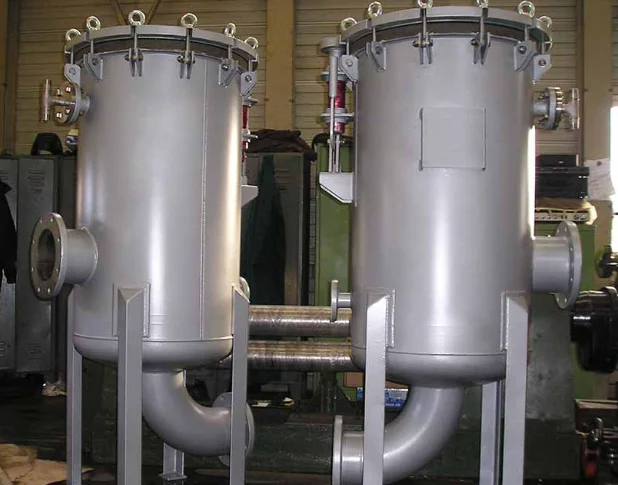
Our state-of-the-art manufacturing facilities utilize advanced computer-aided design, robotic welding, and stringent quality control protocols to supply heavy-duty filter housings tailored for the Oil & Gas, petrochemical, marine, defense, and power generation sectors.
Specializing in custom-engineered solutions that withstand severe pressures, cryogenic or high temperatures, and highly corrosive chemical environments, our industrial cartridge systems guarantee optimal fluid purification, particulate extraction, and downstream equipment protection.
Backed by rigorous API, ASME (U & U2 Stamps), PED 2014/68/EU, and ISO certifications, Nordstone guarantees exceptional operational reliability, long-term structural integrity, and uncompromised compliance with European safety standards.
Frequently Asked Questions (FAQ)
1. What material grades do Italian cartridge filter housing manufacturers typically offer?
Industrial manufacturers utilize a broad spectrum of heavy-duty materials based on the fluid composition and environmental traits. Common choices include standard Stainless Steel (SS304, SS316, and low-carbon SS316L) for general corrosion resistance. For highly aggressive environments—such as marine or sour gas applications—premium alloys like Duplex, Super Duplex, Hastelloy, Monel, and Titanium are routinely deployed.
2. What design codes and certifications are mandatory for cartridge filter housings in Italy?
To operate legally within Italy and the broader European Economic Area (EEA), vessels must strictly adhere to the Pressure Equipment Directive (PED) 2014/68/EU and carry the CE mark. Additionally, international designs frequently incorporate ASME Section VIII (Div. 1 & Div. 2) compliance, alongside API benchmarks for oil and gas infrastructure, and ISO quality management standards.
3. Can a cartridge filter housing be custom-engineered for extreme pressure conditions?
Yes. Heavy industrial filter housings can be engineered to handle operational pressures scaling from full vacuum up to 100 bar or more. Achieving this requires rigorous wall-thickness calculations via software like PV Elite, specialized high-integrity seals, and reinforced structural configurations.
4. What is the difference between Single Open End (SOE) and Double Open End (DOE) cartridge designs inside a housing?
- SOE (Single Open End): Features a closed top and a bottom end equipped with double O-rings (such as Code 7 or 222 configurations) that lock securely into the housing base. This minimizes bypass risks in ultra-pure or high-criticality fluid processing.
- DOE (Double Open End): Open at both ends, relying on flat gaskets compressed by top-and-bottom spring mechanisms to maintain a fluid seal.
5. How do engineers prevent bypass leakage within industrial filter housings?
Bypass prevention is secured using precision-machined internal tube sheets, specialized cartridge seats, and robust compression springs or top plates. These mechanical systems hold the filter cartridges firmly in place, forcing 100% of the raw process fluid through the filter media.
6. What types of industrial applications require heavy-duty cartridge housings?
Heavy industrial units are essential across many complex sectors, including:
- Oil & Gas: Amine sweetening, glycol loops, produced water cleanup, and injection well protection.
- Chemical Processing: Acid/alkali filtration and catalyst recovery.
- Power Generation: Boiler feed water treatment and turbine cooling lines.
- Marine & Defense: Seawater desalination and high-pressure hydraulic fluids.
7. How does a duplex or multi-round housing system work?
A multi-round housing accommodates several cartridges within a single shell to achieve high flow rates while maintaining a compact footprint. A duplex configuration pairs two separate housing assemblies via a localized valve network, allowing operators to divert fluid to the secondary chamber during filter maintenance without shutting down the main production line.
8. What non-destructive testing (NDT) practices ensure the quality of a fabricated filter housing?
To verify structural safety under high loads, manufacturers execute a comprehensive suite of NDT methods, including:
- Radiographic Testing (RT) and Ultrasonic Testing (UT) for weld interiors.
- Dye Penetrant Testing (DPT) and Magnetic Particle Testing (MPT) for surface anomalies.
- Hydrostatic or pneumatic pressure tests exceeding nominal design ratings.
9. What are the common inlet/outlet connection options for these vessels?
To ensure flexible piping integration, housings can be manufactured with various connection styles, including standard ANSI/ASME or EN flanges, sanitary tri-clamp fittings for clean industries, hub connections, or threaded unions, depending on the operational fluid dynamics and pressure class.
10. How is internal corrosion managed in carbon steel filter housings?
When carbon steel is selected for core structural strength, internal corrosion is negated using specialized protective strategies. These include internal corrosion allowances, structural cladding, overlay welding with noble metals, or specialized interior linings like heavy epoxies, phenolics, or glass flakes.
11. What is the role of Computational Fluid Dynamics (CFD) in filter housing design?
CFD simulations map fluid behavior inside the housing before physical production begins. This process ensures even fluid distribution across all cartridge elements, identifies high-velocity erosion points, minimizes overall pressure drops (ΔP), and eliminates stagnant fluid dead zones.
12. When should an operator replace the internal filter cartridges?
Cartridges are typically replaced based on differential pressure (ΔP) measurements. When particulate matter clogs the filter media, resistance rises. Systems are flagged for change-outs when ΔP crosses a pre-determined threshold (typically between 1.5 to 2.5 bar), or on a set preventive maintenance schedule.
13. What closure mechanisms are used for quick cartridge change-outs?
For systems requiring frequent filter changes, swing-bolt or quick-opening closures (QOC) are preferred because they allow tool-free access within minutes. For high-pressure or critical chemical applications, heavy bolted flange tops are standard to maintain maximum structural sealing.
14. Are Italian-manufactured filter housings suitable for hydrogen or cryogenic applications?
Yes. Specialized manufacturers like Nordstone design housings using specialized low-temperature carbon steels (LTCS) or specific austenitic stainless steels that retain high impact strength under cryogenic temperatures, alongside leak-proof sealing configurations suited for hydrogen processing.
15. How can I request a tailored technical quote for an industrial filter housing?
For specialized advice, layout prints, and explicit compliance verification matching your exact process constraints, please contact our global engineering team directly through our official portal at Contact Us.