With 20 years of experience, Nordstone stands at the vanguard of heavy-duty thermal fluid engineering, specializing in the custom design and manufacture of high-performance Blowdown Tanks, Industrial Boiler systems, and Steam Pressure Vessels for critical industrial environments across Italy.
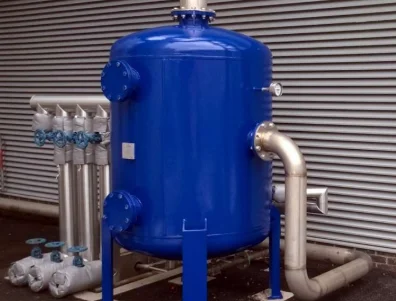
In high-pressure steam systems, the intermittent removal of bottom sludge and concentrated dissolved solids is crucial to prevent scaling and thermal efficiency drop. However, discharging this volatile, high-pressure effluent directly into municipal sewer lines is illegal and structurally destructive. Our certified blowdown vessels act as critical thermal buffers; they handle intense flash steam expansion via tangential inlets and internal wear plates, lowering effluent conditions to a regulated, safe state before final drainage.
Engineered precisely within our state-of-the-art facility, every Nordstone vessel is uniquely constructed to absorb radical thermal shock and handle corrosive, extreme-pressure blowoff actions effortlessly. We combine advanced fluid dynamics with robust metallurgic selections to ensure our industrial steam systems survive the most hostile operating configurations.
Backed by mandatory API, ASME Section VIII Division 1, and rigorous ISO quality frameworks, our engineering team provides Italian manufacturing plants, oil refineries, and power generation hubs with unyielding structural reliability, complete safety compliance, and maximum operational longevity.
To integrate a robust, certified thermal safety buffer into your steam infrastructure or to request a tailored engineering consultation for your facility, visit our specialized team at our Contact Us page today.
Frequently Asked Questions (FAQ)
1. What is the primary function of an industrial Blowdown Tank?
An industrial blowdown tank is a specialized pressure vessel designed to safely receive high-temperature, high-pressure water and sludge discharged from boilers during blowdown cycles. Its primary job is to lower the fluid’s pressure and temperature to a safe, legally dischargeable level. When the volatile boiler water enters the lower-pressure environment of the tank, a portion instantly flashes into steam and vents out to the atmosphere, while the remaining liquid settles, cools, and can be safely directed into sanitary sewers without causing thermal shock or physical damage to plumbing infrastructure.
2. What is the structural difference between a blowdown tank and a blowdown separator?
While both units process boiler blowdown, they differ significantly in size, engineering, and operation:
- Blowdown Tanks: These are much larger vessels designed for intermittent batch cycles. They hold the residual water from previous blowoffs, allowing it to cool naturally via convection over a 6-to-12-hour period. When a new high-temperature blowdown occurs, it mixes with this stored, cooled water to immediately quench the system before overflowing out the drain. www.remadrivac.com+ 1
- Blowdown Separators: These are highly compact, continuous-flow devices. They use internal striking plates or centrifugal actions to separate steam from liquid instantly. Because they do not store a large volume of water for passive cooling, they almost always require an automated cold-water injection system (aftercooler) to temper the exit water on the fly. www.remadrivac.com
3. Why must industrial facilities in Italy implement a certified blowdown system?
In Italy and across the European Union, discharging raw, high-temperature boiler blowdown into public sewage networks is strictly prohibited by environmental and structural safety laws. Unmanaged blowdown water can easily exceed temperatures of 100°C to 180°C under pressure, which vaporizes pipe seals, cracks concrete municipal infrastructure, and disrupts chemical balance in water treatment plants. A certified system guarantees that water temperatures drop well below standard limits (typically maximum 35°C to 60°C depending on local regional regulations) before reaching a public sewer.
4. How does Nordstone calculate the minimum sizing requirements for a blowdown tank?
Sizing is a rigorous engineering process governed by standard codes like the National Board of Boiler and Pressure Vessel Inspectors. As a general rule of thumb, the absolute holding capacity of a blowdown tank must be sized to hold at least twice (and frequently three times) the maximum volume of water released during a single boiler blowdown cycle. This volumetric margin ensures that the tank never overfills, maintains ample space for the flash steam to separate, and retains enough standing cooled water to adequately quench the incoming thermal wave.
5. What design pressure ratings are standard for these steam pressure vessels?
Even though a blowdown tank is heavily vented to the open atmosphere to safely discharge flash steam, it must still be fabricated as a code-stamped pressure vessel to handle rapid, volatile pressure spikes safely. Under conventional design guidelines, a standard industrial blowdown tank should feature a design pressure rating of at least 25% of the maximum allowable working pressure (MAWP) of the connected boiler system, with a standard minimum default design rating often sitting around 50 to 125 psig to ensure an adequate structural safety margin.
6. What is a tangential inlet, and why is it vital for vessel longevity?
A tangential inlet introduces the volatile boiler effluent along the inner circumference of the circular tank wall rather than blasting it straight toward the center. This configuration forces the incoming fluid into a rapid, cyclonic swirling motion. Centrifugal force naturally throws the heavier water droplets outward against the walls to expedite cooling and drain separation, while allowing the lighter flash steam to rise cleanly out of the center vent. This reduces systemic turbulence and prevents internal splashing.
7. What is an internal wear plate (or impingement baffle)?
An internal wear plate or impingement baffle is a heavy-duty, sacrificial steel plate welded inside the vessel directly across from the blowdown entry port. High-pressure boiler blowoff liquid contains high-velocity water, steam pockets, and highly abrasive suspended solids or scaled sludge. Without a protective internal baffle to absorb the localized kinetic impact and redirect fluid energy, this abrasive stream would erode the primary shell wall of the pressure vessel over time, causing premature, catastrophic structural failure.
8. Can a Nordstone blowdown tank handle multiple industrial boilers simultaneously?
Yes, a single, central blowdown tank can be systematically engineered to service a battery of multiple boilers, provided it is sized around the single boiler that exhibits the largest individual blowdown volume. However, for maximum operational safety, boilers should never be blown down simultaneously into the same tank. The interconnecting blowdown lines must feature robust isolation valves and check valves to prevent pressurized steam and scalding sludge from backflowing out into an inactive or open boiler unit during maintenance.
9. What standard certifications do Nordstone vessels carry?
With over 20 years of manufacturing experience, Nordstone guarantees international compliance by fabricating its industrial vessels to meet ASME Section VIII, Division 1 Code stamps, API standards, and ISO 9001 quality management rules. For equipment targeted for Italy and the wider European zone, our systems can be meticulously engineered and stamped to comply with the European Pressure Equipment Directive (PED) 2014/68/EU, ensuring smooth registration and legal commissioning with local safety authorities.
10. Does a blowdown tank require a cold-water supply connection?
For a purely passive, oversized blowdown tank operating on long intermittent cycle intervals (6 to 12 hours apart), a continuous cold-water supply is technically optional because natural ambient heat dissipation cools the remaining liquid. However, if your industrial boiler demands frequent, closely spaced blowdown cycles, the internal water will not have sufficient time to cool naturally. In those heavy-use scenarios, an automated emergency cold-water mixing valve is integrated at the lower portion of the tank to guarantee temperatures always remain safely below legal limits.
11. What regular maintenance is required for an industrial blowdown vessel?
To prevent structural degradation and maintain optimal processing safety, we recommend implementing the following maintenance timeline:
- Daily/Weekly: Visually inspect the tank’s water gauge glass for proper baseline water levels and check for visible exterior leaks.
- Bi-Annually: Isolate and completely cool the system, open the fresh-water flushing lines to wash out accumulated sludge from the bottom floor, and clear out scale buildup using approved chemical scale removers.
- Annually: Conduct a full internal wall thickness inspection and check the atmospheric vent pipe to ensure it is entirely free of obstructions, rust, or blockages.
12. Why is sizing the atmospheric vent pipe so critical?
The atmospheric vent pipe is the ultimate safety mechanism of a blowdown tank. It must be wide enough to pass the maximum projected volume of flash steam instantly without causing pressure to restrict or bottleneck inside the tank. The diameter of the vent must never be smaller than the inlet pipe diameter, and it typically needs to be scaled significantly larger (often 4, 6, 8, or even 10 inches depending on the boiler’s operating pressure). A constricted or undersized vent pipe will instantly convert an unpressurized safety tank into a highly volatile, over-pressurized hazard.
13. What materials does Nordstone use to combat corrosive steam environments?
Depending on the chemical treatment of your boiler feed-water and the corrosiveness of your industrial process, Nordstone utilizes premium-grade metallurgic selections. Standard configurations feature heavy-walled, high-tensile carbon steels optimized for pressure containment. For highly corrosive chemical plants, marine applications, or defense infrastructures, we fabricate vessels utilizing specialized 316L Stainless Steel or custom-engineered corrosion-resistant alloys designed specifically to withstand severe pitting, oxidation, and erosion at high temperatures.
14. Is it possible to recover wasted energy from a blowdown system?
Absolutely. Instead of letting all high-temperature thermal energy escape directly into the atmosphere, facilities can install an integrated Blowdown Heat Recovery System. By incorporating specialized heat exchangers or flash vessels upstream of or directly linked to the blowdown infrastructure, the thermal energy radiating from the flash steam can be used to preheat incoming cold boiler make-up water. This strategy minimizes thermal waste, slashes fuel costs, and drastically improves the total energy efficiency of the industrial plant.
15. How can I begin a custom manufacturing request with Nordstone for my plant in Italy?
To configure a safe, long-lasting steam solution designed precisely for your facility’s unique boiler specs and layout, you can connect directly with our expert engineering team. Simply navigate to our official page at Contact Us to upload your current system blueprints, operational pressures, and target volumetric flow rates. Our team will review your parameters to deliver an optimized, fully certified, turnkey vessel proposal.