For over two decades, Nordstone has established itself as one of the premier oil-water separator vessel manufacturers in Italy, delivering bespoke, certified engineering solutions to the global energy and maritime markets.
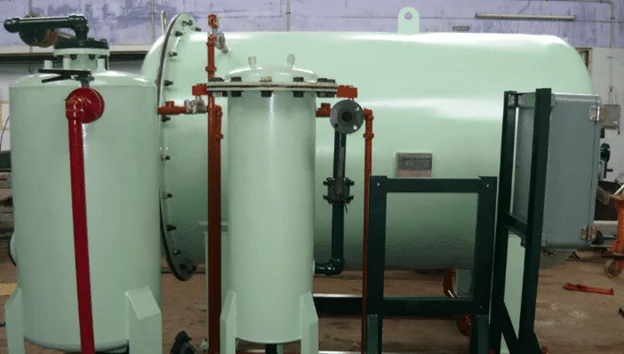
Operating from our advanced manufacturing facility, our expert engineering teams specialize in the custom thermal and mechanical design of two-phase and three-phase industrial separation pressure vessels. These high-performance units are precision-engineered to withstand extreme pressures, cryogenic to high-temperature ranges, and highly corrosive fluid compositions.
By utilizing advanced fluid dynamics and premium materials like Duplex stainless steel and specialized corrosion-resistant alloys, we ensure absolute process reliability.
Every oil-water separator vessel we produce is manufactured in strict compliance with the European Pressure Equipment Directive (PED 2014/68/EU), alongside globally recognized standards including ASME Section VIII, API 12J, and ISO 9001 certifications.
From heavy crude processing in the Mediterranean oil fields to complex industrial bilge water treatment, Nordstone provides reliable, low-maintenance separation systems that consistently optimize throughput and exceed stringent environmental compliance limits. To discuss your project specifications or request a technical consultation, visit our Contact Us page.
Frequently Asked Questions (FAQ)
1. What primary design standards do you follow for manufacturing oil-water separator vessels in Italy?
We design and fabricate all pressure vessels in strict accordance with the European Pressure Equipment Directive (PED 2014/68/EU) and the ASME Section VIII (Div 1 & 2) code. Depending on your project requirements, we also align manufacturing with API 12J specifications and ISO safety and quality management frameworks to ensure global compliance.
2. Can Nordstone build custom configurations for extreme offshore environments?
Yes. Our engineering team specializes in custom solutions tailored to withstand severe conditions, including extreme pressures, high temperatures, and high-salinity or corrosive offshore environments. We integrate specialized metallurgy and internal coatings to prevent premature wear and chemical erosion.
3. What internal components do you utilize to optimize phase separation?
Depending on the specific characteristics of your process fluid, we incorporate a variety of advanced internal structures. This includes inlet deflector plates or cyclonic devices for initial momentum reduction, calming baffles to limit turbulence, plate packs, and high-efficiency coalescing elements to accelerate droplet separation.
4. What materials of construction do you offer for corrosive fluids?
We offer a comprehensive selection of high-grade materials chosen for their specific chemical resistance profiles. This includes standard carbon steels with heavy corrosion allowances, austenitic stainless steels (304L, 316L), Duplex and Super Duplex stainless steels, and clad options for demanding sour gas or high-chloride applications.
5. Do you manufacture both two-phase and three-phase separator vessels?
Yes. We manufacture two-phase separators (designed to isolate liquid from gas or oil from water) and complex three-phase separator vessels (engineered to separate gas, oil, and water into distinct streams within a single pressure envelope based on differential densities).
6. How does Nordstone guarantee the structural integrity of its vessels?
We maintain a rigorous quality control program that includes comprehensive non-destructive testing (NDT). This involves radiographic testing (RT), ultrasonic testing (UT), magnetic particle inspection (MPI), and liquid penetrant testing (PT), culminating in a mandatory hydrostatic pressure test witnessed by certified third-party inspection authorities.
7. What is the typical design life of a Nordstone separator vessel?
Our industrial vessels are engineered for an operational lifespan of 20 to 25+ years. This longevity is achieved through precision wall-thickness calculations, calculated corrosion allowances, high-quality welding processes, and the integration of robust, low-maintenance internal separation components.
8. Are your oil-water separators suitable for compliance with environmental discharge regulations?
Absolutely. Our vessels are engineered to achieve specific, ultra-low parts per million (ppm) oil-in-water targets. This ensures that industrial wastewater or processed bilge water meets or exceeds both local Italian environmental limits and international regulatory standards before safe discharge.
9. Do your separator vessels handle slug flow effectively?
Yes. For applications prone to sudden surges of liquid (slugs), we custom-engineer the vessel volume and integrate specialized slug-catching internals. This dampens incoming fluid momentum, distributes the phase volume evenly, and prevents process upsets downstream.
10. Can you integrate automatic control instruments into the vessel design?
We deliver fully instrumented, skid-mounted modular systems. This includes the integration of precision level transmitters, interface controllers, automatic dump valves, pressure relief valves, and safety interlocks that seamlessly interface with your facility’s main distributed control system (DCS).
11. What industrial sectors do your separation vessels serve?
With 20 years of manufacturing experience, we serve critical infrastructure industries across Europe and globally. This includes Upstream and Midstream Oil & Gas processing, petrochemical refining, heavy chemical manufacturing, defense applications, and large-scale industrial wastewater treatment facilities.
12. How do you determine the correct sizing for a custom separator vessel?
Sizing calculations are based on your specific process data sheet. Our engineers analyze parameters such as maximum and minimum volumetric flow rates for each phase, operating pressure and temperature, fluid densities, viscosities, and required retention times to establish optimal vessel geometry.
13. Do you provide support for shipping and logistics within Italy and the EU?
Yes. Based in Italy, we manage full heavy-transport logistics for large-scale pressure vessels. Our team coordinates specialized transport, road permits, and freight handling to ensure your vessel arrives safely and securely at your onshore facility, refinery, or shipyard.
14. What maintenance is typically required for your separator vessels?
Our vessels are designed to minimize downtime. Standard maintenance primarily involves periodic inspection of the internals via integrated manways, cleaning or backwashing of the coalescer packs to prevent fouling, and routine calibration of external control instruments and level sensors.
15. How can I initiate a request for quotation (RFQ) with your engineering team?
You can contact us directly by submitting your process data sheets, fluid profiles, and mechanical design requirements through our secure web portal on our Contact Us page. Our technical team will review your specifications and provide a detailed engineering and commercial proposal.