State-of-the-Art Flash Drum Manufacturing in Italy
In industrial processing, a flash drum (also recognized as a vapor-liquid separator or knock-out drum) performs a critical role: it executes a rapid thermodynamic pressure reduction to flash a pressurized fluid stream into perfectly distinct vapor and liquid components.
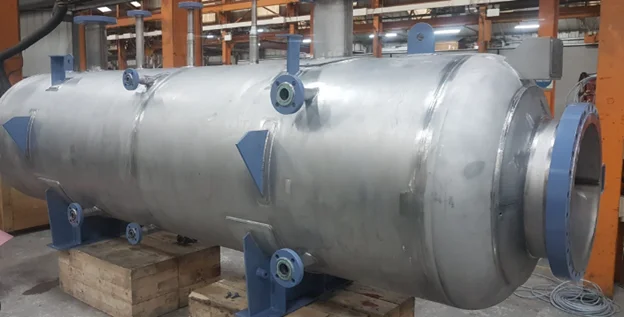
For industrial facilities operating throughout Italy, optimizing this vapor-liquid equilibrium (VLE) is central to boosting processing efficiency, reducing downstream equipment fouling, and safeguarding expensive compressor components from destructive liquid slugging.
Engineering Excellence Grounded in Rigorous Sizing Physics
At Nordstone, we do not rely on guesswork. Our team utilizes advanced thermodynamic modeling alongside empirical equations to construct exact vessel geometries.
The foundational physical envelope of our vertical flash drums relies heavily on calculating the maximum permissible vapor velocity (uperm) to avoid internal liquid droplet entrainment, expressed via the classic Souders-Brown framework:
Where ρL represents the liquid density, ρV is the vapor density, and Kdrum is an empirical factor systematically configured based on Blackwell’s analytical sizing methods. Our engineers optimize the total vessel height-to-diameter ratio (HT/D) within the golden processing window of 3.0 to 5.0. If your specific system dynamics drop below a 3.0 ratio or push beyond 5.0, our experts will seamlessly transition your workflow design into a customized, high-capacity horizontal configuration to ensure optimal internal surge capacities.
Advanced Metallurgy for Corrosive European Streams
Industrial processing media across Southern Europe’s heavy refining sectors regularly introduce intense stress corrosion cracking risks and high sour-gas concentrations. Nordstone addresses these challenging conditions by deploying premium, highly specialized material grades subjected to stringent non-destructive examination (NDE).
Our extensive material selection pipeline includes:
- Carbon Steel variants: SA516 Grade 60/70, engineered for excellent weldability and high tensile strength under standard pressure baselines. nordstoneng.com
- Austenitic & Duplex Stainless Steels: SS304L, SS316L, and Duplex alloys designed to combat aggressive localized pitting in marine and chloride-heavy plants.
- Elite Corrosion-Resistant Alloys (CRA): Full integration or internal cladding using Inconel, Hastelloy, and Alloy 20 for extreme chemical processing feeds.
Top 15 Frequently Asked Questions (FAQs)
1. What core industrial applications do Nordstone flash drums serve in Italy?
Nordstone flash drums are primarily integrated into Italian oil and gas refineries, petrochemical plants, chemical manufacturing hubs, and power generation facilities. They are widely utilized as knock-out drums upstream of compressors, flash economizers in large industrial refrigeration loops, and separation stages directly following distillation column reboilers or high-pressure reactors.
2. How does Nordstone ensure compliance with European and Italian safety regulations?
Every pressure vessel engineered for the Italian market is fully compliant with the European Pressure Equipment Directive (PED 2014/68/EU) and carries the official CE mark. We combine this with strict adherence to ASME Section VIII (Div 1/2) and API standards, managing the entire documentation, inspection, and certification workflow from start to finish.
3. What criteria determine whether a vertical or horizontal flash drum configuration is required?
The choice is dictated by the liquid-to-vapor volumetric ratio and required surge storage. Vertical vessels are ideal when the vapor volume dominates and footprint is limited, as they allow for highly efficient gravity separation. Horizontal vessels are specified when a high liquid volume or an additional liquid-liquid phase separation (such as an oil-water stream) must be handled simultaneously within the pool.
4. How does the Souders-Brown equation impact the physical footprint of the drum?
The Souders-Brown equation establishes the maximum vapor velocity (uperm). By defining this velocity threshold based on your medium’s precise vapor (ρV) and liquid (ρL) densities, we calculate the absolute minimum cross-sectional area required for the vessel body. This prevents internal mist from rising with the gas stream, directly sizing a safe, un-flooded diameter for your unit.
5. What internal mist elimination technologies does Nordstone install?
To achieve separation efficiencies exceeding 99%, we integrate custom internal demister pads, co-knit wire meshes, or high-velocity cyclonic vane packs. These internals catch sub-micron liquid droplets entrained in the rising gas stream, coalescing them into larger drops that fall back safely into the bottom liquid pool.
6. Can your equipment handle rapid cyclic thermal and pressure loading?
Yes. Using advanced finite element analysis (FEA), our design team builds vessels capable of cycles with violent pressure drops (flashing phenomena). We optimize wall thicknesses, reinforcement rings, and high-integrity nozzle connections to absorb cyclic fatigue without risking structural failure or cracking.
7. What non-destructive testing (NDT) protocols are conducted during fabrication?
We employ exhaustive QA/QC measures including Radiographic Testing (RT) for internal weld integrity, Ultrasonic Testing (UT) for wall thickness profiling, Dye Penetrant (PT) and Magnetic Particle (MT) testing for surface defect screening, and definitive hydrostatic pressure testing up to 1.5 times the maximum allowable working pressure (MAWP).
8. Does Nordstone offer fully modular, skid-mounted flash drum systems?
Absolutely. We specialize in engineering pre-assembled, modular process skids. Your flash drum can be delivered fully integrated onto a structural steel frame complete with automated control valves, level transmitters, bypass piping, instrumentation, and localized electrical wiring for immediate plug-and-play field installation.
9. How do you design flash drums to tolerate highly corrosive and sour gas (H2S) services?
For sour services, we strictly follow NACE MR0175/ISO 15156 material mandates. We utilize specialized post-weld heat treatment (PWHT) to eliminate residual weld stresses, select low-carbon steel alloys with strict hardness controls, or utilize internal corrosion-resistant alloy (CRA) cladding to block atomic hydrogen cracking mechanisms.
10. What is the typical vessel height-to-diameter ratio (HT/D) used for your standard builds?
For standard vertical vapor-liquid flash drums, we design with an HT/D aspect ratio between 3.0 and 5.0. This range guarantees sufficient vertical clearance from the liquid surface to the feed nozzle, while leaving ample disengagement space above the nozzle for the vapor to stabilize before hitting the demister pad.
11. What nozzle clearances and spacing parameters are prioritized in your layout?
Following Blackwell’s robust engineering criteria, we maintain a minimum vapor disengagement height (hV) of 36 inches plus half the feed nozzle diameter above the feed line centerline. The free space below the feed line (hf) is strictly held at a minimum of 12 to 18 inches above the highest liquid level to minimize splashing and re-entrainment.
12. How does liquid surge capacity influence the bottom sizing of the vessel?
The bottom section volume is designed around your facility’s control loops and failure response windows. We factor in your required liquid residence time—typically 2 to 5 minutes of storage capacity between the low-level and high-level alarms—to give upstream automated level valves ample time to modulate without tripping processes.
13. What selection of nozzle connections and flange ratings do you provide?
We offer standard ASME B16.5 flanges across all major pressure classes (Class 150 up to Class 2500) utilizing raised face (RF) or ring-type joint (RTJ) connections for high-pressure or hazardous gas applications. Nozzles are structurally reinforced via self-reinforced forgings or pad reinforcements based on strict mechanical stress calculations.
14. What structural considerations are integrated for outdoor installations in Italy?
Every vessel destined for Italian industrial corridors is custom-calculated for local environmental parameters. We engineer the structural supports—whether heavy-duty mounting skirts, structural legs, or ring girders—to withstand regional seismic zones (compliant with Eurocode 8) and high wind loads typical of coastal maritime plants.
15. How do I initiate a technical RFQ or connect with your engineering team for an Italian facility?
Navigating complex separation requirements demands direct, clear engineering collaboration. To review thermal parameters, share VLE data sheets, or request an explicit manufacturing estimate for a custom pressure vessel, please visit our dedicated communication portal at Contact Us to interface with a senior member of our specialized project engineering team.