As a premier manufacturer of custom thermal management solutions, Nordstone specializes in engineering high-performance cryogenic storage tanks for low-temperature storage applications across Italy.
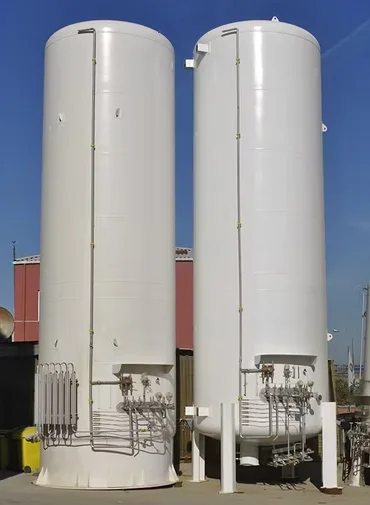
Leveraging over 20 years of technical expertise, our state-of-the-art facility builds rugged, double-walled industrial vessels designed to securely contain liquefied gases such as liquid nitrogen ($\text{LN}_2$), oxygen ($\text{LOX}$), argon, and liquefied natural gas ($\text{LNG}$) at extreme thermal ranges down to $-196^\circ\text{C}$. Our custom-built containment solutions integrate high-grade stainless steel or nickel-based alloys enclosed within an advanced vacuum-jacketed insulation barrier to drastically minimize boil-off gas ($\text{BOG}$) generation.
Fully compliant with ASME Section VIII, API, and European Pressure Equipment Directive ($\text{PED}$) framework, our specialized infrastructure guarantees optimal structural integrity, advanced seismic resistance, and absolute operational efficiency under extreme pressures. From major chemical facilities in Lombardy to aerospace applications near Turin, we deliver tailored pressure vessels that satisfy the tightest safety parameters.
To discuss your specific project volume requirements, technical pressures, or insulation configurations, explore our options or reach out directly to our engineering team via our Contact Us page.
Frequently Asked Questions (FAQ)
1. What types of liquefied gases can be stored in Nordstone cryogenic storage tanks?
Nordstone engineered systems are custom-built to store a wide variety of industrial gases at ultra-low, sub-zero temperatures. These include Liquid Nitrogen (LN2 at −196∘C), Liquid Oxygen (LOX at −183∘C), Liquid Argon (LAR at −186∘C), Liquid Carbon Dioxide (LCO2), and Liquefied Natural Gas (LNG).
2. Which manufacturing standards and safety certifications apply to your vessels in Italy?
All cryogenic equipment destined for Italy strictly complies with the European Union’s Pressure Equipment Directive (PED 2014/68/EU) and carries the CE marking. Additionally, we engineer and stamp equipment to meet ASME Section VIII (Div 1 & 2), API 620, and ISO 21011 standards based on client specifications.
3. How does Nordstone prevent thermal heat ingress and boiling off?
We use a high-efficiency double-walled construction design. The inner storage vessel is wrapped in multi-layer reflective insulation (super-insulation) and placed inside a carbon or stainless steel outer jacket. The annular space between the two walls is evacuated to a high vacuum, eliminating convective and radiative heat transfer to achieve incredibly low boil-off rates.
4. What primary materials are used for the inner and outer vessels?
The inner vessel—which directly contacts the cryogenic liquid—is manufactured from premium materials that resist cold embrittlement, primarily austenitic stainless steel (SS304, SS304L, SS316, SS316L) or specialized nickel alloys. The outer jacket is typically built from high-tensile carbon steel finished with a heavy-duty, marine-grade protective coating, or stainless steel for corrosive chemical environments.
5. What capacity ranges does Nordstone offer for industrial cryogenic storage?
We offer scalable containment systems ranging from small-scale bulk units of 500 liters up to large-scale fixed industrial inventory installations exceeding 50,000 liters. Every aspect, from dimensions to orientation (vertical or horizontal layouts), can be custom tailored to fit the constraints of your facility layout.
6. Are these cryogenic storage units fitted with localized monitoring controls?
Yes. Our vessels come with complete, highly precise instrumentation arrays. This includes advanced differential pressure level gauges, dual temperature sensors, mechanical pressure transmitters, and telemetry systems that integrate smoothly into existing plant SCADA or distributed control systems (DCS) for remote, real-time safety monitoring.
7. What built-in safety relief mechanisms protect against over-pressurization?
Safety is our top priority. Each tank is engineered with redundant safety networks, including dual multi-port safety relief valves connected via a three-way diverter valve (allowing maintenance without taking the tank offline), burst/rupture discs, and dedicated non-condensable gas venting lines.
8. Can Nordstone adapt tanks for localized Italian seismic and environmental codes?
Absolutely. Our engineering group performs thorough structural calculations using specialized software (such as PV Elite) to account for regional environmental factors. We explicitly design the support skirts, anchoring blocks, and leg structures to withstand localized wind loads, thermal stress cycles, and seismic zones across Italy.
9. Does Nordstone produce mobile or skid-mounted cryogenic storage units?
Yes, we supply both fixed vertical/horizontal storage assets and mobile skid-mounted units or Cryogenic ISO Tanks. These are designed with extra mechanical reinforcing structures and baffled interiors to balance fluid shifts and manage sloshing stresses during intermodal transport.
10. What type of post-fabrication quality control checks are performed?
Every pressure vessel undergoes a rigorous quality assurance program before it leaves our shop. This includes 100% Non-Destructive Testing (NDT) such as radiographic (RT) and ultrasonic (UT) weld examinations, helium mass spectrometer leak detection for vacuum integrity, and hydrostatic or pneumatic pressure testing up to design verification levels.
11. Can you configure integrated vaporization systems on these units?
Yes. We can integrate ambient air vaporizers, pressure-building coils, or steam-heated vaporizing packages directly onto the equipment skid. This allows the liquid inventory to expand cleanly into gas phase delivery at your exact process line requirements.
12. What industries in Italy benefit from Nordstone cryogenic infrastructure?
Our 20 years of experience allow us to serve many demanding industries:
- Oil & Gas / Energy: LNG bunkering and gasification networks.
- Healthcare & Pharma: Ultra-low temperature storage of biological products and medical oxygen supplies.
- Manufacturing & Aerospace: Inert gas purging, laser cutting, and specialized thermal treatment.
- Food & Beverage: Flash freezing and controlled atmosphere packaging lines.
13. How long is the expected operational lifespan of a Nordstone tank?
Thanks to our selective use of metallurgy, robust structural design rules, and advanced vacuum restoration systems, our industrial storage assets are built for a service life of 20 to 30 years, provided standard preventative maintenance guidelines are followed.
14. What are the typical lead times for engineering and delivering a custom cryogenic vessel to Italy?
Lead times vary depending on the capacity of the tank, the complexity of the internal geometry, and current material availability. Typically, standard custom builds range from 16 to 24 weeks, including full engineering reviews, certified fabrication steps, and third-party inspections.
15. How can we request a detailed technical proposal or design consultation?
You can reach our engineering team directly by filling out your technical requirements (design pressure, required fluid media, and target volume) on our dedicated portal via our Contact Us link. We will provide a tailored quote and initial general arrangement (GA) drawings within a few business days.