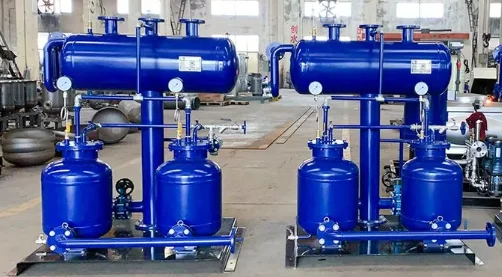
In modern steam-powered industrial processing, thermal efficiency and system integrity are paramount. As prominent boiler & steam pressure vessels manufacturers in Italy, Nordstone designs state-of-the-art blowdown tanks and condensate recovery tanks that transform harsh thermal discharge into predictable energy-saving assets.
High-pressure steam systems naturally accumulate dissolved solids, mineral scale, and corrosive sludge that settle at the base of the boiler shell. Left unchecked, this contamination severe blankets heating tubes, spiking fuel consumption and threatening catastrophic equipment failure.
Our industrial-grade blowdown tanks solve this by safely capturing high-temperature, intermittent or continuous boiler blowdown discharges. Utilizing heavy-duty tangential inlets lined with stainless steel wear plates, these vessels carefully control pressure drops, flashing aggressive steam safely into the atmosphere while slowing down and cooling dangerous, contaminated liquid before it enters the municipal drainage system.
Concurrently, our pressurized condensate recovery tanks serve as the cornerstone of facility-wide thermal recycling. Instead of venting or draining pure, pre-treated water, these vessels isolate and hold hot condensate, returning its massive latent heat content back into the boiler loop. This integrated loop drastically cuts fuel demand, eliminates exorbitant raw makeup water withdrawals, and reduces the chemical treatment expenses necessary to inhibit system oxidation. Engineered precisely within our state-of-the-art facility, every pressure vessel can be built to handle volatile spikes in pressure, extreme temperatures, and corrosive fluids. Equipped with rigorous ASME Section VIII Div 1, API, and ISO quality management certifications, Nordstone provides Italian operators with long-term mechanical safety and optimal thermal performance.
Frequently Asked Questions (FAQ)
1. What is the main purpose of a blowdown tank in a steam boiler system?
A blowdown tank safely collects high-pressure hot water and sludge discharged from a boiler during routine cleaning blowdowns. It allows the liquid to safely drop in pressure, vents the resulting flash steam into the atmosphere, and retains the hot water until it cools to a safe temperature (typically below 65°C) before it is discharged into public municipal sewers.
2. How does a condensate recovery tank differ from a standard blowdown tank?
While a blowdown tank is designed to handle contaminated water and sludge meant for disposal, a condensate recovery tank is an energy-saving device. It collects clean, high-temperature condensed steam (condensate) from process equipment and returns it to the boiler feedwater loop, conserving water, heat energy, and treatment chemicals.
3. Why should Italian industrial plants invest in high-performance condensate recovery?
In Italy, rising energy costs and strict environmental mandates make thermal efficiency essential. Recovering high-purity condensate can reduce boiler fuel consumption by 15% to 25%, drastically lower water utility consumption, and minimize the volume of chemical water treatments required for raw makeup water.
4. What manufacturing certifications does Nordstone hold for pressure vessels?
Nordstone products comply with rigorous international and European safety protocols. Our engineering designs and manufacturing facilities are fully certified under ASME Section VIII Division 1 (including U and S stamps), API, and ISO 9001:2015 quality management guidelines to guarantee total mechanical reliability.
5. Can Nordstone custom engineer blowdown tanks for extreme operational limits?
Yes. Backed by our 20 years of experience, our technical engineering team custom-tailors vessels to survive highly corrosive fluids, extreme cyclical thermal shocks, and high-pressure surges. We handle specialized internal designs, matching exact footprints, nozzle configurations, and volumetric demands.
6. What materials do you use to manufacture your steam pressure vessels?
We choose materials based on the chemical traits of your system water. For standard applications, we utilize high-tensile carbon steel (such as SA-516 Grade 70). For aggressive, low-pH, or highly corrosive condensate loops, we manufacture vessels using premium stainless steel alloys (304, 316, and 316L).
7. How do Nordstone blowdown vessels prevent structural wall erosion?
High-velocity boiler blowdown can rapidly erode the internal walls of a vessel. Nordstone eliminates this vulnerability by utilizing a tangential inlet pipe orientation paired with an internal, heavy-gauge 90-degree stainless steel wear plate. This plate absorbs the physical kinetic impact and protects the structural integrity of the outer pressure shell.
8. Do your blowdown and condensate tanks support automated cooling?
Yes. We can fit our vessels with integrated, automated cooling systems or drain legs. When internal thermal sensors detect temperatures above environmental regulations, an automated thermal control valve activates to blend cold mains water with the hot discharge, protecting local sewer infrastructure automatically.
9. What internal components can be integrated into your condensate recovery tanks?
To optimize liquid-vapor management, our custom vessels can feature internal distribution baffles to eliminate liquid turbulence, demister pads for precise moisture separation, and anti-vortex devices positioned at the pump suction nozzle to ensure smooth, cavitations-free liquid extraction.
10. Are your steam pressure vessels fully tested before shipment to Italy?
Absolutely. Quality control is the cornerstone of our manufacturing philosophy. Every pressure vessel undergoes meticulous non-destructive testing (NDT), including radiographic testing, ultrasonic analysis, and high-pressure hydrostatic testing up to 300 bar inside our facility to guarantee leak-free operational safety.
11. What industries in Italy benefit most from Nordstone vessels?
Our critical application vessels deliver dependable service across highly demanding fields. This includes Oil & Gas refining, heavy petrochemical processing, pharmaceutical manufacturing, food and beverage production, power generation plants, and Marine/Defence applications.
12. How does recovering condensate reduce boiler blowdown frequencies?
Condensate is essentially distilled water, containing virtually zero dissolved solids or mineral impurities. By returning a higher percentage of pure condensate to your boiler instead of raw, mineral-dense makeup water, you slow down scale accumulation, allowing the boiler to run longer between required blowdown cycles.
13. What size ranges do you offer for industrial blowdown tanks?
Our manufacturing configurations span a broad spectrum, ranging from compact 18-inch diameter tanks for light commercial boiler setups up to massive 60-inch (or larger) heavy industrial vessels designed to handle large-scale, continuous-operation multi-boiler configurations.
14. Do your tanks feature access points for physical regulatory inspection?
Yes. In accordance with ASME and European pressure equipment standards, all Nordstone vessels are fabricated with code-compliant access points, such as hand-holes or large man-ways. This ensures that plant engineers can easily inspect, clean, and maintain internal surfaces over decades of operation.
15. How can we get a tailored technical quote for an industrial facility in Italy?
Italian project managers, procurement officers, and plant engineers can consult directly with our specialized engineering team. We will review your flow rates, operating temperatures, and structural footprints to develop an optimized solution. To submit your design specifications, please visit our dedicated communication hub at Contact Us.