
Nordstone is an industry-leading manufacturer specializing in custom, high-efficiency vacuum receiver tanks engineered for industrial liquid collection and storage solutions across Italy.
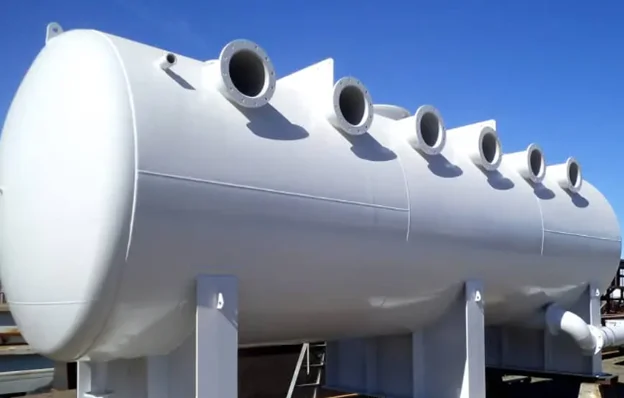
Drawing on 20 years of technical experience in heavy-duty fabrication, our engineers design and manufacture advanced vacuum storage systems that safely withstand internal full vacuum conditions while isolating critical processes from external atmospheric pressure. Operating from our state-of-the-art facilities, we utilize premium carbon steel and specialized stainless steel grades (such as SS304, SS316, and SS316L) to ensure absolute structural integrity, eliminating the risk of implosion under extreme pressure differentials.
Every custom vacuum receiver tank we build integrates seamlessly with industrial liquid extraction, chemical processing, pharmaceutical evaporation, and heavy sludge retrieval networks. By prioritizing precise internal volume ratios and deploying sophisticated fluid-separation mechanics, our vessels prevent liquid carryover into your primary vacuum pumps—extending machinery life cycles and maximizing facility uptime. Adhering strictly to European and international pressure equipment mandates, our manufacturing protocols are validated by API, ASME (Section VIII Division 1), and ISO certifications. From initial engineering blueprints to final non-destructive testing, Nordstone guarantees uncompromised reliability, precision corrosion protection, and optimal fluid management under the most severe operational conditions.
To consult with our technical engineering team regarding precise specifications, custom sizing, or localized project requirements in Italy, please visit our dedicated communication hub at Contact Us.
Frequently Asked Questions
1. What is the primary function of an industrial vacuum receiver tank?
An industrial vacuum receiver tank serves as a specialized storage vessel designed to operate below atmospheric pressure. Its main function is to facilitate the extraction, liquid collection, and storage of fluids, chemical mixtures, or sludge from a process environment while providing a surge buffer that protects upstream vacuum pumps from fluid carryover and erratic pressure spikes.
2. How does Nordstone ensure a vacuum receiver tank will not implode?
Implosion is the primary hazard for vessels under vacuum because atmospheric pressure exerts massive force externally on the shell. With 20 years of manufacturing experience, Nordstone engineers use advanced finite element analysis (FEA) to determine the exact wall thicknesses and reinforcing rings required by ASME Section VIII Division 1 and PED codes to completely withstand a full vacuum environment.
3. Which materials of construction are available for your vacuum collection tanks in Italy?
We select materials based on the chemical compatibility and temperature parameters of your process:
- Carbon Steel: High-strength structural grades like SA 516 Gr. 70, finished with specialized protective internal epoxies. nordstoneng.com
- Stainless Steel: High-purity and anti-corrosive grades including SS304, SS316, and low-carbon SS316L for aggressive chemical, food-grade, or pharmaceutical applications. nordstoneng.com
4. What international design codes and certifications do Nordstone tanks comply with?
Every vessel manufactured by Nordstone aligns with globally recognized engineering benchmarks. Our production processes are fully certified under:
- ASME Section VIII Division 1 (including optional U-Stamp certification for export projects) nordstoneng.com
- CE / PED 2014/68/EU (Pressure Equipment Directive mandatory across Italy and Europe) nordstoneng.com
- API and ISO quality management standards.
5. Can these tanks handle both liquid storage and multi-phase separation?
Yes. Nordstone custom-engineers vacuum receiver tanks with internal baffle plates, demister pads, or cyclonic inlets. These internal structures efficiently separate liquid droplets from gaseous streams, ensuring only dry air or gas reaches the vacuum pump while the liquid drops safely into the lower collection zone.
6. What capacity ranges does Nordstone manufacture for the Italian market?
Our engineering team designs and fabricates vacuum storage units spanning from compact 500-liter units up to large-scale 60,000-liter (60 m³) configurations. Custom-engineered volume solutions exceeding 100 m³ can also be accommodated depending on your facility footprint and structural needs.
7. How do pressure tanks differ fundamentally from vacuum receiver tanks?
While pressure tanks store energy and gases above atmospheric pressure to push materials through a system, vacuum tanks work below atmospheric pressure to draw fluids in via external suction. Structurally, pressure tanks require high tensile wall resistance to prevent bursting, whereas vacuum receiver tanks must feature highly rigid geometry to prevent crushing or implosion.
8. What internal and external coatings are available for corrosion protection?
To prevent degradation from corrosive fluids or harsh seaside environmental conditions in Italy, we offer several surface treatments:
- External: Automated grit blasting to SA 2.5 standards followed by high-durability zinc primers and polyurethane (PU) topcoats.
- Internal: High-build chemical epoxies, rubber linings, or chemical passivation (specifically for stainless steel units handling acid solutions).
9. What standard nozzle configurations are integrated into a vacuum receiver?
A baseline Nordstone vacuum receiver tank features dedicated process nozzles including:
- Main vacuum pump suction port
- Process fluid inlet connection
- Liquid drain nozzle (configured for automated or manual valve drainage)
- Safety relief valve (SRV) connection
- Dedicated ports for vacuum gauges, level transmitters, and quick-access inspection manways.
10. Do you provide automated liquid drainage solutions while the tank is under vacuum?
Yes. If your plant demands continuous operation without losing the system vacuum, we can outfit the tank with automated barometric leg drainage loops, electronic level-switch-controlled secondary dump traps, or specialized progressive cavity extraction pumps.
11. What quality assurance and non-destructive testing (NDT) do you perform?
To guarantee absolute safety, every vacuum tank undergoes rigorous quality inspections prior to deployment. This includes 100% visual weld analysis, hydrostatic pressure testing (typically up to 1.3 to 1.5 times the rating), ultrasonic testing (UT), and radiographic testing (RT) on critical load-bearing seams to ensure zero structural defects.
12. Are Nordstone vacuum tanks suitable for sanitary and GMP applications?
Absolutely. For pharmaceutical, biotech, and food manufacturing facilities in Italy requiring strict adherence to Good Manufacturing Practices (GMP), we produce ultra-smooth stainless steel vessels. These feature internal welds ground flush, continuous passivation treatments, and a mirror-polished finish to avoid chemical or bacterial entrapment.
13. Can Nordstone build modular, skid-mounted vacuum packages?
Yes. We specialize in engineering turn-key modular setups. We can mount the vacuum receiver tank onto a unified structural steel skid complete with interconnected liquid ring or dry claw vacuum pumps, pre-piped manifolds, automated instrumentation, control panels, and moisture separators.
14. What documentation package accompanies a finished Nordstone vessel?
Each delivered tank includes a comprehensive technical quality binder. This package contains detailed engineering drawings, verified Welding Procedure Specifications (WPS), Procedure Qualification Records (PQR), official Material Test Certificates (MTC) proving traceability back to the mill, and signed NDT/hydro-test validation reports.
15. How can a facility in Italy request a custom quote or technical engineering review?
To review custom process specifications, pressure metrics, or volume requirements with our engineering office, you can safely submit your technical parameters via our portal at Contact Us for an explicit quote and mechanical design proposal.