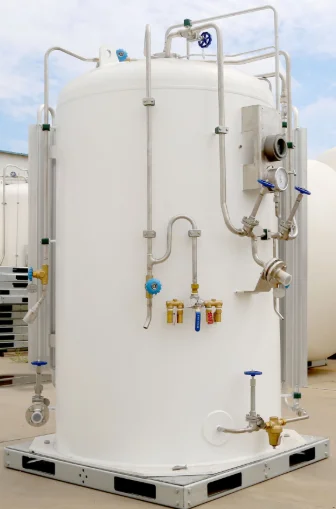
As a premier engineering leader with 20 years of experience, Nordstone specializes in designing and manufacturing high-performance Blowdown Tanks: LN₂ Cryogenic Tank – Liquid Nitrogen Storage Vessels. Across industrial landscapes in Italy and global sectors from Oil & Gas to Defence, our state-of-the-art Italian facility fabricates heavy-duty, custom-engineered pressure vessels that handle extreme thermal stresses down to $-196^circtext{C}$ and intense operational dynamics.
By utilizing advanced Multi-Layer Insulation (MLI), ultra-high vacuum technology, and rigorous double-wall design protocols, we completely mitigate boil-off gas (BOG) losses. Every liquid nitrogen storage vessel and heavy-duty industrial blowdown system we engineer complies strictly with international certifications, including ASME Section VIII Division 1 & 2 (U-Stamp), API, ISO 9001, and European PED 2014/68/EU directives, ensuring unmatched safety, structural integrity, and long-term reliability in the most severe corrosive environments.
Frequently Asked Questions (FAQ)
1. What are the key design differences between an LN₂ cryogenic tank and a standard blowdown tank?
While a standard blowdown tank is engineered to collect, cool, and safely depressurize hot water and steam intermittent purges from boilers, an LN₂ cryogenic tank is built specifically to store liquefied nitrogen at extreme sub-zero temperatures (−196∘C / −320∘F). Cryogenic vessels feature a specialized double-wall structure with an inner stainless steel vessel contained within a carbon steel outer vacuum jacket to eliminate heat transfer.
2. Which manufacturing codes do Nordstone vessels comply with in Italy?
All our industrial pressure vessels and cryogenic storage units are fully certified under ASME Section VIII (Div 1 & 2) with U-Stamp registration, PED 2014/68/EU (European Pressure Equipment Directive) for European markets, as well as applicable API and ISO standards. This ensures total legal compliance and field reliability throughout industrial installations in Italy.
3. How does Nordstone prevent Boil-Off Gas (BOG) in liquid nitrogen storage vessels?
We minimize product loss due to BOG by integrating highly advanced high-vacuum insulation systems combined with Multi-Layer Insulation (MLI) or expanded perlite. This creates an exceptionally efficient thermal barrier that reflects radiant heat away from the inner sub-zero containment cell.
4. What materials are used to withstand −196∘C liquid nitrogen temperatures?
Standard carbon steels become extremely brittle and fail under cryogenic stress. Nordstone utilizes premium-grade austenitic stainless steel (such as Grade 304 or 316) for the inner vessel because its face-centered cubic crystal structure retains high impact toughness and structural ductility at ultra-low liquid nitrogen temperatures.
5. What destructive and non-destructive testing (NDT) do you perform?
Backed by our 20 years of experience, our quality control team enforces rigorous protocols including:
- Full X-ray radiography of all structural weld seams.
- Helium mass spectrometer leak testing to verify the high-vacuum integrity of the outer insulation jacket.
- Cold-shock testing using liquid nitrogen to pre-stress the assembly before high-pressure hydrostatic testing.
6. Can your blowdown tanks and cryogenic systems be custom-engineered?
Yes. Nordstone specializes in custom engineering tailored to specific spatial constraints, pressure requirements, and environmental variables. Using advanced Finite Element Analysis (FEA), we customize orientation (vertical or horizontal), nozzle locations, connection types, and structural support frames to integrate cleanly into your existing facility footprint.
7. What industries in Italy do you primarily serve with these vessels?
Our dual expertise in heavy industrial process equipment and cryogenic storage allows us to supply high-reliability solutions to Oil & Gas processing units, Aerospace and Defence systems, advanced pharmaceutical laboratories, chemical processing plants, and food flash-freezing facilities across Italy.
8. What is the role of an automatic pressure building system on an LN₂ tank?
When liquid nitrogen is drawn from the vessel, the internal pressure drops. Our integrated automatic pressure building circuit safely diverts a small stream of liquid through an external ambient air vaporizer coil, converting it into gas and feeding it back into the top vapor space to maintain a steady, smooth discharge pressure without external pumps.
9. How do you ensure safety against over-pressurization?
Every vessel is outfitted with a redundant, high-capacity safety manifold. This includes dual ASME/PED-approved safety relief valves paired with a three-way diverter valve, allowing safe maintenance or recalibration of one valve without taking the storage tank offline, alongside integrated rupture discs for secondary emergency venting.
10. How is the vacuum inside the outer jacket monitored over time?
Our cryogenic vessels are equipped with a dedicated vacuum-measurement port and premium digital vacuum gauges. This allows your maintenance technicians to perform routine vacuum decay testing to check insulation integrity over years of continuous field operation.
11. What capacities and pressure ratings does Nordstone offer?
We engineer a comprehensive envelope of capacities, ranging from small-scale industrial distribution dewars of 1,000 liters up to large-scale bulk storage fields exceeding 100,000 liters, with design working pressures engineered up to 35 bar (or higher based on custom process criteria).
12. How does Nordstone handle shipping and installation within Italy?
From our state-of-the-art facility, we coordinate full freight logistics, including oversized heavy-transport permits across Italy. Our field engineers provide comprehensive structural foundation requirements, transport rigging oversight, and final commissioning support at your site.
13. Can these cryogenic storage tanks be safely used outdoors?
Absolutely. The outer vacuum jacket is fabricated from heavy-duty carbon steel or structural stainless steel, coated with high-durability, corrosion-resistant marine-grade industrial epoxy paint systems designed to withstand harsh outdoor weather, seaside atmospheric salinity, and industrial environments.
14. What is the expected operational lifespan of a Nordstone vessel?
By utilizing elite precision engineering, superior materials, and automated welding lines, our vessels are designed for an industrial service lifespan exceeding 20 to 25 years, provided regular maintenance of valves and routine vacuum checks are completed.
15. How can we request a detailed technical proposal or engineering quote?
To receive a tailored technical specification package and itemized pricing commercial offer, please provide your exact pressure, volume, temperature, and space parameters directly to our engineering department through our official contact portal.