
When process conditions demand thermal regulation under extreme pressures, high temperatures, or severe fouling tendencies, standard thermal units fall short. As one of the premier double-pipe heat exchanger (DPHE) manufacturers in Italy, Nordstone delivers custom-engineered counter-current thermal solutions designed for true operational longevity.
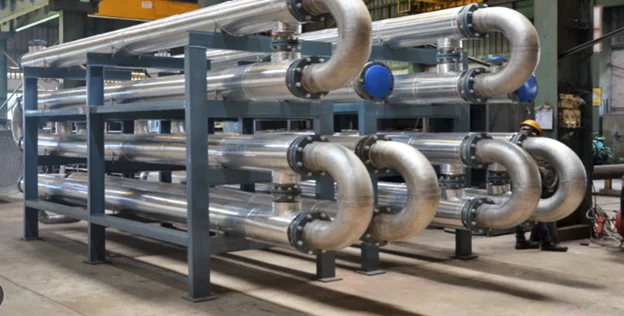
Leveraging over 20 years of experience in heavy-industrial manufacturing, we build robust hairpin and jacketed pipe configurations that handle true temperature cross-conditions without risking internal stress cracks or structural failure.
Our state-of-the-art production facilities combine advanced thermal simulations with premium European metallurgies—including specialized carbon steels, duplex stainless steels, and corrosion-resistant nickel alloys.
Every custom DPHE we export to Italy complies strictly with global and regional regulatory frameworks, holding certifications across ASME Section VIII, API 660, and PED 2014/68/EU.
From high-viscosity hydrocarbon processing to high-pressure chemical synthesis, our engineering team utilizes rigorous testing protocols (including radiography and ultrasonic verification) to guarantee absolute reliability. Optimize your facility’s thermal efficiency and reduce lifecycle maintenance costs by speaking directly with our engineering department or requesting a technical quote through our dedicated team today.
For tailored sizing requests or to discuss specialized project layouts with our engineering desk, please visit our Contact Us page.
Frequently Asked Questions (FAQ)
1. What makes Nordstone a reliable double-pipe heat exchanger (DPHE) manufacturer for Italian industrial facilities?
Nordstone combines over 20 years of industrial pressure vessel manufacturing experience with strict adherence to European and international engineering codes. We offer Italian industries end-to-end service, from custom thermal calculations using advanced design software to localized compliance with the Pressure Equipment Directive (PED).
2. Which industrial sectors in Italy typically utilize double-pipe heat exchangers?
Our DPHE units are primarily deployed across Italy’s heavy process industries, including petrochemical refining, oil and gas processing plants, chemical synthesis facilities, pharmaceutical manufacturing, and heavy power generation plants requiring high-pressure fluid handling.
3. In what scenarios is a double-pipe heat exchanger preferred over a shell and tube design?
A DPHE is highly preferred when handling low fluid flow rates, high temperature differentials (where temperature cross occurs), or when process fluids operate under extreme pressures. Their linear, concentric-pipe layout permits straightforward maintenance and excels in managing highly viscous or fouling-prone fluids.
4. What international and European design standards do Nordstone DPHEs comply with?
All our heat transfer systems are engineered and fabricated in compliance with ASME Section VIII Div. 1 & 2, API 660, TEMA standards, and PED 2014/68/EU requirements, ensuring seamless integration and legal compliance within Italian industrial zones.
5. Can Nordstone supply DPHEs that handle corrosive or highly toxic process fluids?
Yes. We specialize in custom metallurgy designed for aggressive environments. Depending on your chemical composition, we fabricate units using Stainless Steel (304L, 316L, 904L), Duplex and Super Duplex steels, or high-nickel alloys such as Hastelloy, Monel, and Inconel.
6. What types of double-pipe configurations do you manufacture?
We design and construct standard jacketed straight-pipe configurations, multi-tube hairpins, and modular multi-pipe exchangers. These can be supplied as individual units or pre-assembled, skid-mounted multi-tube banks optimized for your plant’s footprint.
7. How does true counter-current flow improve thermal performance in a DPHE?
True counter-current flow allows for a close temperature approach between the hot and cold mediums. This enables the outlet temperature of the cold fluid to exceed the outlet temperature of the hot fluid (temperature cross), a condition that is thermally inefficient or impossible in single-pass shell and tube systems.
8. How does Nordstone prevent thermal expansion stress within the heat exchanger?
To alleviate stress caused by significant temperature differentials between the inner pipe and outer jacket, we incorporate robust mechanical configurations, such as packed floating heads, U-bend layouts (hairpin designs), or integrated expansion bellows.
9. Are your double-pipe heat exchangers suitable for high-fouling applications?
Yes. The simple geometric flow path of a double-pipe design minimizes dead zones where debris or sediment can collect. For extreme fouling applications, we provide removable U-bend covers or flanged clean-out configurations to streamline mechanical cleaning.
10. Do you provide bare inner tubes or finned inner tubes?
We provide both options based on your specific thermal requirements. For applications where one fluid has a significantly lower heat transfer coefficient than the other (such as gas-to-liquid transfer), we utilize longitudinally finned inner tubes to vastly increase the outer surface area and optimize heat transfer efficiency.
11. What quality assurance and non-destructive testing (NDT) steps do you implement?
Every heat exchanger undergoes an extensive Quality Assurance Plan (QAP). Our in-house testing capabilities include Hydrostatic and Pneumatic pressure tests, Radiography (RT), Ultrasonic Testing (UT), Dye Penetrant Testing (DPT), and Magnetic Particle Testing (MPT), all documented thoroughly in the final manufacturing data report.
12. Can your heat exchangers withstand high-pressure and high-temperature limits?
Our custom solutions are engineered to withstand rigorous industrial conditions, successfully operating at design pressures ranging from full vacuum up to 200+ bar and design temperatures spanning from cryogenic levels up to +400°C.
13. How does Nordstone optimize the internal layout of custom-built heat exchangers?
Our engineering department leverages computational fluid dynamics (CFD) analysis alongside specialized thermal simulation software. This ensures fluid velocity profiles are maximized to limit pressure drops while preventing localized erosion.
14. What is the typical lead time for a custom-manufactured DPHE order bound for Italy?
Lead times vary depending on the complexity of the mechanical design, required metallurgy, and raw material availability. Typically, production spans between 12 to 24 weeks, inclusive of certified third-party inspections and logistical preparation.
15. How can we obtain a technical proposal or pricing for a project?
You can initiate a technical consultation by sending your fluid property datasheets, process parameters (temperatures, flow rates, pressures), and space constraints directly to our technical sales team via our secure contact portal at Contact Us.