
As leading spiral heat exchangers manufacturers in Italy, Nordstone delivers premier, custom-engineered thermal solutions designed for the most demanding industrial applications.
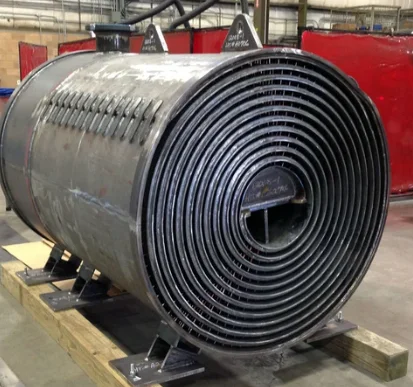
Drawing on over 20 years of manufacturing experience and building upon three decades of group engineering excellence, we specialize in fabricating compact, high-efficiency spiral heat exchangers that optimize thermal performance while minimizing your physical footprint.
Our state-of-the-art facility utilizes advanced metallurgy to build systems capable of handling severe fouling fluids, aggressive slurries, and extreme temperature cross conditions across Italy’s diverse chemical, oil and gas, and heavy manufacturing sectors.
By utilizing a single-channel concentric design, our spiral heat exchangers induce high fluid turbulence, which naturally creates a self-cleaning mechanism that drastically reduces maintenance downtime and prevents sediment buildup.
Whether your operations require precise heat recovery, robust condensation capabilities, or highly reliable cooling for viscous fluids, our dedicated team of expert engineers ensures every unit complies strictly with API, ASME, and ISO certifications. At Nordstone, we integrate premium Italian craftsmanship with world-class engineering standards to deliver thermal solutions that withstand extreme pressures and corrosive environments. To discuss your project specifications or request a technical consultation for your facility, please visit our page to Contact Us.
Technical Overview: The Spiral Design Advantage
The diagram below illustrates the fundamental geometry of a single-channel spiral design. Notice how the hot and cold streams flow through concentric curved paths, maximizing fluid velocity and thermal transfer within a remarkably small physical envelope.
Frequently Asked Questions (FAQ)
1. What makes Nordstone a preferred spiral heat exchangers manufacturer in Italy?
Nordstone combines over 20 years of precise engineering experience with certified state-of-the-art manufacturing facilities. We design custom spiral heat exchangers tailored to complex Italian industrial sectors, ensuring complete adherence to international standards like ASME and API, alongside strict local regulatory compliance.
2. How do spiral heat exchangers achieve higher efficiency than shell and tube designs?
The concentric spiral design creates a single, curved channel for each fluid. This specific geometry induces true counter-current flow and high fluid turbulence even at low velocities. The resulting heat transfer coefficient is significantly higher, allowing for maximum thermal efficiency in a fraction of the space.
3. What industries in Italy benefit most from these thermal solutions?
Our units are heavily utilized across Italy’s chemical processing, oil and gas, wastewater treatment, pharmaceutical, and food and beverage sectors. They excel anywhere engineers must manage high-viscosity products, suspended solids, or intense heat recovery demands.
4. Can your spiral heat exchangers handle severe fouling or slurry fluids?
Yes. The single-channel design creates a “self-cleaning” mechanism. If a deposit begins to form, the local channel width narrows, forcing fluid velocity to increase directly over the restriction. This velocity spike naturally flushes the deposit away, preventing total blockages.
5. What metallurgy and materials do you use for construction?
To withstand corrosive environments, extreme pressures, and high temperatures, we manufacture units using high-grade stainless steel (316L, 304), Duplex and Super Duplex steels, titanium, and advanced nickel alloys depending on your specific chemical compatibility needs.
6. Are Nordstone spiral heat exchangers certified for use in critical applications?
Absolutely. Every vessel and heat exchanger we design complies with rigid quality control benchmarks. We hold active API, ASME Section VIII, and ISO certifications, guaranteeing our thermal solutions meet global safety and reliability standards for defense and oil sectors.
7. How does a compact footprint lower overall facility setup costs?
Because our spiral geometry packs a massive surface area into a tightly wound drum, it requires significantly less structural support, piping re-routing, and floor space than traditional linear heat exchangers. This sharply reduces physical installation and infrastructure costs.
8. What are the typical temperature and pressure limits for your units?
Our customized solutions are structurally engineered to manage extreme operations, securely handling temperatures ranging from sub-zero up to 400°C and design pressures exceeding 30 bar, depending on individual material selection and channel spacing specs.
9. Can these units be opened easily for inspection and cleaning?
Yes. We manufacture spiral heat exchangers with removable, bolted covers. This configuration allows maintenance teams straightforward, direct visual access to both concentric channels for swift inspection, pressure washing, or mechanical cleaning when required.
10. How do you ensure high-quality control during fabrication?
Quality control is embedded into every production stage. We utilize rigorous non-destructive testing (NDT), including ultrasonic, radiographic, and hydrostatic pressure testing, to ensure that every weld seam and structural plate can withstand harsh industrial cycles.
11. Do you offer custom configurations for unique space constraints?
Yes. Our expert engineering team designs custom vertical or horizontal configurations based on your facility’s exact layout, nozzle orientations, and spatial limitations without compromising thermal performance.
12. How do spiral heat exchangers improve energy efficiency in plants?
By facilitating a very close temperature approach (where the temperature difference between the two fluids can be less than 2°C), our units recover waste heat far more effectively, reducing your plant’s reliance on external fuel sources and cutting carbon emissions.
13. What is the expected operational lifespan of a Nordstone unit?
With proper material selection and routine inspections, our spiral heat exchangers are engineered for long-term operational lifespans exceeding 15 to 20 years, even in highly demanding or corrosive chemical environments.
14. What is the difference between a Type I and Type II spiral heat exchanger?
Type I features two completely enclosed spiral channels used for liquid-to-liquid heat transfer. Type II is optimized for condensation or evaporation applications, featuring an open-top channel configuration that allows massive vapor volumes to cross through with minimal pressure drop.
15. How can I get a quote or a technical assessment for my facility in Italy?
You can easily reach out directly to our engineering advisory team by submitting your process data sheets and space requirements via our dedicated contact page at Contact Us. We will provide a comprehensive thermal and mechanical design evaluation.