For over 20 years, Nordstone has been a trusted leader in designing and manufacturing high-performance process pressure vessels for critical, high-purity industrial applications. Our specialized engineering team provides custom-engineered vertical and horizontal degasser vessel solutions tailored specifically for Italy’s demanding Oil & Gas, chemical processing, pharmaceutical, and energy sectors.
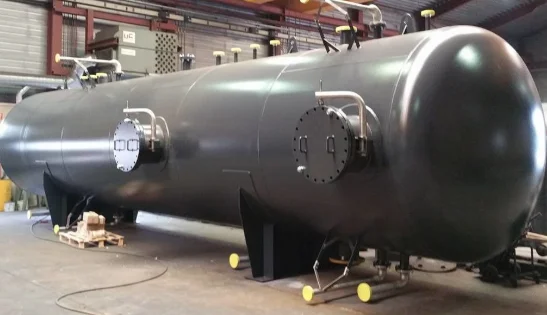
By leveraging advanced thermal and vacuum stripping technologies, our systems achieve precise liquid-gas separation—effectively removing entrained air, dissolved oxygen, carbon dioxide, and volatile compounds down to parts-per-billion (ppb) levels to prevent catastrophic pipeline corrosion and downstream equipment degradation.
Every degasser vessel we manufacture in our state-of-the-art facility is built to withstand extreme temperatures, high vacuum thresholds, and corrosive process fluids.
Fabricated using premium-grade carbon steel, low-temperature carbon steel (LTCS), stainless steel (SS304/SS316L), and duplex alloys, our systems feature robust internal configurations including advanced spray nozzles, packed beds, demister pads, and specialized liquid distribution mechanisms. Our unwavering commitment to European and international industrial safety standards is backed by strict compliance with ASME Section VIII, API, and ISO regulations, ensuring unmatched operational reliability across Italy’s major industrial hubs.
Frequently Asked Questions
1. What is an industrial degasser vessel, and how does it function?
A degasser vessel is a specialized process pressure vessel engineered to remove dissolved gases (such as oxygen, carbon dioxide, and hydrogen sulfide), entrained air, and volatile vapors from liquid streams. It works by altering the thermodynamic state of the fluid—typically through a drop in operating pressure (vacuum degassing) or an increase in temperature (thermal deaeration)—which reduces gas solubility and separates the volatile molecules from the process fluid.
2. Why are degasser vessels critical for industrial applications in Italy?
In Italy’s massive petrochemical, manufacturing, and district heating plants, dissolved gases pose severe operational risks. Oxygen causes pitting in high-pressure boiler tubes, while carbon dioxide dissolves to form highly corrosive carbonic acid. Deploying a custom degasser vessel eliminates these elements, mitigating corrosion, preventing scaling, lowering chemical treatment overhead, and extending the operational lifespan of capital infrastructure by decades.
3. Which specific manufacturing certifications does Nordstone hold for Italian deployments?
Our design and manufacturing workflows comply fully with the strict regulatory framework required for deployment in the European Union and global markets. We build and test systems according to:
- ASME Section VIII (Div. 1 & 2) for pressure vessel safety structures.
- API Standards for upstream and downstream oil and gas infrastructure.
- ISO 9001 for unified quality management controls.
- PED 2014/68/EU (Pressure Equipment Directive) certifications necessary for standard operation across Europe.
4. What materials of construction (MOC) does Nordstone offer?
We select materials based entirely on your specific process environment, fluid chemistry, and temperature profiles:
- Carbon Steel: (e.g., SA 516 Gr. 70) for standard thermal units and feedwater systems.
- Low-Temperature Carbon Steel (LTCS): (e.g., SA 516 Gr. 70N, SA 350 LF2) for sub-zero processing applications.
- Stainless Steel: (SS304, SS316, SS316L) for highly corrosive fluid handling, pharmaceutical setups, and electronics rinse water.
- Duplex & Super Duplex Alloys: For high-salinity or heavy chemical processing environments requiring superior structural integrity.
5. What is the fundamental difference between vacuum degassing and thermal deaeration?
Thermal deaeration heats the process water to its saturation temperature, driving gas solubility down close to zero, utilizing a steam injection or a venting system to eliminate the liberated gases. Vacuum degassing relies instead on a liquid ring vacuum pump to drop the absolute internal pressure (often down to 50–100 mmHg absolute), lowering gas solubility without relying on intense heat. This makes vacuum degassing optimal for temperature-sensitive applications or chemical processes where heat input is restricted.
6. Can Nordstone provide customized internal vessel configurations?
Yes. Our mechanical engineering team customizes internal designs based on the physical properties of the target fluid. Available configurations include horizontal or vertical layouts equipped with high-efficiency multi-nozzle spray systems, structural packed sections, gas-stripping arrangements, specialized liquid distributors, and multi-tier demister pads optimized to prevent fluid carryover during rapid gas venting.
7. What purity and gas-removal performance levels can your vessels achieve?
Our advanced degasser vessels deliver industry-leading efficiency metrics. In typical boiler feedwater systems, mechanical deaeration reduces dissolved oxygen down to under 7 ppb (parts per billion) and carbon dioxide down to under 5 ppm (parts per million). For ultra-pure water configurations required in semiconductors or premium pharmaceuticals, our high-performance vacuum skids can drop residual oxygen thresholds down to under 5 ppb.
8. What quality assurance and testing procedures are performed on each vessel?
To guarantee absolute reliability under high-pressure or deep-vacuum operations, every vessel undergoes rigorous non-destructive testing (NDT) protocols prior to delivery. These include:
- Hydrostatic pressure testing and pneumatic leak checking. nordstoneng.com
- Radiographic testing (RT) of critical structural weld lines. nordstoneng.com
- Ultrasonic, magnetic particle, or liquid penetrant inspection.
- Deep-vacuum hold tests to ensure long-term vacuum tight integrity.
- Comprehensive material traceability reporting (EN 10204 3.1 Material Test Certificates).
9. What standard capacity sizes do you manufacture?
Our manufacturing scope covers everything from highly compact, skid-mounted units for specialized modular pilot systems to massive industrial columns. Standard volumes range from 500 liters up to 60,000 liters, with fully customized heavy-engineering vessel configurations built up to 150 m³ depending on specific project scope, spatial footprint restrictions, and flow velocity requirements.
10. Are your degasser vessels compatible with Clean-In-Place (CIP) systems?
Yes. For industries requiring high sanitary or hygienic profiles, such as pharmaceutical manufacturing or food processing in Italy, we engineer vessels with an integrated CIP configuration. These units feature timed pneumatic valve controls, automated level management via variable-frequency driven (VFD) centrifugal discharge pumps, and smooth internal surface finishes with passivation options to ensure rapid, fully automated sanitization cycles.
11. Can Nordstone build fully integrated, skid-mounted degasser packages?
Absolutely. We construct fully integrated, plug-and-play process skids. These packages arrive pre-piped and pre-wired on a heavy-duty stainless steel skid, complete with the main degasser vessel, multi-tube heat exchangers, automated liquid ring vacuum pumps, instrumentation arrays (pressure transmitters, level gauges, oxygen analyzers), and an integrated PLC control system panel for easy integration into your existing plant distributed control system (DCS).
12. How do your vessels stand up to highly abrasive or volatile fluids?
For volatile or abrasive process streams, we employ specific internal engineering safeguards. This includes structural wall reinforcements, specialized corrosion-resistant linings, internal epoxy coatings, and advanced mist eliminators or cyclone separators designed to handle rapid multi-phase separation without causing mechanical erosion or fluid bypassing within the vessel chamber.
13. What instrumentation options are available for automated monitoring?
We provide complete instrumentation arrays to enable remote monitoring and fully autonomous operation. This includes smart digital pressure switches, high-accuracy level transmitters, inline dissolved gas/oxygen analyzers, moisture sensors, automatic purge valves, and IoT-enabled remote telemetry hardware for integration with modern SCADA automation frameworks.
14. How long has Nordstone been building these systems?
Nordstone brings 20 years of proven experience in precision engineering and high-purity pressure vessel manufacturing. Over the decades, we have partnered with major operators in heavy industries, defense, and power generation to solve complex gas-separation problems in challenging processing environments.
15. How do we initiate a custom design project or request a comprehensive technical quotation?
To discuss your technical parameters—such as target flow rates, fluid chemistry, operational temperature profiles, and spatial footprint constraints—please visit our dedicated portal to connect directly with an expert senior applications engineer:
Contact our technical engineering team for a customized design consultationYes
If you have an immediate RFQ or require site-specific engineering assistance for an impending project deployment within Italy, please reach out directly through our account interface at Contact Us to receive an optimized engineering layout and pricing structure.