When evaluating top-tier accumulator manufacturers in Italy, industrial operators require partner facilities that blend deep manufacturing heritage with stringent compliance. Nordstone bridges this gap, leveraging 20 years of experience to deliver bespoke, high-performance industrial accumulator vessels engineered for critical, heavy-duty applications.
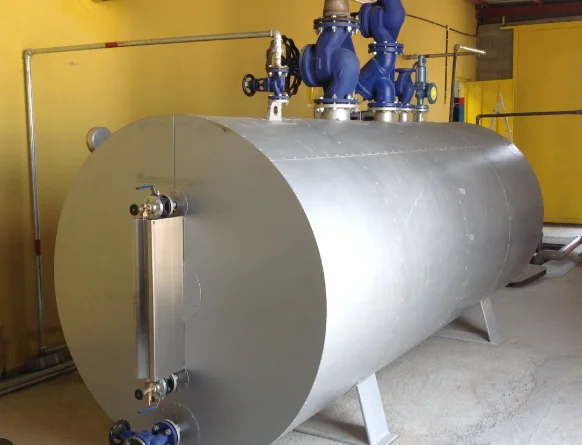
From liquid surge and gas-liquid accumulators to robust steam drum and refrigeration systems, our engineering focus centers on protecting infrastructure from catastrophic pressure imbalances, transient shocks, and system failures.
Operating from our state-of-the-art facility, our specialized teams utilize advanced thermodynamic modeling and CFD (Computational Fluid Dynamics) optimized internal flow patterns to minimize turbulence and stabilize flow continuity. Whether your project demands carbon steel, high-grade stainless steel (such as SS316L), or advanced corrosion-resistant clad linings, our vessels are precision-built to operate safely within extreme parameters ranging from -50°C to +400°C and pressures up to 200 bar.
Every unit we produce undergoes comprehensive non-destructive testing (NDT), including radiography and ultrasonic evaluations, ensuring absolute baseline structural integrity. Backed by universally recognized API, ASME, and ISO certifications, our custom-engineered solutions deliver low pressure drops, long operational lifetimes, and uncompromised safety. For tailor-made system integrations, skid assemblies, or specialized engineering consultations, please visit our dedicated portal to connect with our regional technical sales specialists:
Frequently Asked Questions
1. What core industrial roles do Nordstone accumulator vessels serve?
Accumulator vessels act as vital buffer containment systems within process lines. They are designed to absorb sudden fluid volume spikes, manage transient thermal expansion, separate gas from liquid phases, and stabilize system pressure during unexpected pump shutdowns or equipment start-ups.
2. What specific types of accumulators do you manufacture for the Italian market?
Our production lines focus heavily on specialized process accumulators, including:
- Liquid Surge Accumulators: To prevent liquid hammer in pipeline networks.
- Gas-Liquid Accumulators: To maintain controlled gas cushions.
- Refrigeration & Flash Accumulators: Engineered to prevent compressor slugging and recover high-temperature steam.
- Steam Drum Accumulators: Designed to balance rapid load swings in power plants.
3. Which design codes and international standards do your vessels comply with?
Every accumulator is designed, built, and tested according to the highest global design metrics. Our manufacturing processes strictly satisfy ASME Section VIII Div. 1, API standards, ISO 9001 quality management rules, and regional PED (Pressure Equipment Directive) benchmarks necessary for seamless deployment within Italy and the broader European Union.
4. What materials are utilized to ensure chemical and pressure resistance?
We source certified materials based on the application’s corrosivity and thermal stress profile. This includes heavy-duty carbon steels (SA 516 Gr. 60/70), austenitic stainless steels (SS304L, SS316L), Duplex/Super Duplex alloys, and exotic Chrome-Moly or Nickel alloys for highly corrosive or offshore configurations.
5. Can Nordstone integrate custom internal components into the accumulators?
Yes. Depending on your operational process data, we integrate custom-engineered internals such as mesh or vane-type demister pads for high-efficiency droplet separation, anti-vortex devices, inlet diffusers, weirs, and specialized surge control baffles.
6. What types of protective coatings or linings are available?
To withstand aggressive process media, we offer advanced corrosion-resistant internal linings. Options include high-build epoxy, specialized glass flake linings, phenolic coatings, and food-grade alternatives explicitly tailored to client specifications.
7. What testing procedures do you execute to guarantee vessel integrity?
Every individual pressure vessel undergoes strict, multi-stage quality control checks, including:
- Hydrostatic and pneumatic pressure testing.
- Non-Destructive Testing (NDT) including Radiography (RT) and Ultrasonic Testing (UT).
- Magnetic Particle (MPI) and Dye Penetrant (DPT) inspections.
- Independent third-party validation (e.g., TUV, Bureau Veritas, Lloyds, DNV).
8. What are the maximum pressure and temperature thresholds for your accumulators?
Our custom design engineering accommodates severe industrial environments, featuring operational pressure capacities scaling from 0.5 bar up to 200 bar, and temperature ratings stretching safely from -50°C up to +400°C.
9. Do you provide turn-key skid-mounted accumulator assemblies?
Yes, we engineer and construct completely integrated, skid-mounted accumulator systems. These packages come fully pre-piped, structure-tested, and outfitted with required instrumentation networks to drop seamlessly into existing facility footprints.
10. What kind of instruments and automation tracking packages are included?
We offer complete instrumentation control arrays, including magnetic or glass level gauges, ultrasonic or radar level transmitters, safety relief valves (SRVs), pressure indicators, and standalone PLC/SCADA automation tie-ins for continuous safety tracking.
11. How does Nordstone optimize fluid dynamics to limit system pressure drops?
Our engineers run comprehensive CFD flow simulations to evaluate fluid residence times and distribution profiles. This ensures internal structural elements guide liquid/vapor streams seamlessly, keeping pressure drops to an absolute minimum.
12. Are your manufacturing welding procedures independently certified?
Absolutely. All structural and pressure-boundary welding processes are strictly bound by verified Welding Procedure Specifications (WPS) and Procedure Qualification Records (PQR). Our highly trained fabricators hold independent welder performance qualifications (WPQ).
13. What documentation package accompanies a completed vessel delivery?
Every vessel ships alongside a comprehensive quality track book containing mechanical design calculations (via PV Elite/COMPRESS), certified Mill Test Certificates (MTC 3.1/3.2), NDT records, hydro-test logs, and certificate of conformity paperwork.
14. How does a 20-year manufacturing history benefit custom industrial projects?
Two decades of highly focused heavy fabrication experience allow us to recognize and resolve complex structural, material, and chemical compatibility concerns early in the engineering phase, preventing costly project delays or on-site modifications.
15. How can I submit process parameters to receive a custom technical quote?
To submit data sheets, design boundaries, or project drawings, you can reach out directly via our digital gateway at Contact Us. Our engineering department will analyze your parameters and deliver a detailed technical layout and quotation.