For chemical processors, petrochemical plants, and pharmaceutical manufacturers across Europe, achieving precise liquid-liquid mass transfer under severe operational parameters demands unparalleled heavy fabrication expertise.
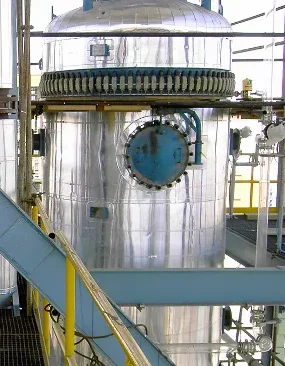
As leading extraction columns manufacturers in Italy, Nordstone combines 20 years of proven engineering experience with a state-of-the-art fabrication facility to deliver high-performance, custom-engineered industrial vessels. Every unit we engineer is purpose-built to withstand extreme pressures, high temperatures, and aggressive chemical environments, ensuring absolute structural integrity.
Backed by stringent API, ASME (Section VIII, Division 1), and ISO certifications, our specialized engineering team implements meticulous non-destructive testing (NDT), including automated radiographic and ultrasonic inspections, alongside rigorous hydrostatic validation.
From custom packed-bed configurations and sieve tray architectures to advanced rotating disk contactors (RDCs), Nordstone delivers the exact separation efficiency, phase-interface stability, and scalable throughput required by critical global industries.
Contact our industrial engineering experts today via our Contact Us portal to discuss your technical specifications, custom metallurgy choices, or system scaling needs.
Frequently Asked Questions
1. What types of industrial extraction columns does Nordstone manufacture in Italy?
We design and fabricate a comprehensive range of custom industrial liquid-liquid extraction columns tailored to specific mass transfer profiles:
- Packed Extraction Columns: Utilizing advanced random or structured packing configurations to maximize interfacial surface area.
- Sieve Tray Columns: Engineered with calculated tray spacing and precise free cross-sectional areas to allow optimal phase dispersion and settling.
- Rotating Disk Contactors (RDCs): Equipped with a robust central rotating shaft and stators for intense, controlled mechanical agitation and high separation efficiency.
- Pulsed Extraction Columns: Available in pulsed-packed and pulsed sieve-tray designs where directional mechanical pulsing energy prevents back-mixing and improves mass transfer rates.
2. Which manufacturing codes and global compliance certifications do you follow?
Our engineering workflows comply fully with global pressure vessel codes and regional regulations. We possess certified manufacturing authorization under ASME Section VIII Div 1, API standards, and the European Pressure Equipment Directive (PED 2014/68/EU). All our operations are executed under a strict ISO 9001 quality management framework to guarantee full compliance for installations throughout Italy and the broader European market.
3. What materials of construction (MOC) are available for highly corrosive chemical extraction?
To handle aggressive solvents, high-salinity brines, and acidic or alkaline media, we work with an extensive selection of metallurgical options and lined configurations:
- Austenitic Stainless Steel: SS304, SS316, SS316L, and SS317.
- Super Alloys: Hastelloy (C276, C22), Inconel, Monel, and Duplex/Super Duplex steels.
- Advanced Linings & Coatings: High-integrity bonded or loose fluoroplastic linings such as TFM, PTFE, FEP, and PVDF to provide chemical inertness in highly corrosive service zones.
4. Can you customize column internals for specialized chemical processes?
Yes. Our internal engineering department designs, fits, and validates customized column internals to resolve challenging process hydraulics. This includes custom-engineered feed and solvent distribution headers, phase-interface control baffles, solid PTFE spargers, dip-pipes, bed limiters, and specialized multi-stage tray assemblies that match your exact chemical affinity profiles and flow ratios.
5. What are the typical sizing and physical scale capabilities of your Italian fabrication facility?
Backed by 20 years of heavy fabrication experience, our state-of-the-art facility handles broad dimensional spans for pilot plants up to large-scale industrial operations. We routinely manufacture vertical column vessels ranging from 0.3 meters to over 6 meters in diameter, and overall heights extending from 3 meters to 30+ meters, engineered perfectly to withstand wind loads, seismic variables, and lifting stresses.
6. What operating pressure and temperature limits can your column vessels accommodate?
Every vessel is individually engineered for its distinct service conditions. We design and stamp vessels capable of operating from full vacuum conditions up to high-pressure regimes exceeding 15 psig (1 bar to 10+ bar design ratings), paired with continuous-service temperature envelopes stretching from sub-zero cryogenic states up to 200°C+.
7. How does Nordstone prevent the common issue of back-mixing and phase entrainment?
Phase entrainment and efficiency-killing back-mixing are minimized through precise hydrodynamic and mass-transfer modeling during our initial design stage. By optimizing phase-settling zones, refining the spacing between tray or packing stages, and installing proprietary interface monitoring controls, we ensure stable phase separation and steady counter-current flow patterns.
8. What non-destructive testing (NDT) protocols do you perform to ensure weld and material integrity?
We enforce a zero-tolerance quality control system from raw material receiving to final hydrostatic validation. Our certified inspectors execute a strict testing schedule on all pressure-retaining welds:
- Radiographic Testing (RT): Complete X-ray evaluation of critical longitudinal and circumferential seams.
- Ultrasonic Testing (UT): Advanced UT for internal flaw detection and weld profiling.
- Liquid Penetrant (PT) & Magnetic Particle (MT): Rigorous surface inspection of all structural attachments.
- Hydrostatic Pressure Test: Performed safely at 1.5 times the calculated design pressure to guarantee absolute mechanical seal.
9. Do your extraction columns support continuous multi-stage separation or batch operation?
Our custom columns are primarily optimized for continuous, uninterrupted industrial processing, which minimizes operational downtime and delivers high product purity. However, we also design custom batch and semi-continuous configurations for specialty chemical or API (Active Pharmaceutical Ingredient) production facilities that require frequent product changeovers.
10. For what industrial sectors do you manufacture industrial extraction columns in Italy?
Our high-performance vessels are deployed worldwide across several critical high-pressure, high-purity sectors:
- Oil & Gas / Petrochemicals: For solvent extraction, aromatics separation, and hydrocarbon purification.
- Pharmaceuticals & Biotech: For API extraction, intermediate refining, and solvent recovery.
- Specialty Chemicals: For organic acid recovery, metal extraction, and chemical synthesis.
- Environmental Technology: For industrial wastewater scrubbing, valuable compound recovery, and contaminant removal.
11. Do you supply full material traceability and compliance documentation?
Absolutely. We provide a comprehensive quality documentation package with every delivered vessel. This includes complete material test reports (MTC 3.1 according to EN 10204) ensuring 100% material traceability, weld maps, NDT inspection logs, post-weld heat treatment (PWHT) charts, and certificates of compliance from independent third-party inspectorates such as TÜV, Bureau Veritas, or Lloyd’s Register.
12. Can you manufacture modular, skid-mounted extraction systems?
Yes, we specialize in modular, pre-engineered skid-mounted designs. Fabricating the extraction column alongside its accompanying heat exchangers, automated control valves, piping arrays, and process instrumentation on a unified structural frame significantly minimizes on-site construction, welding, and commissioning times at your industrial site in Italy.
13. How does Nordstone optimize columns for energy efficiency?
We incorporate advanced process features like structured DURAPACK® packing or integrated heat-jacket elements that optimize contact surface mechanics and lower mass transfer resistance. This maximizes extraction yield per pass, vastly reducing the required solvent-to-feed ratios and minimizing down-stream solvent distillation energy costs.
14. Is it possible to execute pilot trials or simulation tests before full-scale manufacturing?
Yes. Our design engineering process utilizes advanced hydraulic modeling, mass transfer simulations, and computational fluid dynamics (CFD) analysis to map flow distribution uniformities. We collaborate closely with your technical teams to review pilot data or experimental trial results, validating our geometric scaling factors prior to rolling and welding the final industrial vessel shell.
15. How do I request a custom engineering quote and technical consultation for my plant?
You can initiate a technical evaluation by reaching out directly to our engineering sales team through our dedicated portal at Contact Us. Please submit your target process parameters—such as stream flow rates, operating temperatures, chemical compositions, corrosion allowances, and required ASME/PED stamps—and our engineering specialists will respond promptly with a detailed technical proposal.