As a premier manufacturer of custom industrial vessels, Nordstone delivers high-performance HVAC & thermal skids and precision-engineered modular heat transfer systems designed to withstand extreme pressures and corrosive environments.
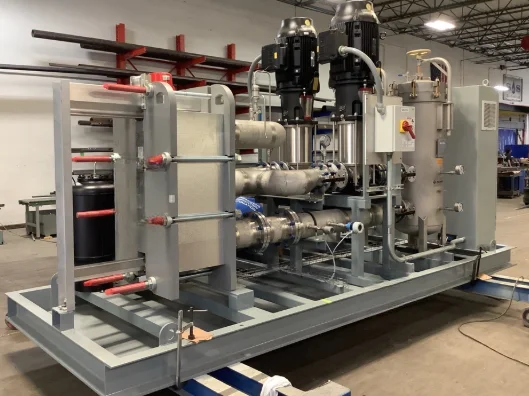
Backed by over 20 years of engineering excellence, we specialize in the complete mechanical design, fabrication, and integration of turnkey thermal management solutions for critical sectors across Italy, including Oil & Gas, chemical processing, power generation, and defense. Our state-of-the-art manufacturing facilities utilize advanced automation and meticulous quality control to build compact, process-ready skid packages that seamlessly integrate into existing infrastructure.
From shell-and-tube configurations to complex multi-zone thermal control units, every modular system is fully optimized for thermal efficiency, footprint reduction, and operational safety.
By maintaining strict compliance with international benchmarks—including ASME Section VIII, API standards, and ISO 9001 certifications—Nordstone guarantees unmatched reliability for Italy’s most demanding industrial thermal processes.
To discuss your project parameters with our engineering team or request a technical consultation, visit our contact page.
Technical FAQ (Top 15)
To maximize search visibility and address specific B2B buyer intent, these FAQs target the precise technical and regulatory questions asked by Italian procurement managers and plant engineers.
Q1: What types of thermal skids does Nordstone manufacture for the Italian market?
We design and fabricate a comprehensive range of modular heat transfer systems, including industrial HVAC circulation skids, steam heating packages, process cooling units, heat exchanger skid assemblies (shell-and-tube or plate-and-frame), and specialized chemical dosing or thermal fluid regulation systems.
Q2: Which industry certifications do your HVAC and thermal skids comply with?
Every modular system is built to international quality and safety benchmarks. Depending on your project requirements, our skids carry ASME (American Society of Mechanical Engineers) stamps, conform to API (American Petroleum Institute) standards, and comply fully with European CE marking requirements, including the PED (Pressure Equipment Directive 2014/68/EU).
Q3: Can Nordstone customize skids for explosive or hazardous environments (ATEX zones)?
Yes. Given our extensive background in the Oil & Gas and defense sectors, we design and manufacture fully certified ATEX-compliant thermal skids for Zone 1 and Zone 2 hazardous locations, utilizing explosion-proof electrical enclosures, intrinsically safe instrumentation, and spark-resistant components.
Q4: What materials are used in the fabrication of your heat transfer loops?
We work with high-grade materials selected specifically for the process fluid and environmental conditions. Options include standard Carbon Steel, 304/316L Stainless Steel, Duplex and Super Duplex stainless steels, Hastelloy, and other corrosion-resistant alloys ideal for aggressive marine or chemical environments.
Q5: Do you provide turnkey skid packages including automation and controls?
Absolutely. Our modular heat transfer systems are delivered as fully integrated, turnkey packages. They feature pre-wired electrical panels, integrated Programmable Logic Controllers (PLCs) calibrated to your control philosophy, variable frequency drives (VFDs), and precision instrumentation for seamless SCADA integration.
Q6: What are the primary structural advantages of your modular skid designs?
Our skids are engineered to optimize spatial constraints. Built on heavy-duty, structural steel base frames (skids), they feature a compact footprint that reduces on-site civil works, simplifies transportation, and allows for accelerated “plug-and-play” installation at the factory or plant site.
Q7: How does Nordstone validate the thermal efficiency of its custom designs?
Our engineering team utilizes advanced thermal rating software alongside Computational Fluid Dynamics (CFD) modeling to simulate heat transfer rates, pressure drops, and fluid behavior. This ensures the physical system meets your exact thermodynamic requirements before manufacturing begins.
Q8: What quality control and non-destructive testing (NDT) protocols do you use?
In line with our ISO certifications, all pressure piping and vessels undergo rigorous non-destructive testing, including Radiographic Testing (RT), Ultrasonic Testing (UT), Liquid Penetrant Testing (PT), and hydrostatic pressure testing at our factory prior to shipment.
Q9: Are your thermal systems suitable for high-temperature or high-pressure applications?
Yes. Our core expertise lies in critical applications. We regularly engineer modular systems capable of handling extreme process conditions, with design pressures exceeding several hundred bar and temperature ranges matching heavy industrial steam or cryogenic cooling needs.
Q10: How does sourcing from an Italian-focused manufacturer benefit local industrial operations?
Sourcing from Nordstone ensures that your equipment aligns perfectly with local European safety mandates, EN structural standards, and grid regulations. It also streamlines logistics, reduces transit times, and simplifies compliance documentation during facility audits.
Q11: Can your HVAC skids be integrated with existing plant heat recovery systems?
Yes, we frequently design custom heat transfer loops specifically to capture waste heat from industrial exhausts, turbine systems, or chemical reactions, redirecting that thermal energy back into your facility’s HVAC or process streams to drastically lower carbon footprints.
Q12: Do you offer factory acceptance testing (FAT) before delivery?
Yes. We perform comprehensive Factory Acceptance Testing at our facility. Clients or third-party inspection agencies (such as Lloyd’s Register, Bureau Veritas, or TÜV) are welcome to witness physical pressure tests, electrical loop checks, and functional control tests.
Q13: What parameters do you need from my engineering team to provide a technical quote?
To deliver an accurate proposal, we typically require your process flow diagrams (PFD), desired hot and cold fluid properties (flow rates, inlet/outlet temperatures), maximum allowable pressure drop, space constraints, and required structural or electrical classifications.
Q14: What is the typical lead time for a custom-engineered modular thermal skid?
Lead times vary depending on system complexity, material availability, and certification requirements. Generally, custom thermal skids range from 12 to 24 weeks from final engineering design approval to ex-works delivery.
Q15: How can I submit an RFP or get in touch with Nordstone’s engineering team in Italy?
You can easily upload your project specifications, data sheets, or engineering designs directly through our secure portal. For immediate assistance and to initiate your technical project review, please connect with us via our contact page.