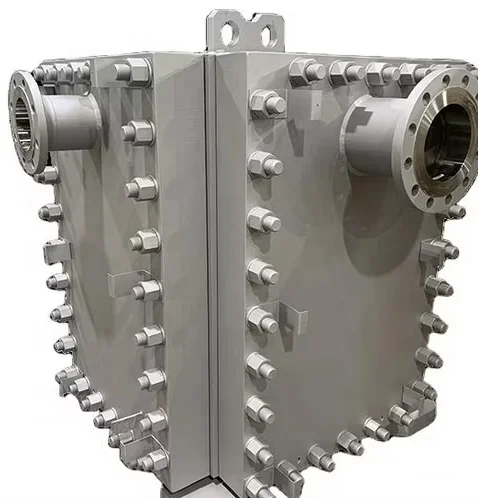
With over 20 years of experience in heavy-duty industrial engineering, Nordstone designs and manufactures custom Plate & Shell Heat Exchangers for Italy’s most demanding processing sectors. Engineered to bridge the gap between traditional shell-and-tube units and gasketed plate models, our fully welded configurations deliver exceptional thermal efficiency under extreme pressures and temperatures.
As a trusted industrial partner across Italy, we supply high-performance thermal systems to regional chemical plants, pharmaceutical hubs, and offshore energy projects.
Our manufacturing facility utilizes robotic laser welding to eliminate the risk of gasket failure, allowing these compact units to withstand operational stress from full vacuum up to 100 bar+. Designed strictly in compliance with ASME Section VIII, API 660, and European PED 2014/68/EU standards, Nordstone heat exchangers optimize your thermal processes, maximize uptime, and drastically lower footprint requirements across demanding local industrial environments.
For custom sizing, technical datasheets, or to consult with our engineering team regarding your specific process parameters, visit our dedicated Contact Us page.
Frequently Asked Questions
1. What is a Plate & Shell Heat Exchanger, and how does it work?
A Plate & Shell Heat Exchanger combines the pressure-retaining capability of a cylindrical shell with the high thermal efficiency of a welded plate pack. One fluid flows through the channels formed by the corrugated plate pack, while the second fluid runs through the outer shell space around the plates. This hybrid arrangement creates high fluid turbulence, generating excellent heat transfer coefficients in a compact form factor.
2. What are the core advantages of Plate & Shell designs over conventional Shell & Tube models?
Plate & Shell configurations require up to 70% less floor space and lower operational fluid volume compared to traditional Shell & Tube designs. The intense turbulence created by the corrugated plates yields thermal efficiency levels that are three to five times higher. This helps industrial facilities lower structural load, trim initial material costs, and reduce energy consumption.
3. What industries in Italy benefit most from these heat exchangers?
Our systems are primarily deployed across Italy’s chemical processing plants, oil and gas refineries, marine environments, and pharmaceutical manufacturing facilities. They are ideally suited for processes involving high-pressure condensation, gas cooling, steam heating, or hazardous chemicals where cross-contamination must be structurally prevented.
4. Can your Plate & Shell Heat Exchangers operate under extreme pressures and temperatures?
Yes. Because our plate packs are fully welded without synthetic rubber gaskets, our units safely operate under design pressures ranging from full vacuum up to 100 bar+ and handle process temperatures from −20∘C to +400∘C, depending on the specified metallurgy.
5. What design codes and certifications do Nordstone units follow?
Every unit is designed, fabricated, and rigorously tested under international quality frameworks. We provide fully certified equipment matching ASME Section VIII (Div 1 & 2), European Pressure Equipment Directive (PED 2014/68/EU), API 660, and ISO 9001 quality management protocols.
6. What material options do you provide for highly corrosive environments?
To handle aggressive processing media, we build plate packs using a wide spectrum of premium metals. Beyond standard stainless steels (SS304, SS316L, and SS904L), we specialize in advanced corrosion-resistant alloys, including Hastelloy C276, Monel, Inconel, and Titanium.
7. How does a fully welded plate pack prevent cross-contamination?
Gasketed plate heat exchangers run the risk of chemical degradation or blowout of elastomer seals under high stress. Nordstone utilizes precise automated laser welding to seal the perimeter of the plate channels. This establishes an absolute physical barrier between the two fluid streams, eliminating leakage paths and preventing dangerous cross-contamination.
8. Are these heat exchangers prone to fouling, and how are they cleaned?
The high shearing stress and fluid turbulence generated by the corrugated plates naturally create a “self-cleaning” effect that slows down particle deposition and scaling. For cleaning, units can be effectively flushed using automated Cleaning-In-Place (CIP) cycles. Removable shell options are also available if mechanical plate pack washing is required.
9. Can these units handle phase-change applications like condensing or evaporating?
Absolutely. The internal channel geometry can be customized specifically for asymmetric flow paths. This makes them highly effective as steam condensers, organic solvent evaporators, vacuum condensers, or cascade chillers in heavy industrial refrigeration loops.
10. Does Nordstone offer fully customized thermal engineering solutions?
Yes. Every process environment features unique variables like specific gravity, viscosity, flow rate, and pressure drop limits. Our dedicated engineering team uses specialized thermodynamic software to custom-calculate the plate profile, thickness, pass arrangement, and connection sizes required for your plant’s exact conditions.
11. What is the typical footprint savings compared to traditional units?
Due to the concentrated heat transfer area of stacked plates, a single Nordstone Plate & Shell unit can replace a Shell & Tube unit that is three times its physical length and volume. This footprint reduction significantly simplifies integration into tight modular skid environments or crowded factory floors.
12. How does Nordstone verify the structural integrity of welded plates?
We implement strict Quality Assurance Plans (QAP) and Non-Destructive Testing (NDT) programs. Every heat exchanger undergoes complete helium leak testing, radiographic or ultrasonic weld examination, and hydrostatic pressure testing at 1.3 to 1.5 times the maximum allowable working pressure before leaving our factory.
13. What is the expected service lifespan of a Nordstone Plate & Shell unit?
When operating within specified thermal boundaries and managed with proper fluid filtration, our fully welded units regularly achieve an operational lifespan exceeding 15 to 20 years. The absence of wearing parts, like rubber gaskets, significantly cuts down ongoing maintenance costs.
14. Do you provide integrated process systems beyond standalone units?
Yes, Nordstone specializes in engineering and assembling turnkey Modular Skid Packages. We can deliver your heat exchanger pre-piped and completely integrated with structural frames, process valves, instrumentation, variable frequency drives, and PLC control panels for faster on-site installation.
15. How can Italian industrial buyers request a custom quote or engineering review?
To obtain a detailed thermal calculation and commercial proposal, you can securely submit your process parameter sheets (detailing fluid properties, flow rates, inlet/outlet temperatures, and allowable pressure drops) directly to our technical team via our official page at Contact Us.