
As a premier engineering entity with 20 years of experience in high-performance industrial vessel fabrication, Nordstone delivers unparalleled precision as one of the leading vacuum chamber manufacturers in Italy.
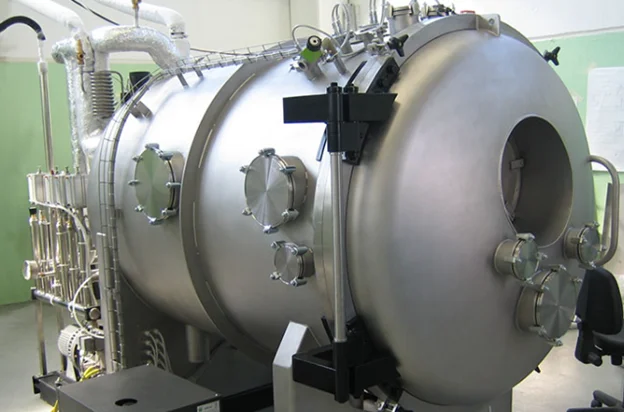
Specializing in custom, leak-tight solutions built to withstand extreme environmental parameters, our industrial vacuum chambers are engineered to support critical operations across the aerospace, automotive, semiconductor, and defense sectors throughout Europe. By integrating advanced finite element analysis (FEA) with rigorous fabrication protocols, we ensure that every custom cylindrical or rectangular vacuum vessel we produce offers optimal structural integrity, minimized outgassing, and long-term reliability.
Our state-of-the-art manufacturing facility combines robotic welding with certified human craftsmanship to deliver ultra-high vacuum (UHV) environments that strictly comply with international regulatory benchmarks, including API, ASME Section VIII, and ISO certifications.
From advanced aerospace thermal vacuum testing to heavy-duty industrial processing, Nordstone builds tailored, resilient systems that reliably safeguard your most sensitive applications against structural collapse and microscopic degradation. For comprehensive technical specifications or to consult with an expert engineer regarding your specific operational requirements, please visit our dedicated communication hub to Contact Us.
Frequently Asked Questions (FAQ)
1. What makes Nordstone a leading vacuum chamber manufacturer in Italy?
Nordstone combines 20 years of experience in heavy industrial vessel engineering with a specialized manufacturing plant capable of handling complex geometries. Our team designs and fabricates high-vacuum (HV) and ultra-high vacuum (UHV) systems using advanced automated welding and strict non-destructive testing (NDT), matching the rigorous engineering demands of the Italian and broader European aerospace, defense, and semiconductor sectors.
2. Which design codes and industrial standards do your vacuum chambers comply with?
Every chamber built by Nordstone is engineered in compliance with international pressure and vacuum vessel guidelines. We work predominantly under ASME Section VIII Division 1 parameters (including “U” and “UM” stamps where required), alongside full alignment with ISO 9001 quality management systems and API standards for heavy oil, gas, or chemical process integration.
3. What materials does Nordstone use for industrial vacuum chamber fabrication?
Material selection is critical to preventing structural failure and outgassing under deep vacuum conditions. We manufacture chambers using high-grade 300-series stainless steel (such as 304L and 316L for reduced magnetic permeability and carbon precipitation), aerospace-grade aluminum alloys, and high-performance nickel alloys (such as Inconel or Hastelloy) for highly corrosive industrial environments.
4. How does Nordstone prevent outgassing in high-vacuum environments?
Outgassing—the release of trapped gases from within the chamber materials—can ruin vacuum levels. We combat this through specialized material sourcing, strict control of welding filler metals, high-grade mechanical polishing, and electropolishing surface finishes. Additionally, our vessels can undergo thermal baking validation to eliminate volatile surface contaminants prior to deployment.
5. Can you manufacture custom shapes and large-scale geometries?
Yes. Depending on your spatial constraints and process requirements, Nordstone designs and builds custom cylindrical chambers, spherical systems, and large rectangular box chambers. Our facility utilizes advanced 5-axis machining and robotic welding configurations to secure uniform structural integrity across complex joint interfaces and oversized access ports.
6. What vacuum ranges can your vessels reliably achieve?
Our custom-engineered vessels are optimized across the entire pressure spectrum:
- Rough/Medium Vacuum: Industrial drying and processing.
- High Vacuum (HV): Semiconductor processing and thin-film deposition.
- Ultra-High Vacuum (UHV): Advanced aerospace testing, particle accelerators, and sensitive defense R&D.
7. What types of testing and quality validation do your chambers undergo?
To guarantee leak-tight operation, we apply standard and advanced non-destructive evaluation (NDE) protocols. This includes helium mass spectrometer leak testing, hydrostatic testing, radiographic (X-ray) weld inspection, dye penetrant inspection, and positive material identification (PMI) to confirm complete structural and chemical composition accuracy.
8. Do you provide integrated components like viewports, feedthroughs, and structural frames?
Yes. We manufacture fully integrated vacuum assemblies. Nordstone can design and install precision access doors, specialized viewport windows for process monitoring, electrical/fluid feedthrough ports, internal shelving arrays, and heavy-duty structural steel support frames or skids to fit directly into your production line.
9. Which industries in Italy utilize Nordstone vacuum chambers?
Our primary European client base spans high-fidelity industries including Aeronautics & Aerospace (thermal vacuum test chambers), Semiconductors (ion implantation and deposition vessels), Defense systems testing, Chemical Processing, and Advanced Research Laboratories utilizing synchrotrons or plasma physics setups.
10. How does external atmospheric pressure affect chamber wall thickness design?
Unlike traditional pressure vessels facing internal bursting forces, a vacuum chamber must resist external atmospheric pressure pushing inward (~1 bar or 14.7 psi at sea level). Our engineering team uses finite element analysis (FEA) to calculate the precise wall thickness and reinforcing rib structures needed to prevent buckling or catastrophic structural implosion.
11. Can your vacuum chambers handle extreme temperature variations?
Yes. For applications like space simulation or thermal processing, our chambers are designed to withstand extreme thermal gradients. We integrate custom heating jackets, internal cooling plates, or multi-zone thermal shrouds that operate reliably alongside deep vacuum levels without causing thermal stress cracks along critical weld lines.
12. What is the typical lead time for a custom Nordstone vacuum chamber?
Lead times vary depending on structural complexity, chamber volume, and necessary certifications (e.g., specific ASME stamps). Because we co-locate our engineering, machining, and welding operations within a single unified facility, we compress production schedules. A detailed project timeline is provided during your initial engineering consultation.
13. How does Nordstone ensure weld integrity in vacuum applications?
A vacuum chamber is only as safe as its joints. We utilize full-penetration welds and specific internal seal-welding techniques that eliminate “virtual leaks”—tiny pockets of trapped air within joint crevices that slowly leak into the chamber over time. All welding procedures conform strictly to ASME Section IX standards.
14. Do you offer field installation or maintenance services within Italy?
Yes. Nordstone provides comprehensive engineering support from concept to completion. Our technical teams assist with onsite installation, final vacuum drawdown integration, seal inspections, and structural re-validation to ensure your system performs to its exact design parameters throughout its operational lifecycle.
15. How can I request a technical quote or begin a project with Nordstone?
To submit your request for proposal (RFP), engineering drawings, or operational parameters (such as target vacuum level, dimensions, and temperature ranges), please connect directly with our engineering sales division through our secure contact portal at Contact Us.