With over 20 years of proven expertise in high-performance pressure vessel engineering, Nordstone designs, manufactures, and supplies premium, sanitary-grade food and pharmaceutical tanks across Italy.
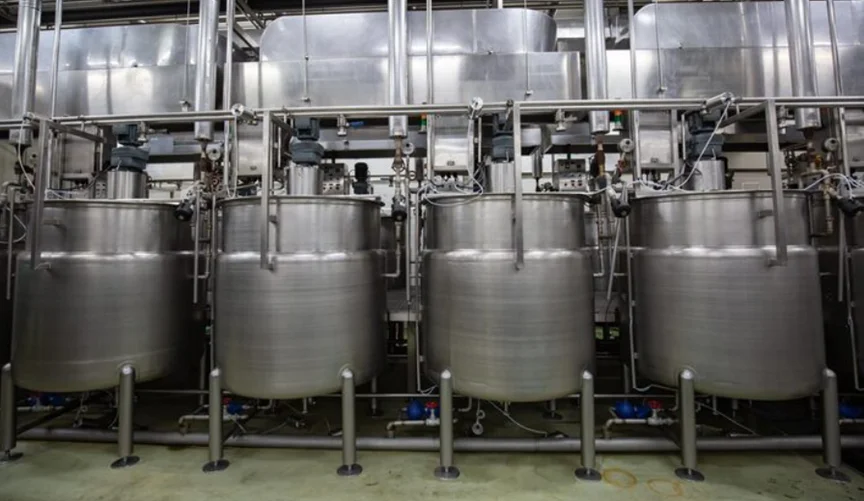
Operating out of our state-of-the-art production facilities, our expert engineers develop bespoke processing and storage systems tailored to withstand extreme temperatures, specialized clean-in-place (CIP/SIP) thermal cycles, and corrosive chemical environments. From initial structural modeling to rigorous non-destructive testing (NDT), every custom-engineered vessel is built strictly to comply with European PED 2014/68/EU and UNI standards, alongside international ASME Section VIII and API codes.
By integrating elite raw materials like certified 316L stainless steel with ultra-smooth, crevice-free internal surfaces ($R_a le 0.4,mutext{m}$), we eliminate microbial contamination risks while drastically boosting operational efficiency for Italy’s leading food, dairy, and active pharmaceutical ingredient (API) processing facilities.
Whether your operations require jacketed compounding reactors or automated batching systems, we deliver uncompromising reliability backed by comprehensive quality control documentation.
Ready to scale your production standards? Contact our engineering team today to discuss your custom processing requirements.
Frequently Asked Questions (FAQ)
1. What makes Nordstone a leading food and pharmaceutical tank manufacturer in Italy?
Nordstone blends 20 years of industrial engineering experience with advanced fabrication technologies. We do not just build tanks; we deliver custom-engineered, certified process vessels tailored explicitly to the strict safety profiles of the European bio-pharma and food-and-beverage sectors.
2. Which international and local standards do your tanks comply with?
Every sanitary vessel manufactured for the Italian market is engineered in compliance with:
- European Regulations: PED 2014/68/EU, CE marking, and UNI standards.
- Global Design Codes: ASME Section VIII (Div 1), API 650, and API 620.
- Hygienic Guidelines: FDA, cGMP, and 3-A Sanitary Standards. nordstonein.com
3. What grades of stainless steel do you use for hygienic tanks?
We exclusively utilize premium, fully traceable alloys, primarily SS316L (EN 1.4404) for pharmaceutical and high-acid food environments due to its superior pitting corrosion resistance. For standard food-grade applications, SS304 (EN 1.4301) is applied. High-chloride applications can be accommodated with specialized super-alloys like 904L.
4. What internal surface finishes do you provide to prevent contamination?
Surface roughness is a key metric for contamination control. We offer mechanical polishing up to Ra≤0.4μm, which can be followed by advanced electropolishing to achieve a mirror-like, ultra-passive surface layer that prevents cellular adhesion and biofilm development.
5. Do you manufacture jacketed tanks for precise thermal control?
Yes. We custom-engineer jacketed processing vessels featuring dimple jackets, conventional channels, or half-pipe coil profiles. These configurations enable precise heat transfer for pasteurization, fermentation, or chilled storage under high-pressure conditions.
6. Can your tanks handle automated Clean-in-Place (CIP) and Sterilize-in-Place (SIP) protocols?
Absolutely. Our tanks are designed with specialized internal spray balls, sloped or conical bottoms for complete drainage, and zero-dead-leg sanitary fittings. They are fully capable of handling aggressive caustic cleaning cycles and high-temperature steam sterilization (>121∘C) without losing structural integrity.
7. What types of food-grade vessels do you supply in Italy?
Our portfolio covers the entire processing line, including:
- Raw milk holding and dairy storage tanks
- Syrup and liquid concentrate blending vessels
- Jacketed mixing and formulation tanks
- Automated CIP chemical preparation systems
8. What pharmaceutical vessels do you engineer?
We manufacture sterile process hardware for critical applications, including:
- Water for Injection (WFI) storage and distribution tanks
- Active Pharmaceutical Ingredient (API) compounding reactors
- Bioreactor vessels and fermentation units
- Media preparation and sterile holding tanks
9. What testing and quality control procedures do you perform?
Every vessel undergoes rigorous in-house quality verification before shipping, which includes:
- Hydrostatic and pneumatic pressure testing
- Radiographic testing (RT) or ultrasonic testing (UT) for weld integrity
- Borescope inspection of internal orbital TIG welds
- Surface roughness (Ra) mapping and liquid penetrant testing
10. Do you provide full material traceability and documentation?
Yes. To satisfy strict AIFA (Italian Medicines Agency) and EFSA (European Food Safety Authority) inspections, we supply a comprehensive validation turn-over package. This includes EN 10204 3.1 Material Test Reports (MTRs), weld logs, surface roughness certifications, and IQ/OQ (Installation/Operational Qualification) protocol support.
11. Can Nordstone integrate mixers, agitators, and instrumentation into the tanks?
Yes. We offer fully integrated turn-key process solutions. Our engineers specify and install magnetic mixers, high-shear homogenizers, top or bottom-entering anchor agitators, as well as sanitary instrumentation ports for level, temperature, and pressure sensors.
12. Are your tanks designed to withstand vacuum and high-pressure conditions?
Yes. Leveraging our core background in high-pressure heavy industry (Oil & Gas, Defence), we possess the sophisticated software and welding expertise necessary to design thin-walled sanitary vessels capable of handling full vacuum during SIP cycles or high positive pressures during processing.
13. How do I request a quote or an engineering consultation for a project in Italy?
You can initiate a technical consultation easily by visiting our dedicated portal: Contact Nordstone Italy. Our bilingual application engineers will review your process parameters, space constraints, and regulatory needs to deliver a detailed technical proposal.
14. What is your typical lead time for a custom-built stainless steel tank?
Lead times vary depending on design complexity, raw material availability, and certification protocols. Generally, custom-engineered sanitary tanks range from 8 to 16 weeks from approved technical drawings to final factory acceptance testing (FAT).
15. Do you handle delivery and logistical coordination within Italy?
Yes. Nordstone manages secure, code-compliant transport logistics across Italy, including the industrial hubs of Lombardy, Lazio, Piedmont, and Emilia-Romagna. All vessels are securely cradled, packed, and shipped under strict environmental protection standards to guarantee they arrive at your plant dock in pristine, factory-tested condition.