As an established pioneer in heavy industrial fabrication, Nordstone stands at the forefront of premier thermal oil heaters manufacturers in italy, delivering robust, high-performance organic fluid thermal systems for high-temperature process applications. Engineered to operate at temperatures up to 350°C and beyond under low system pressures, our industrial thermal fluid heaters provide critical utility lines for sectors where traditional steam systems fall short—including chemical processing, plastic extrusion, textile manufacturing, marine bunkering, and Oil & Gas refining.
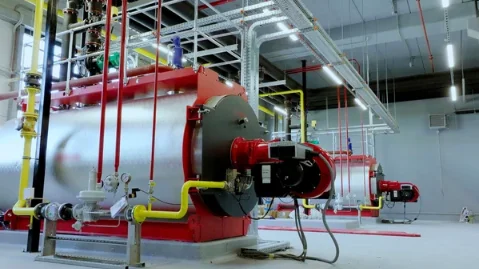
Drawing on over 20 years of expert engineering experience, our team specializes in the precise mechanical and thermodynamic design of multi-pass helical coil heaters optimized for uniform heat flux, maximum thermal efficiency, and zero fluid degradation.
Our state-of-the-art manufacturing facility combines advanced welding automation with premium metallurgy to construct heavy-duty heater bodies that eliminate thermal expansion stress and withstand severe environmental conditions.
Every thermal fluid package is engineered as a highly integrated modular skid, unifying the primary heating coil, multi-stage circulating pumps, expansion tanks, and smart automation panels for rapid, seamless plug-and-play field installation. By maintaining uncompromising compliance with critical international and European engineering benchmarks—including ASME Section VIII, EN 13445, DIN 4754, CE marking, and the European Pressure Equipment Directive (PED 2014/68/EU)—Nordstone guarantees unmatched structural longevity, minimal operational risk, and absolute safety for Italy’s most complex industrial thermal operations.
To collaborate with our senior thermodynamic engineering team on your custom fluid parameters or to request a detailed technical proposal, please visit our contact page.
Technical FAQ (Top 15)
Q1: What is a thermal oil heater and what are its core advantages over a steam boiler?
A thermal oil heater (or organic fluid heater) circulates a specialized synthetic or mineral-based thermal fluid instead of water. The primary advantage is its ability to reach very high process temperatures (up to 350°C or more) while remaining at near-atmospheric pressures. This completely eliminates the high-pressure safety risks, water treatment expenses, and corrosion issues associated with high-temperature steam boilers.
Q2: Which industrial certification codes govern your thermal oil heaters in Italy?
All Nordstone thermal fluid heating systems are engineered to meet global safety mandates. For projects in Italy and across Europe, our equipment carries the CE marking in strict compliance with the Pressure Equipment Directive (PED 2014/68/EU) and European standard EN 13445, alongside specific design alignments with DIN 4754 (Heat transfer installations with organic fluids) and ASME Section VIII regulations.
Q3: What burner and fuel configurations are available for your thermal fluid heaters?
Our heaters feature highly versatile, multi-fuel industrial burner configurations. They can be engineered to run on standard natural gas, liquefied petroleum gas (LPG), or heavy fuel oils. We also design custom systems optimized for sustainable alternative fuels, including biogas and green hydrogen blending, ensuring alignment with European decarbonization goals.
Q4: How does Nordstone prevent thermal oil degradation (cracking) within the system?
Fluid degradation typically occurs when the oil is subjected to localized overheating or low velocities. Our engineering team utilizes advanced Computational Fluid Dynamics (CFD) to design precise multi-pass helical coil configurations that ensure high fluid velocity and a uniform heat flux rate, keeping film temperatures safely below the oil’s thermal cracking limit.
Q5: Can your thermal oil heaters be delivered as fully integrated, turnkey modular skids?
Yes. Every system is engineered and shipped as a highly integrated modular skid. The turnkey package unifies the heater body with high-temperature circulating pumps (featuring mechanical seals or magnetic drives), a nitrogen-blanketed expansion tank, deaeration loops, control valves, and centralized automated control panels.
Q6: What materials are utilized in the fabrication of the heating coils?
We work exclusively with certified, high-grade seamless pressure tubes (such as ASTM A106 Grade B or European P235GH equivalents) rated specifically for high-temperature service. For aggressive process chemicals or severe external environments, product paths can be reinforced with premium stainless steel or specialized alloy options.
Q7: Are your thermal oil heating systems certified for deployment in explosive or ATEX-rated zones?
Absolutely. Drawing on our deep engineering history in the defense and petrochemical sectors, we routinely manufacture fully ATEX-certified thermal oil components for Zone 1 and Zone 2 hazardous locations. This includes integrating explosion-proof electrical enclosures (Ex d), intrinsically safe loops (Ex i), and flameproof field instrumentation.
Q8: What type of automated safety mechanisms are built into the control panels?
To protect the system and personnel, our control loops feature redundant safety interlocks. The automated system continuously monitors oil flow rate, inlet/outlet fluid temperatures, stack exhaust temperatures, and expansion tank levels, executing an instantaneous burner shutdown if any parameter steps outside safe operational boundaries.
Q9: Can Nordstone thermal fluid heaters handle dual-circuit heating and cooling processes?
Yes. For industries requiring precise temperature transitions, such as pharmaceutical or chemical batch reactors, we design custom multi-loop thermal oil skids equipped with secondary heat exchangers. These allow a single system to provide both high-temperature heating and rapid controlled cooling to separate zones simultaneously.
Q10: What non-destructive testing (NDT) protocols are implemented during fabrication?
In strict adherence to our ISO 9001 quality systems, all structural and pressure welds undergo exhaustive NDT tracking. This includes 100% Radiographic Testing (RT), Ultrasonic Testing (UT), and Magnetic Particle Testing (MT). Every completed heating coil undergoes a witnessed hydrostatic pressure test up to 1.5 times its design pressure boundaries.
Q11: How do your control systems interface with an existing plant-wide SCADA or DCS network?
Our automated control panels are engineered with open-architecture PLCs (such as Siemens or Rockwell Automation platforms). We configure the communication layers to native industrial protocols like Modbus TCP, Profinet, or Ethernet/IP, providing your central control room with full real-time telemetry, oil condition metrics, and safety alarm logging.
Q12: Do you offer Factory Acceptance Testing (FAT) at your facility in Italy?
Yes. Every thermal oil heater undergoes rigid Factory Acceptance Testing prior to shipment. Your engineering representatives or designated third-party inspection bodies are given complete facility access to witness electrical loop testing, PLC logic validation, safety interlock trips, and hydrostatic integrity checks.
Q13: Which third-party inspection and classification societies do you regularly partner with?
We regularly coordinate our materials traceability, weld validation records, and safety compliance logs with premier classification bodies active in the European market, including RINA, Bureau Veritas, TÜV, and Lloyd’s Register.
Q14: What baseline data does your team require to draft a precise technical proposal?
To compile an accurate engineering proposal, please supply your required thermal capacity (in kW or MW), desired operating temperature, specific type of thermal fluid being used, available fuel source, space or footprint limits, and the necessary area electrical classification.
Q15: How can a facility engineer or procurement manager initiate a thermal oil heater project?
You can securely upload your request for proposal (RFP), piping and instrumentation diagrams (P&IDs), or technical equipment data sheets through our corporate interface. To establish an initial technical consultation with our senior thermal engineers, please connect with us directly via our contact page.