Sibur Approved Process Skid Suppliers: What the Standard Really Requires
Sibur is Russia’s largest integrated petrochemical company, operating a network of production complexes spanning polymers, synthetic rubber, and other petrochemical products. When a project’s process skids are ultimately destined for a Sibur-linked facility, “approved supplier” isn’t a marketing phrase — it’s a specific, audited status the client grants to individual manufacturers after a formal qualification process. For procurement and engineering teams in Italy researching this topic, understanding what that process actually involves is far more useful than searching for a badge.
This article explains what Sibur vendor approval covers and the engineering baseline it’s historically been built on. It does not constitute guidance on whether such a relationship is currently permissible.
An Important Compliance Note
Sibur and its subsidiaries are currently subject to extensive sanctions and export control restrictions imposed by the European Union, the United Kingdom, the United States, and other jurisdictions in connection with Russia’s energy and petrochemical sectors. These measures are broad, have changed multiple times, and continue to evolve. Any Italian or EU-based company considering a vendor relationship connected to Sibur must review current EU sanctions regulations and consult qualified legal counsel before any commercial engagement — this is not a step that can be skipped or assumed away. Nothing in this article should be read as encouraging or facilitating a transaction with a sanctioned entity.
What Sibur Vendor Approval Historically Meant
Sibur and its subsidiary operating companies have maintained their own vendor qualification processes, which typically involve a detailed audit of a manufacturer’s quality management system, welding and piping fabrication procedures, material control, non-destructive testing capability, and documented fabrication and integration history. That audit is typically carried out by the client’s own engineering and inspection teams or a third-party inspection agency acting on its behalf, and the resulting approval is specific to the manufacturer.
Because this status is granted directly by the client to a named manufacturer, it isn’t something any supplier can claim without going through that process.
The General Engineering Baseline for This Equipment Category
Independent of any specific end client, the technical requirements that generally underpin process skid manufacturing at this grade include:
Design Codes
ASME B31.3 for process piping and ASME Section VIII for any integrated pressure vessels are commonly used reference codes, with client engineering standards and process licensor requirements layered on top for project-specific requirements.
Material Traceability
Full mill test certificates and heat-number traceability for structural steel, piping, and pressure-retaining components, carried through to the finished, integrated skid.
Structural and Piping Design
Skid frame design that accounts for lifting, transport, and seismic loading, combined with piping stress analysis to account for thermal expansion and vibration across the integrated system.
Welding Procedure Qualification
WPS and PQR documentation for both structural and piping welds, with welders individually qualified under ASME Section IX.
Non-Destructive Testing
Radiographic or ultrasonic testing of piping welds, magnetic particle testing of structural welds, and visual inspection of all fabricated joints.
Hydrostatic and Functional Testing
A full hydrostatic test of piping and integrated pressure equipment, followed by functional testing of instrumentation, controls, and rotating equipment before dispatch.
Third-Party Inspection
Hold-point sign-off from an accredited inspection body such as Lloyd’s Register, Bureau Veritas, TÜV, or DNV at critical stages of fabrication and final testing.
Where Notdstone Fits
Notdstone manufactures customized process skids for demanding petrochemical applications, serving Italy, the GCC, and international markets, with more than three decades of engineering experience across the team. We are not claiming, and do not hold, any Sibur vendor approval status. What we can speak to with confidence is the engineering rigor our process skids are built to on every project we undertake, subject to all applicable trade compliance requirements.
Equipment Built to That Standard
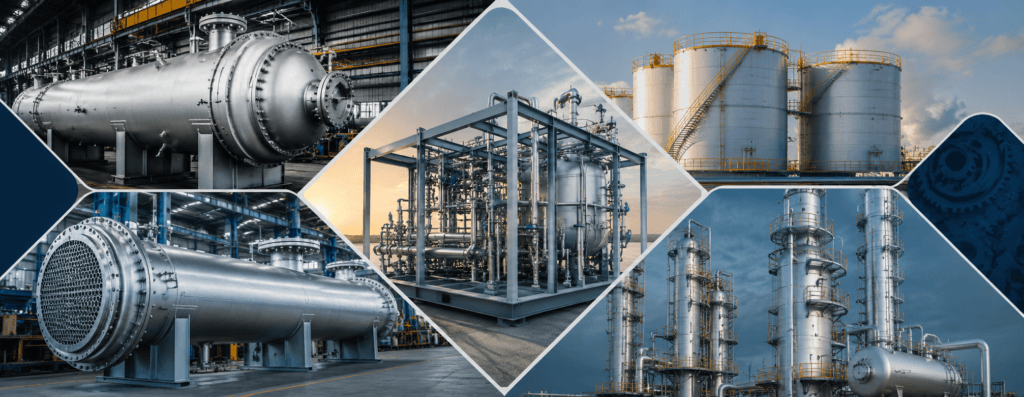
Pressure Vessels
ASME Section VIII-compliant vessels engineered for safe containment under demanding pressure and temperature conditions.
Heat Exchangers
TEMA-designed shell-and-tube units for heating, cooling, condensation, and energy recovery.
Storage Tanks
API 650/620-referenced tanks for liquids, gases, chemicals, and petroleum products.
Columns
Distillation, absorption, and stripping columns engineered for process efficiency in chemical and petrochemical service.
Reactors
Custom-engineered reactors for controlled chemical processing and reaction management.
Process Skids
Factory-assembled modular skids integrating vessels, pumps, piping, and instrumentation to compress site installation time.
FAQWhat does “Sibur approved” mean for a process skid supplier?
Historically, it meant the manufacturer had been formally audited and accepted by Sibur or one of its subsidiaries, covering their quality system, fabrication procedures, and testing capability. Current sanctions significantly restrict new vendor relationships with Sibur entities — verify applicable EU, UK, and US restrictions before pursuing any such relationship.
Can a manufacturer supply Sibur-linked process skids today?
Any such arrangement must be assessed against current EU sanctions regulations, UK and US export controls, and other applicable trade restrictions before proceeding. This determination requires qualified legal advice and cannot be answered generically.
What design code generally applies to process skids in this class?
ASME B31.3 commonly governs the process piping, with ASME Section VIII applied to any integrated pressure vessels.
How can I verify a supplier’s vendor-approval claim?
Ask for written confirmation of the approval status and its exact scope, and independently verify the supplier’s current sanctions compliance status rather than relying on a general claim.
Working With Notdstone
If your project requires process skids engineered and fabricated under documented quality control — for projects and counterparties consistent with applicable trade compliance requirements — our engineering team can review your process requirements and provide a project-specific proposal. Get in touch with Notdstone to discuss your requirements.
Get In Touch
Recent Posts