SABIC Approved Pressure Vessel Suppliers: A Buyer’s Guide to the Real Standard
Pressure vessels feeding into SABIC’s petrochemical facilities have to hold up under sustained high-pressure, high-temperature, and often corrosive process conditions. For Italian buyers researching pressure vessel manufacturers for SABIC-linked projects, it’s worth understanding exactly what “approved supplier” involves before shortlisting anyone on the strength of the phrase alone.
What SABIC Vendor Approval Actually Means
SABIC operates its own vendor qualification program. Getting listed involves a direct audit of a manufacturer’s quality management system, welding and fabrication procedures, material control, and prior project performance — typically carried out by SABIC’s own engineering and inspection teams, or an accredited third-party inspection agency acting on SABIC’s behalf. That approval is issued to the specific, audited manufacturer.
Because the status is granted directly by SABIC after its own review, it isn’t something a supplier can claim without going through that process. What buyers can reasonably assess before a formal audit is whether a manufacturer’s pressure vessel engineering and fabrication practices already meet the level SABIC expects.
What Goes Into a SABIC-Grade Pressure Vessel
The technical requirements behind SABIC-grade pressure vessel fabrication are consistent with the broader petrochemical industry standard:
- Design code — ASME Section VIII (Div. 1/2), the primary reference for pressure-retaining vessel design across chemical and petrochemical service.
- Material selection — Super-Duplex, Hastelloy, or Titanium construction for vessels handling corrosive process streams, sour service, or elevated operating temperatures.
- Material traceability — full mill test certificates and heat-number traceability from raw plate through the finished, welded vessel.
- Welding qualification — WPS and PQR documentation, with welders individually qualified under ASME Section IX.
- Non-destructive testing — radiographic and ultrasonic examination of pressure-boundary welds, plus magnetic particle or dye-penetrant testing where specified.
- Hydrostatic and high-pressure testing — every vessel pressure-tested to code before it leaves the shop floor.
- Third-party inspection — hold-point sign-off from an accredited body such as Lloyd’s Register, Bureau Veritas, TÜV, or DNV at critical stages of fabrication.
- Precision CNC machining — for flanges, nozzles, and other pressure-boundary components requiring tight dimensional tolerances.
A manufacturer that applies this level of control as standard practice — not only on jobs earmarked for a named client — is generally the one equipped to pass a formal SABIC vendor audit when the opportunity arises.
Where Notdstone Fits
Notdstone designs and manufactures pressure vessels for industrial applications requiring safe containment under pressure, backed by more than three decades of engineering experience, API/ASME/ISO certification, and specialist capability in Super-Duplex, Hastelloy, and Titanium fabrication. Every vessel is built under a zero-defect quality philosophy, supported by an in-house R&D team for custom engineering requirements.
To be transparent with buyers researching this topic: formal SABIC vendor approval is issued directly by SABIC to specific, audited manufacturers, and we’re not claiming that status here. What we can speak to with confidence is the engineering discipline behind every vessel we build.
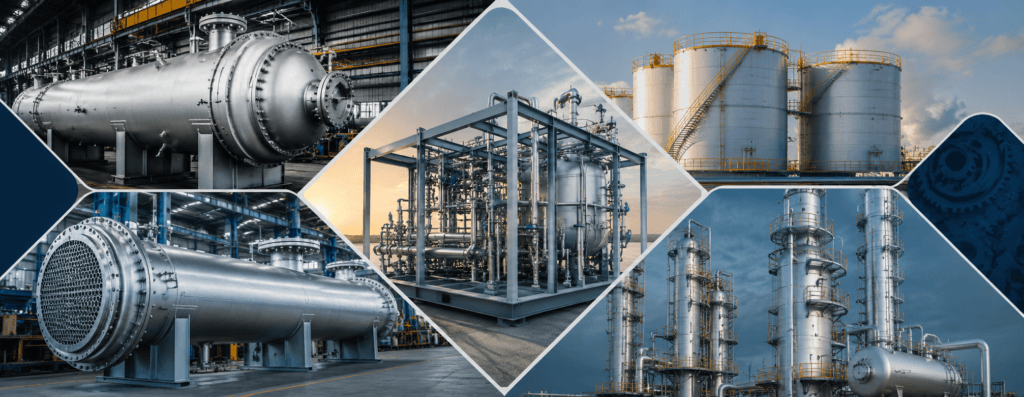
Equipment Built to That Standard
Pressure Vessels
ASME Section VIII-compliant vessels engineered for safe containment under demanding pressure and temperature conditions.
Heat Exchangers
TEMA-designed shell-and-tube units for heating, cooling, condensation, and energy recovery.
Storage Tanks
API 650/620-referenced tanks for liquids, gases, chemicals, and petroleum products.
Columns
Distillation, absorption, and stripping columns engineered for process efficiency in chemical and petrochemical service.
Reactors
Custom-engineered reactors for controlled chemical processing and reaction management.
Process Skids
Factory-assembled modular skids integrating vessels, pumps, piping, and instrumentation to compress site installation time.
FAQ:
1. What does SABIC vendor approval cover for pressure vessels?
The manufacturer’s quality management system, welding procedures, material control, and testing capability, verified through a direct SABIC or third-party audit.
2. What design code governs SABIC-linked pressure vessels?
ASME Section VIII (Division 1 or 2) is the primary reference code for petrochemical service.
3. Do these vessels need exotic materials?
Frequently — corrosive or high-temperature petrochemical processes often call for Super-Duplex, Hastelloy, or Titanium.
4. What testing is required before dispatch?
Non-destructive testing of pressure-boundary welds followed by hydrostatic or pneumatic pressure testing to code.
5. Can an Italian manufacturer supply pressure vessels into SABIC-linked projects?
Yes, provided code compliance, material traceability, and inspection arrangements meet the technical specification.
Working With Notdstone
If your project requires pressure vessels engineered to international codes, built in demanding materials, and manufactured under documented quality control, our engineering team can review your process requirements and provide a project-specific proposal. Get in touch with Notdstone to discuss your specifications.