Niger Delta Petroleum Resources Approved Pressure Vessel Suppliers: What the Standard Really Requires
Niger Delta Petroleum Resources Limited (NDPR), a subsidiary of Niger Delta Exploration & Production Plc, operates the Ogbele modular refinery near Ahoada in Rivers State, Nigeria — the only privately held refinery in the country. Commissioned in 2012 as a 1,000-barrel-per-day diesel topping plant, the facility was later expanded to roughly 11,000 barrels per day to add kerosene, marine diesel oil, heavy fuel oil, and premium motor spirit (gasoline) to its original diesel-only slate. That expansion, like the original plant, was built around a set of pressure-containing process units — distillation columns, separators, reboilers, and reactors, all mounted on or fed by pressure vessels — which is why "approved supplier" status for pressure vessel fabrication is a specific, audited designation rather than a claim any manufacturer can make on its own. It's granted by NDPR or its EPC/modular-package contractor to individual fabricators after a formal qualification process.
For procurement and engineering teams in Italy sourcing pressure vessels for modular refinery projects of this kind, understanding what that qualification process actually covers is far more useful than searching for a badge. This article explains what NDPR-linked pressure vessel vendor approval involves, the engineering baseline behind it, and what to look for when qualifying a manufacturer for NDPR-linked or NDPR-grade vessel packages.
What NDPR Vendor Approval Actually Means
Vendor qualification for pressure vessel fabrication on a modular refinery typically involves a detailed audit of a manufacturer's quality management system, plate-rolling and shell/head fabrication practices, welding procedures, material control, heat-treatment capability, and prior track record delivering vessels that pass hydrostatic testing and third-party code inspection without rework. That audit is usually carried out by the plant owner's engineering and inspection function, or by a third-party inspection agency or modular-package contractor acting on its behalf, and the resulting approval is specific to the named manufacturer.
Because this status is granted directly by NDPR or its contractor, it isn't something a supplier can claim by general reputation. What buyers can reasonably assess before any formal audit is whether a manufacturer's design, fabrication, and testing practices are already built to the standard that modular refinery pressure equipment demands.
The Engineering Baseline Behind NDPR-Grade Pressure Vessels
A pressure vessel destined for a modular refinery process train has to handle the specified hydrocarbon service reliably for the life of the plant, while being sized and detailed for transport and rigging onto a compact, phased-capacity site. The requirements behind NDPR-grade vessel fabrication reflect that combination:
Design Codes
ASME Section VIII, Division 1 (or Division 2 where the design pressure and thickness call for it) governs vessel design, with nozzle orientation, support design, and lifting-lug placement engineered around the specific unit — separator, reboiler, reactor, or knock-out drum — the vessel serves.
Material Traceability
Full mill test certificates and heat-number traceability for shell, head, and nozzle material, carried through cutting, forming, and welding, and into the as-built data package and manufacturer's data report (MDR) delivered with the vessel.
Design for Service Conditions
Wall thickness, corrosion allowance, and internals (baffles, demister pads, distributor trays) sized for the specified pressure, temperature, and hydrocarbon stream, with nozzle schedules coordinated against the piping and skid layout the vessel will tie into.
Welding Procedure Qualification
WPS and PQR documentation covering longitudinal and circumferential shell welds, head-to-shell welds, and nozzle attachment welds, with welders individually qualified under ASME Section IX and post-weld heat treatment applied where the material or thickness requires it.
Non-Destructive Testing
Radiographic testing of pressure-boundary welds, ultrasonic testing where specified, and dye penetrant or magnetic particle testing of nozzle welds and other critical joints, all completed before the vessel is prepared for hydrostatic testing.
Hydrostatic Testing
Hydrostatic testing of the completed vessel to the design test pressure, held for the specified duration, with results recorded on the manufacturer's data report ahead of final stamping and paint/coating.
Third-Party Inspection
Hold-point sign-off from an accredited inspection body such as Lloyd's Register, Bureau Veritas, TÜV, or DNV at critical stages — material receipt, weld completion, and hydrotest — giving the end client independent verification that the completed vessel matches its design package before it ships.
A manufacturer applying this level of control as standard practice — not only when a named end client is involved — is generally the one positioned to succeed if and when a formal NDPR-linked audit takes place.
Where Notdstone Fits
Notdstone designs and fabricates pressure vessels and other process equipment for process industries, serving Italy, the GCC, and international markets, with more than three decades of engineering experience across the team. Our fabrication and QA/QC processes are structured around the baseline described above — documented material traceability, ASME IX-qualified welding, comprehensive NDT, and hydrostatic testing before delivery.
To be clear with buyers researching this topic: formal vendor approval with Niger Delta Petroleum Resources Limited is issued directly by NDPR or its appointed contractor to specific manufacturers following its own audit process, and we're not claiming that status here. What we can speak to with confidence is the engineering rigor our pressure vessels are built to on every project.
Equipment Built to That Standard
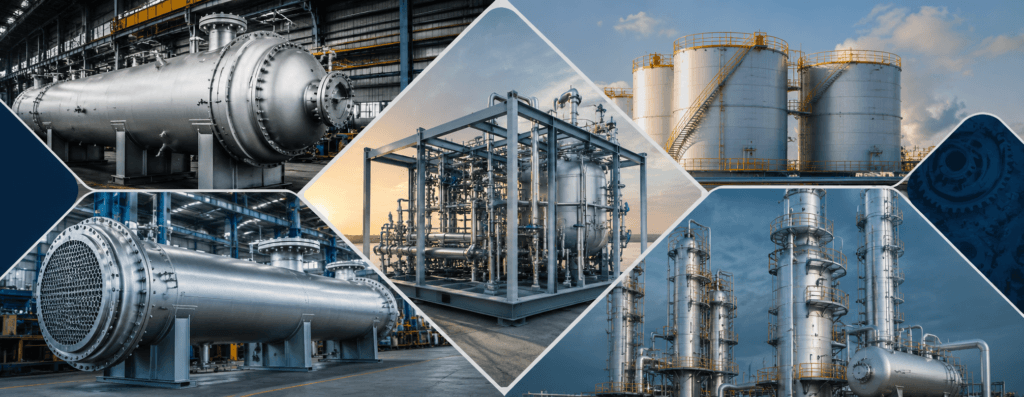
Pressure Vessels
ASME Section VIII-compliant vessels engineered for safe containment under demanding pressure and temperature conditions.
Process Skids
Factory-assembled modular skids integrating vessels, pumps, piping, and instrumentation to compress site installation time.
Reactors
Custom-engineered reactors for controlled chemical processing and reaction management.
Heat Exchangers
TEMA-designed shell-and-tube units for heating, cooling, condensation, and energy recovery.
Storage Tanks
API 650/620-referenced tanks for liquids, gases, chemicals, and petroleum products.
Columns
Distillation, absorption, and stripping columns engineered for process efficiency in chemical and petrochemical service.
FAQWhat does "NDPR approved" mean for a pressure vessel supplier?
It means the manufacturer has been formally audited and accepted by Niger Delta Petroleum Resources or its appointed contractor, covering their design, fabrication, and testing capability for pressure vessel packages.
What design codes apply to pressure vessels on NDPR-linked projects?
ASME Section VIII, Division 1 or 2, applies to the vessel design itself, with the supporting saddles or skirt engineered for the vessel's operating loads and the transport route to the Ogbele site.
How is a modular refinery vessel different from one supplied for a large fixed refinery?
A modular refinery vessel typically has to fit within tighter skid or module envelopes and phased-expansion sequencing, so nozzle layout, support design, and delivery scheduling need closer coordination with the surrounding units than on a large fixed-refinery project.
Can a manufacturer outside Nigeria supply NDPR-linked pressure vessels?
Yes, provided their code compliance, material traceability, and third-party inspection arrangements meet the project specification, and export and transport logistics support delivery of the completed vessel to the Ogbele site in Rivers State.
How can I verify a supplier's vendor-approval claim?
Ask for written confirmation of the approval status and its exact scope — which vessel categories and design codes it covers — rather than relying on a general claim.
Working With Notdstone
If your project requires pressure vessels engineered to ASME standards and manufactured under documented quality control, our engineering team can review your process requirements and provide a project-specific proposal. Get in touch with Notdstone to discuss your requirements.
Get In Touch
Recent Posts