Engie Approved Heat Exchanger Suppliers: What the Standard Really Requires
ENGIE is the third-largest district heating operator in Italy, managing 14 active networks across the country, including four in Lombardy — Lonato del Garda, Segrate, Cinisello Balsamo, and Corsico. In late 2025, ENGIE acquired the Corsico cogeneration plant on the outskirts of Milan, becoming the sole operator of the town's district heating system through vertical integration of production and distribution. The 16.5 MW cogeneration unit there is powered 70% by residual heat recovered from the furnace of the nearby Verallia glassworks, with water heated to 110°C piped over to the plant and fed into the district heating network. ENGIE Italia runs similar heat-recovery cogeneration schemes elsewhere in the country, including a 6.5 MW electrical / 42 MW thermal plant at the Alcantara production site in Nera Montoro, Terni, and a cogeneration plant in Leinì supplying 440 GWh of thermal energy a year into Turin's district heating network. Every one of these schemes depends on heat exchangers to move thermal energy safely and efficiently between the industrial waste-heat source, the cogeneration cycle, and the distribution network — which is why "approved supplier" status for heat exchanger fabrication is a specific, audited designation rather than a claim any manufacturer can make on its own. It's granted by ENGIE or its EPC/engineering contractor to individual fabricators after a formal qualification process.
For procurement and engineering teams in Italy sourcing heat exchangers for cogeneration and district heating projects of this kind, understanding what that qualification process actually covers is far more useful than searching for a badge. This article explains what ENGIE-linked heat exchanger vendor approval involves, the engineering baseline behind it, and what to look for when qualifying a manufacturer for ENGIE-linked or ENGIE-grade exchanger packages.
What ENGIE Vendor Approval Actually Means
Vendor qualification for heat exchanger fabrication on a cogeneration or district heating project typically involves a detailed audit of a manufacturer's quality management system, tube-bundle and shell fabrication practices, welding and tube-to-tubesheet joint procedures, material control, and prior track record delivering exchangers that pass hydrostatic and tube-side leak testing without rework. That audit is usually carried out by the plant owner's engineering and inspection function, or by a third-party inspection agency or EPC contractor acting on its behalf, and the resulting approval is specific to the named manufacturer.
Because this status is granted directly by ENGIE or its contractor, it isn't something a supplier can claim by general reputation. What buyers can reasonably assess before any formal audit is whether a manufacturer's design, fabrication, and testing practices are already built to the standard that cogeneration and district heating heat-transfer equipment demands.
The Engineering Baseline Behind ENGIE-Grade Heat Exchangers
A heat exchanger destined for a cogeneration plant or district heating substation has to manage two very different duties depending on where it sits in the scheme — recovering waste heat from an industrial partner's process water, as at Corsico and Nera Montoro, or transferring heat from a combined-cycle or cogeneration unit into the primary distribution network — each with its own temperature, fouling, and reliability requirements. The requirements behind ENGIE-grade exchanger fabrication reflect that combination:
Design Codes and Standards
The EU Pressure Equipment Directive (PED) governs pressure-containing exchangers placed on the EU market, with EN 13445 commonly applied to the design of unfired pressure vessels and EN 305/EN 306 referenced for shell-and-tube heat exchanger performance and testing; TEMA and ASME Section VIII are also used where a project specification calls for them.
Material Traceability
Full mill test certificates and heat-number traceability for shell, tube, tubesheet, and channel material, carried through fabrication and into the as-built documentation package and manufacturer's data report delivered with the exchanger, including the EU Declaration of Conformity where PED applies.
Thermal and Mechanical Design for Service Conditions
Tube bundle sizing, baffle configuration, and fouling-factor allowance calculated against the specific duty — industrial waste-heat recovery, cogeneration heat-recovery steam generation, or district heating substation transfer — with shell and channel nozzle layout coordinated against the piping it will connect to.
Tube-to-Tubesheet Joint Qualification
Expanded or welded tube-to-tubesheet joints qualified by procedure and sample testing before production, since this joint is typically the first point of leakage on an in-service exchanger and the one most scrutinised during vendor audits.
Welding Procedure Qualification
WPS and PQR documentation covering shell, channel, and tubesheet welds, with welders individually qualified under EN ISO 9606 or ASME Section IX as specified.
Non-Destructive Testing
Radiographic or ultrasonic testing of pressure-boundary welds, dye penetrant or magnetic particle testing of tubesheet and nozzle welds, and eddy-current or hydrostatic testing of the tube bundle before the exchanger is closed up.
Hydrostatic Testing
Separate hydrostatic testing of the shell side and tube side to their respective design test pressures, with results recorded on the manufacturer's data report ahead of final assembly and coating.
Third-Party Inspection
Hold-point sign-off from an accredited inspection body such as TÜV, Bureau Veritas, Lloyd's Register, or DNV at critical stages — material receipt, tube bundle assembly, and hydrotest — giving the end client independent verification that the completed exchanger matches its design package before it ships, including notified-body involvement where PED categorisation requires it.
A manufacturer applying this level of control as standard practice — not only when a named end client is involved — is generally the one positioned to succeed if and when a formal ENGIE-linked audit takes place.
Where Notdstone Fits
Notdstone designs and fabricates heat exchangers and other process equipment for process industries, serving Italy, the GCC, and international markets, with more than three decades of engineering experience across the team. Our fabrication and QA/QC processes are structured around the baseline described above — documented material traceability, code-qualified welding, comprehensive NDT, and hydrostatic testing before delivery.
To be clear with buyers researching this topic: formal vendor approval with ENGIE is issued directly by ENGIE or its appointed contractor to specific manufacturers following its own audit process, and we're not claiming that status here. What we can speak to with confidence is the engineering rigor our heat exchangers are built to on every project.
Equipment Built to That Standard
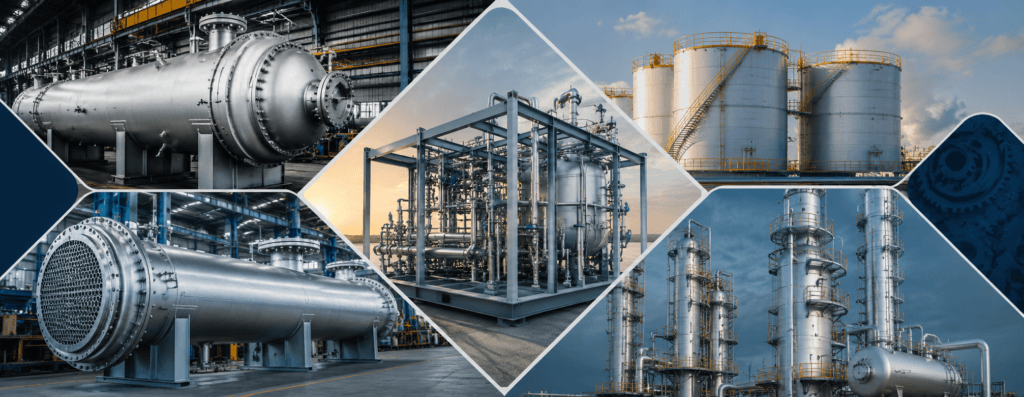
Heat Exchangers
TEMA-designed shell-and-tube units for heating, cooling, condensation, and energy recovery.
Pressure Vessels
ASME Section VIII-compliant vessels engineered for safe containment under demanding pressure and temperature conditions.
Process Skids
Factory-assembled modular skids integrating vessels, pumps, piping, and instrumentation to compress site installation time.
Storage Tanks
API 650/620-referenced tanks for liquids, gases, chemicals, and petroleum products.
Columns
Distillation, absorption, and stripping columns engineered for process efficiency in chemical and petrochemical service.
Reactors
Custom-engineered reactors for controlled chemical processing and reaction management.
FAQWhat does "ENGIE approved" mean for a heat exchanger supplier?
It means the manufacturer has been formally audited and accepted by ENGIE or its appointed contractor, covering their design, fabrication, and testing capability for heat exchanger packages.
What design codes apply to heat exchangers on ENGIE-linked projects in Italy?
The EU Pressure Equipment Directive governs pressure-containing exchangers placed on the EU market, with EN 13445 and EN 305/EN 306 commonly applied to design and performance, and TEMA or ASME Section VIII used where a project specification calls for them.
How is a heat exchanger for industrial waste-heat recovery different from one used in a standard cogeneration cycle?
A waste-heat recovery exchanger, like the one recovering furnace heat from a glassworks or similar industrial partner, has to be designed around the host process's variable temperature and fouling characteristics rather than a clean utility stream, while a cogeneration-cycle exchanger typically works with more consistent, better-characterised process conditions.
Can a manufacturer outside Italy supply ENGIE-linked heat exchangers?
Yes, provided their code compliance, material traceability, and third-party inspection arrangements meet the project specification, and export and transport logistics support delivery of the completed exchanger to the relevant ENGIE cogeneration or district heating site.
How can I verify a supplier's vendor-approval claim?
Ask for written confirmation of the approval status and its exact scope — which exchanger types and standards it covers — rather than relying on a general claim.
Working With Notdstone
If your project requires heat exchangers engineered to European and international standards and manufactured under documented quality control, our engineering team can review your process requirements and provide a project-specific proposal. Get in touch with Notdstone to discuss your requirements.
Get In Touch
Recent Posts