As an established pioneer in heavy industrial fabrication and pressure containment, Nordstone stands at the forefront of premier safety & relief valves manufacturers in italy, engineering advanced overpressure protection solutions for high-stakes oil and gas, defense, power generation, and metallurgical operations.
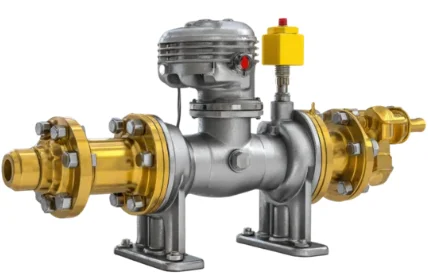
Designed to provide instantaneous, fail-safe thermal and pneumatic pressure relief within volatile process loops, our heavy-duty valve configurations protect upstream industrial vessels and downstream pipelines from catastrophic overpressurization events.
Drawing on over 20 years of expert engineering experience, our team specializes in the detailed mechanical design, spring-rate optimization, and precise calibration of critical overpressure mitigation assemblies—including pilot-operated safety valves, conventional direct-spring relief configurations, bellows-sealed balance valves, and high-capacity thermal expansion relief blocks optimized to maintain absolute tightness up to set-point thresholds.
Our state-of-the-art manufacturing facility utilizes advanced automated machining and premium certified metallurgy to construct durable valve bodies, nozzles, and discs that resist thermal distortion, mechanical galling, and aggressive chemical corrosion. Every specialized pressure relief package is engineered with high-precision internal guiding components, specialized erosion-resistant hard facings, and extensive body wall thicknesses capable of managing extreme flashing and fluid velocities during discharge cycles. By maintaining uncompromising compliance with critical international and European engineering benchmarks—including API 520/526, ASME Section VIII Division 1, ISO 4126, CE marking, and the European Pressure Equipment Directive (PED 2014/68/EU)—Nordstone guarantees unmatched structural longevity, certified flow capacities, and absolute operational reliability for Italy’s vital industrial processing and energy recovery networks.
To collaborate with our senior overpressure protection and flow control engineering team on your custom safety or relief valve parameters, please visit our contact page.
Technical FAQ (Top 15)
Q1: What is the fundamental operational difference between a safety valve and a relief valve?
The primary distinction lies in the opening characteristic and the handled fluid medium. A safety valve is an overpressure protection device characterized by rapid, full-opening pop action, typically deployed in compressible fluid vapor or gas systems (like steam, air, or hydrocarbon gases). A relief valve opens progressively in proportion to the systemic overpressure, making it ideal for incompressible liquid processing loops.
Q2: What major manufacturing codes and international safety certifications govern your valves in Italy?
All Nordstone overpressure protection systems are engineered to meet rigid global safety mandates. For projects in Italy and across Europe, our equipment carries the CE marking in strict compliance with the Pressure Equipment Directive (PED 2014/68/EU) and international standard ISO 4126 (Safety devices for protection against excessive pressure), alongside technical alignments with ASME Section VIII and API 520/526 design guidelines.
Q3: When should a balanced bellows design be selected over a conventional spring-loaded safety valve?
A balanced bellows configuration is critical when a valve discharges into a closed header system where variable backpressure exists. The bellows isolates the guide, spring, and upper stem from the process fluid while mechanically neutralizing the effect of backpressure on the valve’s set pressure, ensuring consistent popping accuracy.
Q4: How does Nordstone prevent seat leakage in safety valves operating close to the system set pressure?
To guarantee absolute tight shut-off up to the popping threshold, we precision-lap our metallic sealing discs and nozzles to an optical flatness measured in light bands. Additionally, for severe-service or micro-leakage applications, we can implement automated hard-facing weld overlays (such as Stellite) or incorporate high-performance resilient soft seats compliant with API standard seat tightness.
Q5: What metallurgy is utilized for safety valves handling highly corrosive or high-temperature media?
We work exclusively with certified, high-tensile pressure steels (such as WCB carbon steel or LCB/LCC low-temperature alloys). For highly corrosive, cryogenic, or high-temperature lines, our valve bodies, nozzles, and internal trim are manufactured from premium stainless steel alloys (316L, Duplex, Super Duplex, or exotic Monel and Hastelloy configurations).
Q6: Can your safety and relief valves be deployed in explosive, ATEX-rated plant zones?
Absolutely. Because relief valves frequently vent volatile, combustible gases or are installed within hazardous petrochemical environments, all integrated instrumentation—such as pneumatic or electric lift indicators, limit switches, and remote test transmitters—are fully ATEX-certified for Zone 1 and Zone 2 hazardous areas.
Q7: What is the role of a pilot-operated safety valve (POSV) in high-pressure vessel systems?
A pilot-operated valve utilizes system pressure to hold the main valve disc closed, meaning the seating force increases as the system pressure approaches the set point. This allows plants to operate much closer to the valve’s set pressure without leakage, making POSVs ideal for high-capacity, high-pressure gas applications with narrow operating margins.
Q8: How does Nordstone determine the certified discharge capacity of its relief configurations?
Our relief valve discharge profiles and flow coefficients (Kd) are determined, verified, and certified through rigorous flow testing in accordance with ASME PTC 25 and ISO 4126 testing standards, ensuring that our valves safely vent the exact mass or volumetric fluid totals required by your system’s overpressure scenario calculations.
Q9: How do your valves handle the phenomena of built-up backpressure during a relief cycle?
Built-up backpressure occurs due to fluid flow through the discharge piping after the valve opens. In a conventional valve, built-up backpressure exceeding 10% of the set pressure can cause the valve to chatter or close prematurely. If your piping configuration exhibits high built-up backpressure, we utilize a balanced bellows or pilot-operated architecture to ensure stable lift stability.
Q10: What non-destructive testing (NDT) protocols are implemented during valve manufacturing?
In strict compliance with our ISO 9001 quality infrastructure, all pressure-containing valve castings and structural welds undergo exhaustive NDT tracking. This includes Radiographic Testing (RT) or Ultrasonic Testing (UT) on critical shell sections, Magnetic Particle Testing (MT), and Liquid Penetrant Testing (PT), followed by hydrostatic shell testing and API 527 seat leakage tests.
Q11: Do you offer cryogenic testing for safety valves intended for LNG or cold-storage service?
Yes. For specialized low-temperature and LNG infrastructure projects in Italy, we conduct dedicated cryogenic testing where valves are stabilized at sub-zero temperatures (down to −196∘C) to verify mechanical tracking, spring functionality, structural shrink allowances, and seat sealing performance under severe thermal contraction.
Q12: Do you offer Factory Acceptance Testing (FAT) and witnessed pressure set-point calibration?
Yes. Every single safety and relief valve configuration undergoes rigid Factory Acceptance Testing prior to leaving our facility. Your engineering representatives or designated third-party inspection bodies are given full access to witness dimensional verification, shell hydro-testing, exact pressure set-point lifting calibration, and seat tightness verification.
Q13: Which third-party inspection and classification societies do you regularly partner with?
We regularly coordinate our material traceability logs, welding procedure qualifications (WPQR), and final safety certifications with leading notified bodies active in the European heavy industrial sector, including RINA, Bureau Veritas, and TÜV.
Q14: What baseline engineering data does your team require to calculate a precise safety valve model?
To compile an accurate technical calculation and proposal, please supply the fluid medium name and physical state, required relieving capacity, design/operating pressures and temperatures, requested set pressure, expected overpressure percentage, variable/built-up backpressures, and preferred inlet/outlet flange ratings (ANSI/ASME or EN).
Q15: How can a procurement manager or pressure vessel engineer initiate a project with Nordstone?
You can securely upload your process datasheets, safety relief loop requirements, or piping layout coordinates through our secure corporate interface. To arrange an initial technical consultation with our senior overpressure protection and flow control engineers, please connect with us directly via our contact page.