As an established pioneer in heavy industrial fabrication, Nordstone stands at the forefront of premier high-temperature & refractory-lined valves – bfg systems manufacturers in italy, delivering highly specialized, thermal-barrier flow control solutions for critical ironmaking and energy recovery infrastructures. Engineered to manage the severe, uncooled gas streams exiting the blast furnace top, our robust valve configurations are designed to withstand extreme thermal gradients, aggressive carbon monoxide corrosion, and intense particulate abrasion.
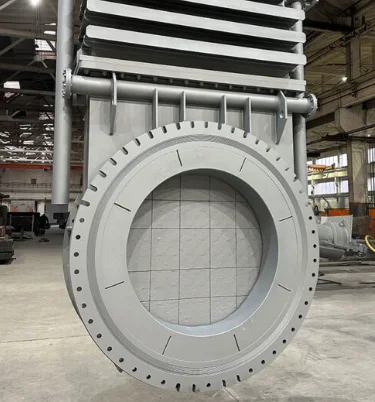
Drawing on over 20 years of expert engineering experience, our team specializes in the precise structural design and custom manufacturing of high-stakes blast furnace gas assemblies—including refractory-lined goggle valves, high-exposure butterfly control blocks, hot gas equalization units, and emergency bleed valves optimized to maintain absolute tight mechanical shut-off under relentless radiant heat fields.
Our state-of-the-art manufacturing facility combines advanced automated welding with high-density, erosion-resistant refractory anchors and castable linings to construct durable valve bodies and discs that completely eliminate thermal cracking, mechanical warping, and localized shell hotspots.
Every high-temperature valve package is engineered with integrated forced-circulation water cooling manifolds, advanced multi-layered metallic sealing faces, and heavy-duty hydraulic or electric actuation configurations designed for flawless, spark-free plant automation.
By maintaining uncompromising compliance with critical international and European engineering benchmarks—including API 6D, ASME Section VIII, EN 12516, CE marking, and the European Pressure Equipment Directive (PED 2014/68/EU)—Nordstone guarantees unmatched structural longevity, operational safety, and maximum blast furnace uptime for Italy’s vital steel manufacturing and emissions-handling networks.
To collaborate with our senior thermodynamic and flow control engineering team on your custom high-temperature or refractory-lined blast furnace gas valve parameters, please visit our contact page.
Technical FAQ (Top 15)
Q1: Why are refractory linings necessary for certain blast furnace gas (BFG) valves?
Raw, uncooled blast furnace gas exiting the furnace throat routinely carries temperatures well above the safe operating limits of standard structural carbon steels. High-purity refractory linings act as a dense thermal barrier, shielding the primary steel pressure casing from intense radiant heat and localized hot spots while minimizing heat loss across the gas main network.
Q2: What major manufacturing codes and safety certifications do your high-temperature BFG valves carry?
All Nordstone industrial BFG valves are engineered to meet rigid global safety mandates. For projects in Italy and across Europe, our equipment carries the CE marking in strict compliance with the Pressure Equipment Directive (PED 2014/68/EU) and standard EN 12516 (Valves – Shell design strength), alongside fabrication alignments with ASME Section VIII and API 6D design codes.
Q3: How does Nordstone prevent the refractory lining from breaking or spalling during thermal cycling?
We utilize a robust thermo-mechanical engineering approach. The internal steel surfaces of the valve are equipped with dense arrays of stainless steel anchoring pins (typically Grade 310 or Inconel). We then apply premium, low-cement castable refractories with high thermal shock resistance and low linear expansion coefficients to ensure structural integrity during intense heating and blasting cycles.
Q4: What type of internal water-cooling configurations are integrated into your high-temperature valves?
To protect critical sealing zones and moving mechanical shafts from structural distortion, we integrate independent, forced-circulation water cooling manifolds directly into the valve seats, body rings, and internal disc skeletons. These fluid pathways are optimized using Computational Fluid Dynamics (CFD) to prevent localized boiling or vapor binding.
Q5: What metallurgy is used for the primary pressure-retaining valve shells beneath the refractory?
We work exclusively with certified, high-tensile boiler and pressure steel plates (such as P355NH, 16Mo3, or ASME equivalents) optimized for elevated-temperature service. This ensures that even in the unlikely event of localized refractory wear, the secondary structural shell retains full pneumatic and mechanical design strength.
Q6: How does a refractory-lined goggle valve achieve a zero-leakage seal in hot BFG lines?
Our heavy-duty goggle valves utilize an advanced mechanical clamping system that retracts the water-cooled valve seats axially before shifting the spectacle plate. The actual sealing faces are precision-machined and cladded with high-hardness alloys like Stellite, which compresses tightly against the plate to guarantee a 100% gas-tight mechanical shut-off.
Q7: Are your high-temperature BFG system components certified for explosive ATEX zones?
Absolutely. Because BFG contains highly volatile, combustible concentrations of carbon monoxide and hydrogen, all integrated electrical instrumentation—including position transmitters, limit switches, solenoid blocks, and field junction boxes—are fully ATEX-certified for Zone 1 and Zone 2 hazardous areas.
Q8: How do your valves handle the abrasive dust present in high-temperature blast furnace gas?
Abrasive dust erosion is managed by combining hard refractory materials with automated hard-facing weld overlays on all exposed metal parts. Additionally, our valve configurations feature mechanical scraping profiles that clear accumulated particulate cakes and sinter dust from the sealing seats during each operating stroke.
Q9: Can Nordstone customize valve dimensions to retro-fit historical Italian steel mill dimensions?
Yes. Utilizing our state-of-the-art manufacturing facility and custom design engineering team, we routinely design and fabricate bespoke large-diameter valve assemblies (ranging from DN 600 up to DN 3000+) to perfectly match the existing, non-standard structural footprints and piping layout coordinates of legacy furnaces.
Q10: What non-destructive testing (NDT) protocols are implemented during fabrication?
In strict compliance with our ISO 9001 quality systems, all pressure-containing and structurally critical welds undergo exhaustive NDT tracking. This includes 100% Radiographic Testing (RT) on primary joints, Ultrasonic Testing (UT), and Magnetic Particle Testing (MT), followed by witnessed high-pressure shell and pneumatic seat-leakage tests prior to refractory installation.
Q11: How do your automated valve systems interface with a plant’s master SCADA or DCS?
Our automated valve modules feature smart field enclosures built around open-architecture PLCs. We configure the communication layers to support native industrial protocols like Modbus TCP, Profinet, or Profibus DP, providing real-time telemetry regarding exact valve position, cooling water flow rates, and hydraulic pressure parameters back to your central control room.
Q12: Do you offer Factory Acceptance Testing (FAT) at your facility in Italy?
Yes. Every refractory-lined and high-temperature valve configuration undergoes rigid Factory Acceptance Testing prior to shipment. Your engineering representatives or designated third-party inspection bodies are given full access to witness dimensional verification, electrical loop checks, automated sequence timing, water-loop pressure testing, and structural sealing verification.
Q13: Which third-party inspection and classification societies do you regularly partner with?
We regularly coordinate our material traceability logs, welding procedure qualifications (WPQR), and final safety certifications with leading notified bodies active in the European heavy industrial sector, including RINA, Bureau Veritas, and TÜV.
Q14: What baseline data does your team require to draft a precise engineering proposal?
To compile an accurate technical proposal, please supply the nominal pipe diameter (DN), design and operating gas pressures, maximum gas temperature peaks, dust concentration levels (g/Nm3), preferred actuation method (hydraulic or electric), available cooling water parameters, and dimensional space constraints.
Q15: How can a procurement manager or metallurgical project engineer initiate a valve project with Nordstone?
You can securely upload your technical specifications, piping layout coordinates, or equipment data sheets through our secure corporate interface. To arrange an initial technical consultation with our senior flow control and thermodynamic engineers, please connect with us directly via our contact page.