As an established pioneer in heavy industrial fabrication, Nordstone stands out among premium HVAC pipelines – high-side (plantroom & main equipment piping works) manufacturers in italy, delivering heavy-duty, high-performance fluid distribution arrays for large-scale climate control and district thermal networks.
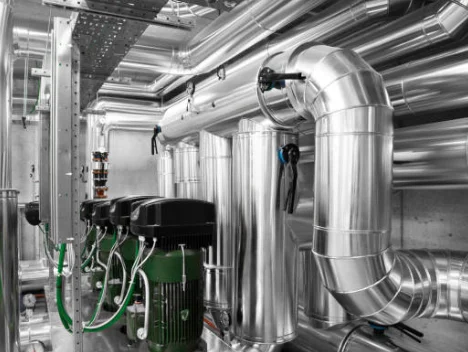
Engineered to handle high volumetric flows, intense pressure fluctuations, and severe thermal expansion stresses, our heavy-gauge piping configurations connect primary generation infrastructure—such as high-capacity chillers, cooling towers, industrial boilers, and heat exchangers—with absolute mechanical integrity.
Drawing on over 20 years of expert engineering experience, our team specializes in the detailed structural design, stress analysis, and modular fabrication of heavy-wall high-side piping networks optimized for peak hydraulic efficiency and decades of leak-free service life.
Our state-of-the-art manufacturing facility utilizes advanced automated orbital welding and premium certified metallurgy to construct large-diameter header manifolds, decoupled loops, and complex plantroom distribution configurations that resist velocity-induced erosion and internal galvanic corrosion. Every high-side mechanical package is engineered as a highly integrated modular system or pre-fabricated spool kit, complete with robust structural support frames, integrated vibration isolators, and calibrated instrumentation ports designed for rapid, flawless integration on-site.
By maintaining uncompromising compliance with critical international and European engineering benchmarks—including ASME B31.3 (Process Piping), EN 13480 (Metallic Industrial Piping), CE marking, and the European Pressure Equipment Directive (PED 2014/68/EU)—Nordstone guarantees unmatched structural longevity, minimal operational risk, and absolute safety for Italy’s most complex commercial, district heating, and defense-grade infrastructure projects.
To collaborate with our senior mechanical engineering team on your high-side plantroom piping layouts or to request a comprehensive technical proposal, please visit our contact page.
Technical FAQ (Top 15)
Q1: What is included under “High-Side” HVAC plantroom and main equipment piping works?
“High-Side” piping refers strictly to the primary, high-capacity fluid loops located within the main plantroom or mechanical energy center. This encompasses the large-diameter header manifolds, distribution loops, and connection spools that interface directly with primary thermal equipment like chillers, cooling towers, primary pumps, and utility heat exchangers before the fluid enters secondary distribution branches.
Q2: What major manufacturing codes and safety certifications do your HVAC piping spools carry?
All Nordstone high-side piping systems are manufactured to rigid global and European safety mandates. For projects in Italy, our metallic industrial piping arrays carry the CE marking in strict compliance with the Pressure Equipment Directive (PED 2014/68/EU) and are designed and verified according to harmonized standard EN 13480 or ASME B31.3.
Q3: Why is pre-fabricated modular piping superior to field-welded plantroom piping?
Pre-fabricated spools are built inside our controlled manufacturing facility using automated positioning machinery, robotic orbital welding, and rigid environmental controls. This guarantees 100% weld penetration, eliminates contamination risks common to active construction sites, drastically shortens plantroom installation timelines, and significantly lowers field assembly labor costs.
Q4: What materials do you utilize for heavy high-side industrial HVAC loops?
We match material selection directly to the fluid properties and thermal demands of the project. Typically, we utilize high-grade carbon steels (such as EN 10216-2 P235GH or ASTM A106 Grade B) for closed-loop chilled and hot water systems. For open-loop cooling tower circuits or aggressive environments, we utilize premium 304L/316L stainless steel to avoid oxidation and corrosion.
Q5: How does Nordstone address thermal expansion and mechanical stress within plantrooms?
Our engineering department performs detailed pipe stress analysis using specialized software to map out thermal expansion, weight loads, and dynamic forces. We strategically integrate custom expansion loops, flexible metallic bellows, and structural anchor points to absorb structural shifts and isolate primary equipment nozzles from excessive mechanical piping stress.
Q6: Can your HVAC pipeline assemblies be deployed in explosive or ATEX-rated plantrooms?
Absolutely. Drawing on our deep engineering history in the defense and petrochemical sectors, we routinely manufacture fully ATEX-compliant plantroom piping and support components for Zone 1 and Zone 2 hazardous areas. This includes integrating certified bonding strips for static dissipation and explosion-proof instrumentation connections.
Q7: What non-destructive testing (NDT) protocols do you apply to HVAC pressure piping?
In strict adherence to our ISO 9001 quality management systems, all pressure-retaining welds undergo comprehensive NDT tracking. Depending on the fluid category and design pressure, this includes 100% Visual Testing (VT), Radiographic Testing (RT), or Ultrasonic Testing (UT), followed by a witnessed hydrostatic pressure test up to 1.5 times the system design pressure.
Q8: Do you manufacture large-diameter header manifolds with integrated structural branching?
Yes. We design and fabricate custom large-diameter low-loss headers and distribution manifolds. Branch connections are made using reinforced nozzle welds or forged fittings (such as Weldolets or Thredolets) in strict compliance with EN 13480 design rules to preserve structural wall integrity under constant pressure.
Q9: How are your pre-fabricated HVAC spools prepared for corrosion protection?
Prior to shipment from our Italian facility, all carbon steel piping surfaces undergo thorough mechanical preparation (blasting) and are treated with high-performance, heat-resistant anti-corrosive primers. For extreme or exposed settings, we offer multi-coat epoxy systems or hot-dip galvanizing options to guarantee long-term corrosion resistance.
Q10: Can Nordstone integrate instrumentation tapings and valve stations directly into the spools?
Yes. Our spools arrive on-site fully equipped with precise, pre-welded sockets and flanged connections for temperature wells, pressure gauges, flow meters, air vents, and drain valves. This reduces field modifications and ensures that all measurement points are perfectly positioned according to the P&ID layout.
Q11: How do your plantroom piping systems mitigate vibration transmission from heavy machinery?
To prevent high-frequency vibrations from chillers and primary pumps traveling through the piping network and into the building structure, we integrate engineered spring hangers, heavy-duty pipe clamps with elastomeric linings, and flexible braided stainless steel connectors right at the machine interfaces.
Q12: Do you offer Factory Acceptance Testing (FAT) for modular piping assemblies?
Yes. Complete modular skid-mounted piping headers and valve blocks undergo detailed Factory Acceptance Testing at our facility. This includes dimensional verification via laser scanning, pressure holding tests, and comprehensive weld mapping reviews before delivery.
Q13: Which third-party inspection and classification societies do you partner with in Italy?
We regularly coordinate our material traceability logs, welding procedure qualifications (WPQR), and final safety certifications with leading notified bodies active in the European sector, including RINA, Bureau Veritas, and TÜV.
Q14: What baseline engineering documents are required to receive a detailed technical quote?
To compile an accurate proposal, please provide your plantroom layout drawings (3D models or 2D layouts), piping and instrumentation diagrams (P&IDs), fluid media specifications, maximum operating pressures, design temperature thresholds, and preferred material classes.
Q15: How can a mechanical contractor or project engineer initiate a high-side piping project?
You can securely upload your request for proposal (RFP), technical specifications, or isometric drawings through our corporate interface. To schedule an initial design review or technical consultation with our senior mechanical engineers, please connect with us directly via our contact page.