As an established pioneer in heavy industrial fabrication, Nordstone stands out among premium high-capacity industrial boiler manufacturers in italy, delivering robust, high-performance thermal generation systems for the most demanding utility applications. Engineered to withstand continuous thermal stress, extreme pressures, and harsh environments, our heavy-duty boiler configurations provide critical process steam and high-temperature water for sectors where downtime is not an option—including chemical processing, Oil & Gas refineries, district heating networks, and defense infrastructure.
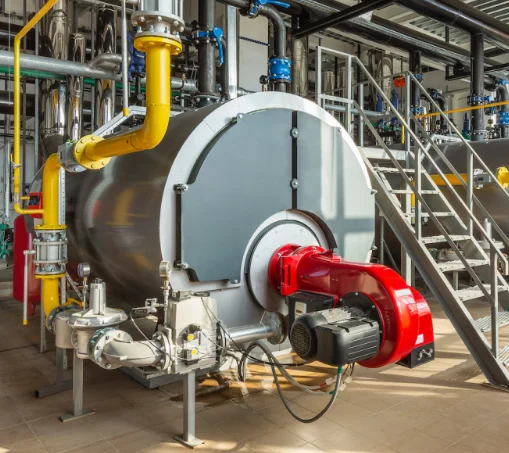
Drawing on over 20 years of expert engineering experience, our team specializes in the mechanical design and precision fabrication of fire-tube and water-tube systems optimized for maximum thermodynamic efficiency, fuel versatility, and low emission output.
Our state-of-the-art manufacturing facility utilizes advanced automated welding and premium metallurgy to construct robust, large-scale boiler shells that completely eliminate thermal fatigue and resist corrosive condensate environments.
Every high-capacity thermal installation is engineered as a fully integrated modular system featuring advanced economizers, automated water management configurations, and smart control panels designed for flawless plant integration.
By strictly maintaining compliance with critical international and European engineering benchmarks—including ASME Section I, EN 12953, CE marking, and the European Pressure Equipment Directive (PED 2014/68/EU)—Nordstone guarantees unmatched operational safety, rapid thermal responsiveness, and structural longevity for Italy’s vital energy and manufacturing infrastructures.
To collaborate with our senior thermodynamic engineering team on your custom high-capacity boiler specifications or to request a detailed technical proposal, please visit our contact page.
Technical FAQ (Top 15)
Q1: What defines a “high-capacity” industrial boiler in Nordstone’s manufacturing lineup?
In our production facility, high-capacity industrial boilers refer to heavy-duty steam or hot water systems designed for large-scale utility and process applications. Our outputs typically span from 5 tons of steam per hour up to 50+ tons per hour (or equivalent megawatt thermal ratings), engineered to manage severe, continuous industrial loads.
Q2: What major manufacturing codes and safety certifications do your boilers carry?
All Nordstone high-capacity boilers are built to rigid global safety mandates. For projects in Italy and across Europe, our equipment carries the CE marking in strict compliance with the Pressure Equipment Directive (PED 2014/68/EU) and European standard EN 12953. We are also fully certified to apply ASME Section I (Power Boilers) stamps for international configurations.
Q3: What fuel types are supported by your high-capacity combustion systems?
Our boilers feature versatile, multi-fuel industrial burner configurations. They operate efficiently on standard natural gas, liquefied petroleum gas (LPG), and heavy fuel oils. Additionally, we engineer custom systems optimized for sustainable alternative fuels, including biogas and green hydrogen blending, ensuring compliance with evolving European environmental directives.
Q4: How does Nordstone optimize the thermodynamic efficiency of large-scale boilers?
We integrate advanced thermal recovery technologies directly into the skid or plant configuration. By utilizing custom-engineered flue-gas economizers, combustion air preheaters, and high-density multi-layered insulation, we capture residual thermal energy and redirect it into the feed-water loop, raising overall efficiency up to 95%.
Q5: What metallurgy is used to prevent thermal fatigue and corrosion in high-pressure service?
We work exclusively with certified, high-tensile boiler steel plates (such as P265GH or ASME-grade equivalents) and seamless pressure tubes rated for extreme thermal service. For aggressive condensate return networks or harsh chemical process fluids, product paths are reinforced with premium stainless steel or corrosion-resistant alloy trims.
Q6: Can Nordstone handle the complete integration of the boiler auxiliary equipment?
Yes. We deliver fully integrated, turnkey thermal packages. Alongside the primary boiler pressure vessel, we engineer and supply all essential auxiliary systems, including high-pressure feed-water pumps, deaerators, blowdown heat recovery modules, chemical dosing stations, and flue-gas treatment units.
Q7: Are your high-capacity boilers certified for deployment in explosive or ATEX-rated zones?
Absolutely. Drawing on our deep engineering history in the defense and petrochemical sectors, we routinely manufacture fully ATEX-certified boiler systems for Zone 1 and Zone 2 hazardous locations. This includes integrating explosion-proof electrical enclosures (Ex d), intrinsically safe loops (Ex i), and flameproof field instrumentation.
Q8: What automated water-quality control mechanisms are built into the systems?
To eliminate internal scale formation and dissolved oxygen corrosion, our boilers feature automated surface and bottom blowdown control systems linked to real-time conductivity sensors. This maintains precise water chemistry parameters in strict accordance with EN 12953-10 standards, maximizing equipment lifespan.
Q9: Can these high-capacity boiler systems operate continuously without manual intervention?
Yes. We engineer our automation and safety arrays to comply with European safety norms for 24-hour or 48-hour continuous operation without constant manual supervision. The system monitors critical safety boundaries (such as low water levels or overpressure conditions) and executes automatic fail-safe shutdowns if boundaries are breached.
Q10: What non-destructive testing (NDT) protocols are implemented during fabrication?
In strict adherence to our ISO 9001 quality systems, all structural and pressure welds undergo exhaustive NDT tracking. This includes 100% Radiographic Testing (RT), Ultrasonic Testing (UT), and Magnetic Particle Testing (MT). Every completed boiler undergoes a witnessed hydrostatic pressure test up to 1.5 times its design pressure.
Q11: How do your control systems interface with an existing plant-wide SCADA or DCS network?
Our automated control panels are engineered with open-architecture PLCs (such as Siemens S7-1500 or Rockwell Automation platforms). We configure the communication layers to native industrial protocols like Modbus TCP, Profinet, or Ethernet/IP, providing your central control room with full telemetry, efficiency metrics, and alarm logging.
Q12: Do you offer Factory Acceptance Testing (FAT) at your facility in Italy?
Yes. Every high-capacity industrial boiler undergoes rigid Factory Acceptance Testing prior to shipment. Your engineering representatives or designated third-party inspection bodies are given complete facility access to witness electrical loop testing, logic validation, and hydrostatic integrity checks.
Q13: Which third-party inspection and classification societies do you regularly partner with?
We regularly coordinate our materials traceability, weld validation records, and safety compliance logs with premier classification bodies active in the European market, including RINA, Bureau Veritas, TÜV, and Lloyd’s Register.
Q14: What baseline data does your team require to draft a precise engineering proposal?
To compile a detailed technical quote, please supply your required steam mass flow rate (kg/h or t/h) or thermal output (MW), maximum operating pressure, steam condition (saturated or superheated), preferred fuel source, feed-water inlet temperature, and any specific local emissions limits (NOx/CO).
Q15: How can a procurement officer or project manager initiate a large-scale boiler project?
You can securely upload your request for proposal (RFP), piping and instrumentation diagrams (P&IDs), or technical equipment data sheets through our secure corporate interface. To establish an initial technical consultation with our senior thermal engineers, please connect with us directly via our contact page.