As an established leader in heavy industrial fabrication, Nordstone specializes in the custom design and production of high-performance firefighting system skids and engineered modular fire suppression packages across Italy.
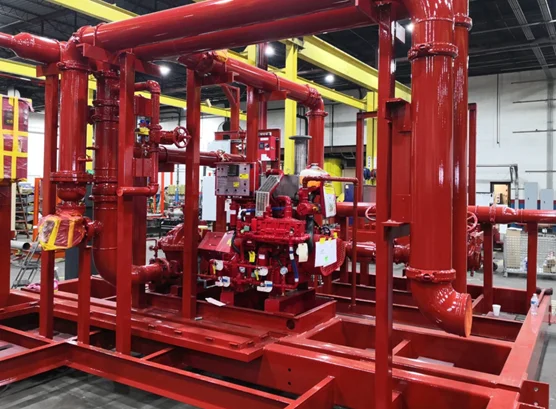
Built to withstand extreme environmental conditions, our rugged fire pump skids deliver maximum safety and reliability for critical sectors where failure is not an option, including offshore oil platforms, onshore refineries, chemical processing plants, and defense infrastructure.
Drawing on more than 20 years of technical expertise, our expert engineering team designs every modular skid for immediate, plug-and-play field integration. We utilize premium, corrosion-resistant alloys and heavy-duty industrial vessels to guarantee structural integrity under extreme pressures and temperatures.
Every custom firefighting package is fully integrated with smart control panels, automated diesel or electric pump drivers, and reliable foam-blending systems, all optimized within a compact, space-saving footprint. Because safety in high-risk zones requires absolute precision, Nordstone guarantees total compliance with rigorous international and European safety standards, including NFPA 20, EN 12845, ASME Section VIII, and API mandates.
To request custom engineering specifications, review compliance documentation, or obtain a project quote, please reach out via our contact page.
Technical FAQ (Top 15)
Q1: What types of firefighting system skids does Nordstone manufacture in Italy?
We design and manufacture a wide variety of custom modular fire suppression packages. This includes NFPA 20 compliant fire pump skids (diesel, electric, or split-case driver configurations), foam concentrate proportioning skids, water mist system packages, and deluge valve skid assemblies engineered specifically for high-hazard environments.
Q2: Do your fire skids comply with European and international fire safety standards?
Yes. Depending on your specific facility and project mandates, our firefighting skids are fully engineered and manufactured to meet NFPA 20 (National Fire Protection Association) criteria, European EN 12845 regulations, and carry relevant CE markings alongside compliance with the Pressure Equipment Directive (PED).
Q3: Can Nordstone construct fire pump skids for explosive or ATEX-rated hazardous zones?
Absolutely. Leveraging our long-standing engineering background in the Oil & Gas and defense sectors, we specialize in constructing fully certified ATEX-compliant firefighting skids for Zone 1 and Zone 2 hazardous areas. These feature explosion-proof control panels, flameproof electrical wiring, and intrinsically safe instrumentation.
Q4: What materials are utilized to prevent corrosion in offshore or coastal environments?
To fight the aggressive nature of seawater or brackish water, we build our piping networks and industrial pressure vessels using premium corrosion-resistant materials. Options include 316L Stainless Steel, Duplex, Super Duplex, and Cupro-Nickel alloys to maximize the equipment’s field lifespan.
Q5: Are your firefighting system skids delivered as fully integrated turnkey units?
Yes, all of our modular packages are delivered as completely self-contained, turnkey units. They come pre-piped, pre-wired, and fully integrated with mechanical equipment, electrical control panels (PLCs), pressure switches, instrumentation, and fuel containment tanks, allowing for minimal on-site installation time.
Q6: What testing protocols do the firefighting skids undergo prior to delivery?
To maintain our unyielding commitment to reliability, every firefighting package undergoes extensive Factory Acceptance Testing (FAT) at our state-of-the-art facility. This includes hydrostatic pressure testing of all piping and vessels, electrical loop checking, and full dynamic hydraulic performance testing of the pump systems.
Q7: Can these firefighting packages be monitored remotely via a central plant system?
Yes. Our control panels are engineered for seamless integration into existing industrial facility workflows. We support standard industrial communication protocols such as Modbus, Profibus, or Ethernet/IP, enabling full remote status monitoring, alarm tracking, and diagnostics through your central SCADA or DCS system.
Q8: How does Nordstone optimize the footprint of heavy fire suppression equipment?
Our engineering team utilizes advanced 3D CAD modeling to design the equipment layouts within compact, rugged, structural steel skid frames. This modular approach significantly minimizes the physical footprint, making them ideal for space-constrained environments like offshore platforms or compact industrial facilities.
Q9: Do you incorporate pressure vessels and surge tanks into the skid configurations?
Yes. Backed by our decades of excellence in designing and manufacturing high-performance industrial vessels, we can integrate custom ASME-stamped surge tanks, foam bladder tanks, or priming vessels directly onto the firefighting skid to handle sudden pressure spikes and maintain steady hydraulic flow.
Q10: What are the benefits of choosing a modular skid over field-erected fire pump houses?
Modular skids eliminate the logistical headaches of field construction. Because the system is fabricated, wired, and fully tested in our controlled factory environment, on-site labor is reduced to simple fluid and power hookups, significantly lowering installation costs and avoiding field delays.
Q11: Can your systems handle foam-proportioning for petrochemical storage fires?
Yes, we engineer dedicated high-capacity foam firefighting skids utilizing balanced pressure proportioners, round-the-pump proportioners, or inline educators. These systems are optimized for rapid deployment in fuel storage terminals, refineries, and chemical warehouses.
Q12: How do your diesel-driven fire skids ensure starting reliability in emergencies?
Our diesel fire pump skids are engineered with redundant safety features, including dual electric starting motors powered by independent battery banks, mechanical hydraulic starting backups, and automated engine cooling loops to guarantee immediate startup under emergency conditions.
Q13: Can third-party inspection agencies witness the testing of our system?
We completely welcome third-party inspections. We regularly coordinate our factory testing procedures with leading classification and validation societies, including RINA, Bureau Veritas, Lloyd’s Register, and TÜV, to verify that all international compliance benchmarks are fully met.
Q14: What technical information is required to receive a customized project proposal?
To provide an accurate technical quote, our engineering team requires details on the required flow rate (m3/h or GPM), design discharge pressure, fluid type (freshwater, seawater, or foam mix), zone classification (safe area vs. ATEX), and your preferred applicable standard (NFPA or EN).
Q15: How can I request an engineering consultation for a project based in Italy?
You can easily coordinate directly with our engineering department by submitting your operational parameters, data sheets, or RFP guidelines directly through our secure contact page.