As a premier manufacturer of heavy industrial process equipment with 20 years of engineering excellence, Nordstone designs and manufactures state-of-the-art industrial reboilers tailored specifically for demanding thermal separation units across Italy.
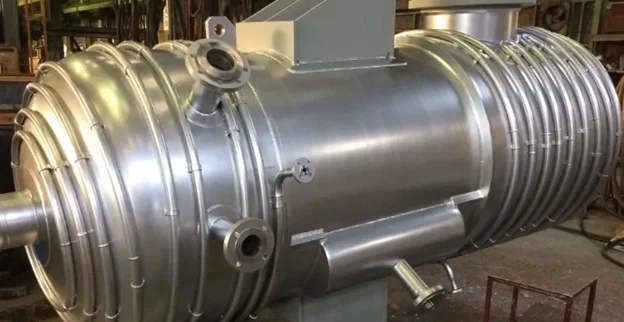
Serving critical sectors from oil refineries and petrochemical complexes in Lombardy and Sicily to chemical processing plants across Europe, our custom-engineered vaporization solutions provide exceptional thermal efficiency, precise boiling control, and continuous uptime for your process columns.
Every unit is built within our advanced fabrication facility, ensuring absolute compliance with rigorous global directives and European pressure equipment standards. By optimizing fluid dynamics and heat transfer coefficients, our heavy-duty reboilers reliably eliminate operational bottlenecks, control dangerous fouling, and minimize energy consumption in extreme chemical environments.
Engineering Precision: Custom Reboiler Architectures
Industrial distillation requires diverse boiling regimes depending on the thermal sensitivity, viscosity, and fouling tendency of the bottoms product. We design and manufacture all major structural configurations of industrial reboilers:
- Kettle Reboilers (TEMA Type K): Engineered with an oversized shell that acts as an internal vapor-liquid disengagement zone. Immersed tube bundles guarantee a highly stable, continuous vapor rate, making them perfect for high-vaporization duties and variable process column loads.
- Thermosyphon Reboilers (Horizontal & Vertical): Utilizing natural hydrostatic head and fluid density differentials to drive high-velocity circulation without external pumps. These systems maximize energy efficiency and drastically reduce initial capital costs.
- Forced Circulation Reboilers: Driven by high-performance process pumps, these units are specifically tailored for highly viscous liquids, slurry streams, or heavily contaminated fluids where high shear forces are mandatory to prevent surface fouling.
Uncompromising Quality Assurance & Technical Compliance
Our technical authority is backed by standard-setting industry certifications. We manage complete in-house mechanical and thermal design simulations using tools like HTRI and finite element analysis (FEA).
| Feature / Certification | Technical Scope & Compliance Standards |
|---|---|
| Design Standards | ASME Section VIII Div. 1, TEMA (Class R, C, B), API 660 |
| European Directives | PED 2014/68/EU, ATEX Zone 1 & 2 safety regulations |
| Material Competence | Carbon Steel, 316L Stainless Steel, Duplex, Super Duplex, Titanium, Inconel |
| Testing Protocols | Radiography (RT), Ultrasonic (UT), Hydrostatic test, Dye Penetrant (PT) |
Get In Touch with Our Engineering Team
Are you optimizing a new fractionation column or replacing an aging, fouled heat exchanger in your facility? Contact our technical sales division to discuss thermal sizing, metallurgical specifications, and custom structural layouts.
Speak directly with a Nordstone industrial pressure vessel specialistYes
Frequently Asked Questions (FAQ)
1. What role does an industrial reboiler play in a process column system?
An industrial reboiler functions as the structural thermal engine for a distillation or fractionating column. It takes the liquid bottoms stream from the lower section of the column, applies thermal energy (typically utilizing steam, hot oil, or process streams) to vaporize a designated percentage of the mixture, and returns those high-velocity vapors back into the column to drive continuous vapor-liquid mass separation.
2. How does Nordstone ensure compliance with European regulations for installations in Italy?
Every pressure vessel and reboiler engineered for the Italian market strictly adheres to the Pressure Equipment Directive (PED) 2014/68/EU. We provide complete CE marking, verified material traceability logs, and independent notified body inspection reports along with complete weld mapping to fulfill local occupational safety and environmental codes.
3. Which reboiler configuration is most suitable for heavy fouling or slurry applications?
For high-fouling process fluids, a Forced Circulation Reboiler is heavily preferred. By integrating a dedicated circulation pump, we maintain high fluid velocities inside the heat exchanger tubes. The resulting high shear stress cleans the inner tube walls continuously, preventing localized dry-outs and minimizing chemical baking or scale accumulation.
4. What is the fundamental operational difference between a kettle reboiler and a thermosyphon reboiler?
A kettle reboiler relies on pool boiling where a submerged tube bundle heats a vast reservoir of liquid, utilizing a built-in overflow weir to separate the remaining unvaporized liquid product. A thermosyphon reboiler relies on natural circulation driven by the density difference between the cold liquid entering the unit and the hot, low-density vapor-liquid mixture returning to the column, completely eliminating the need for an internal weir or a pump.
5. Can Nordstone build reboilers capable of handling highly corrosive organic acids?
Yes. Backed by 20 years of experience, our metallurgical welding specialists work extensively with high-alloy materials. We manufacture equipment using Duplex stainless steel, Super Duplex, Titanium, and Nickel alloys like Inconel to ensure long-term mechanical reliability under aggressive corrosive attacks.
6. Do you design your reboilers using specialized thermal simulation software?
Yes. Every thermal design is modeled, verified, and cross-checked using HTRI (Heat Transfer Research, Inc.) software. This lets us perfectly simulate phase-change dynamics, optimize overall heat transfer coefficients (U), determine precise mean temperature differences (LMTD), and accurately predict localized shell-side or tube-side pressure drops.
7. What certifications does Nordstone hold for manufacturing high-pressure process vessels?
Nordstone maintains an ASME-certified manufacturing infrastructure with authorized U, U2, and S stamps. We operate under rigorous ISO 9001:2015 quality management guidelines and conform to global manufacturing parameters defined by the American Petroleum Institute (API 660).
8. What is “film boiling” and how does Nordstone design around it?
Film boiling occurs when an excessive heat flux forms a blanketing layer of vapor along the hot tube surfaces, drastically reducing heat transfer efficiency and potentially causing localized thermal stresses. We prevent this by designing safe, calculated heat flux limits and ensuring appropriate tube spacing based on strict TEMA parameters.
9. Can your engineering team perform retrofits or drop-in replacements for existing Italian facilities?
Absolutely. We specialize in engineering exact drop-in replacements for old or underperforming heat exchangers. Our engineering team can analyze your current space constraints, processing parameters, and nozzle orientations to fabricate a custom unit that fits perfectly into your existing structural steel frameworks.
10. What structural testing protocols do you execute before shipment?
We execute comprehensive non-destructive testing (NDT) programs. This includes 100% radiography (RT) on long-cycle pressure boundary welds, ultrasonic testing (UT), liquid penetrant inspections (PT) on nozzle attachments, and a final calibrated hydrostatic pressure test at a minimum of 1.3 times the maximum allowable working pressure (MAWP).
11. Why is vapor-liquid disengagement so vital in a kettle reboiler shell?
If the internal vapor velocity is too high, liquid droplets can become entrained in the rising vapor stream and exit the reboiler, compromising the purification performance of the distillation column trays above. Nordstone designs oversized eccentric kettle shells to systematically lower vapor velocity, ensuring clean separation.
12. What types of heating media can be utilized in Nordstone industrial reboilers?
Our units are extremely versatile. They can be engineered to utilize saturated high-pressure steam, organic thermal oils (hot oil loops), heavy refinery process streams, or vaporized column overhead products to maximize internal plant heat integration.
13. How does tube-side vs. shell-side boiling affect reboiler maintenance?
Placing the boiling fluid inside the tubes (typical in vertical thermosyphons) allows for easy mechanical cleaning using straight-tube hydro-blasting during plant shutdowns. Placing the boiling fluid on the shell side (standard in kettle designs) requires a removable, floating tube bundle configuration so that maintenance crews can access the outer surfaces easily.
14. What parameters are crucial for sizing a process column reboiler?
To generate an accurate mechanical and thermal quote, our team requires the total thermal duty (kW or kcal/h), precise inlet fluid composition, operating pressure, design temperature, allowable pressure drops, fouling factors, and the specific properties of the heating medium available.
15. How do I start a technical consultation or request a quote for a reboiler project?
You can safely initiate an engineering review by visiting our official portal at Contact Us. Provide your data sheets, design codes, and site-specific criteria, and our senior thermal design engineers will contact you to review your specifications.