As an established leader with 20 years of experience in heavy industrial fabrication, Nordstone designs and manufactures high-performance Air-Cooled Heat Exchangers (ACHE) for critical applications across Italy and global energy markets.
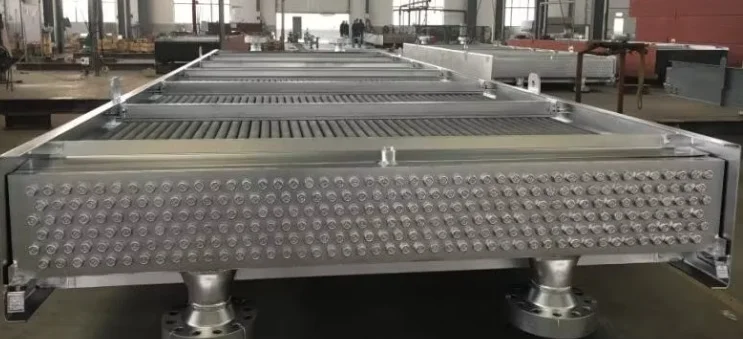
In industrial environments where water conservation, mechanical reliability, and structural footprint are paramount, our custom-engineered air-cooled heat exchangers provide an ultra-efficient closed-loop thermal management system. Engineered to perform flawlessly under extreme operating pressures and high-temperature conditions, our systems optimize heat dissipation by utilizing ambient air forced across heavy-duty finned tube bundles, completely bypassing the need for costly water cooling infrastructure.
Every industrial ACHE system we manufacture at our advanced facilities complies strictly with API Standard 661 and ASME Section VIII design regulations. Whether your project requires a forced-draft layout to keep mechanical components accessible at ambient temperatures or an induced-draft configuration to minimize hot air recirculation in tight spaces, Nordstone provides specialized, durable engineering. Our corrosion-resistant finned tubes (including L-foot, G-fin, and extruded aluminum options) ensure maximum heat transfer area and thermal efficiency across the Oil & Gas, chemical processing, power generation, and heavy manufacturing sectors. Discover how our certified engineering team can optimize your facility’s uptime by visiting our dedicated contact page today.
Frequently Asked Questions (FAQ)
1. What is an Air-Cooled Heat Exchanger (ACHE) and how does it work?
An Air-Cooled Heat Exchanger (ACHE), also known as an air fin cooler or fin-fan cooler, is a pressure vessel that rejects process heat directly into the atmosphere. The hot process fluid flows inside a series of extended-surface finned tubes, while axial fans push or pull ambient air across the outside of the tubes to cool or condense the fluid without using water.
2. What are the main benefits of using an ACHE over a water-cooled shell and tube heat exchanger?
ACHE units eliminate the need for an external cooling water supply, cooling towers, and intensive water chemical treatments. They eliminate common water-side issues such as scaling, biofouling, and galvanic corrosion, while lowering long-term operating costs and preventing thermal pollution of local water bodies.
3. Does Nordstone comply with international engineering standards for ACHEs?
Yes. With 20 years of manufacturing experience, Nordstone designs, builds, and tests all air-cooled heat exchangers in strict accordance with API Standard 661 (Air-Cooled Heat Exchangers for General Refinery Service), ASME Section VIII Division 1 & 2, and ISO 13706 certifications.
4. What is the difference between a forced draft and an induced draft ACHE?
- Forced Draft: The axial fans are located below the tube bundle. This setup pushes cold ambient air through the fins, keeping mechanical parts like motors, belts, and bearings exposed to cool air for easier maintenance and longer component life. thepipingtalk.com
- Induced Draft: The fans are located above the tube bundle. They pull air upward through the bundle, providing a more uniform air distribution across the tubes and minimizing hot air recirculation, which is ideal when working with tight outlet temperature windows. www.scribd.com
5. Which industries in Italy utilize Nordstone’s ACHE systems?
Our custom thermal management systems are widely deployed across heavy processing industries in Italy, including:
- Upstream, midstream, and downstream Oil & Gas plants www.coolfabequipments.com
- Petrochemical and chemical processing facilities www.starcoolingtowers.com
- Power generation stations and renewable energy plants www.starcoolingtowers.com
- Heavy manufacturing, refining, and gas compression stations www.kaskomakine.com
6. What types of finned tubes do you manufacture to maximize thermal efficiency?
We offer various fin designs tailored to your process environment, including:
- L-Foot Fins (Wrap-on): Great for standard temperatures up to 130°C.
- Overlapped L-Foot (Double L): Offers enhanced tube protection against atmospheric corrosion.
- Embedded Fins (G-Fin): Slotted mechanically into the tube wall, accepting high thermal and physical stress up to 400°C.
- Extruded Aluminum Fins: Provides the highest level of atmospheric corrosion protection and structural integrity. www.altexinc.com
7. Can your air-cooled heat exchangers operate under extreme pressures and temperatures?
Yes. Backed by our decades of pressure vessel manufacturing excellence, Nordstone specializes in heavy-wall header construction (such as plug headers or removable cover-plate designs) that safely manage high-pressure hydrocarbon gases, steam, and corrosive chemical processes up to 600°C.
8. How does seasonal ambient temperature fluctuation affect ACHE performance?
Because an ACHE relies on the atmospheric dry-bulb temperature, its cooling capacity changes between winter and summer. To maintain a stable process outlet temperature year-round, Nordstone integrates Variable Frequency Drives (VFDs) on fan motors, auto-adjustable louvers, or multi-fan control logic to modulate airflow during colder seasons.
9. What materials of construction (MOC) do you use for tube bundles?
Depending on the corrosiveness of your process fluid, our engineers select and fabricate tube bundles using high-grade materials such as Carbon Steel, Stainless Steel (SS304, SS316, SS316L), Duplex and Super Duplex stainless steels, Titanium, or specialized nickel alloys.
10. How much space do air-cooled heat exchangers require?
Because ambient air has a low specific heat capacity compared to water, ACHEs require a larger heat transfer surface area, resulting in a larger physical footprint. To solve space constraints, Nordstone designs compact structural frames, multi-row configurations, or A-frame structures that optimize overhead vertical space.
11. What are the routine maintenance requirements for a Nordstone ACHE?
Maintenance is significantly lower than that of water-cooled alternatives. Standard procedures include checking fan belt tension, inspecting bearing lubrication, verifying VFD operation, and occasionally cleaning external dust or debris from the aluminum fins using low-pressure air blowing or specialized water-washing.
12. Are Nordstone’s air-cooled systems suitable for coastal or highly corrosive environments in Italy?
Yes. For industrial installations along Italy’s coastlines or within aggressive chemical plants, we apply specialized anti-corrosive coatings to the steel supporting frames, utilize marine-grade aluminum alloys for the fins, and offer fully sealed, corrosion-resistant fan assemblies.
13. How does Nordstone manage noise levels generated by large ACHE fan assemblies?
Large axial fans can generate substantial noise. We address environmental and municipal acoustic regulations across Italy by designing our systems with custom high-efficiency, ultra-low-noise fan blades, optimizing fan tip speeds, and using direct-drive setups where necessary to meet strict decibel thresholds.
14. Can you provide custom skid-mounted ACHE configurations?
Yes. We engineer complete, turn-key, skid-mounted modular ACHE units. These packages arrive pre-assembled with finned tube bundles, fans, motors, structure, inlet/outlet piping manifolds, and integrated instrumentation to minimize onsite installation time and mechanical commissioning costs.
15. How do I initiate a technical request or request a thermal sizing calculation?
You can contact our expert engineering team directly through our online communication portal. Please share your mass flow rates, inlet/outlet process fluid properties, operating pressures, and design ambient conditions via our contact us page to receive a detailed HTRI thermal sizing simulation and technical proposal.