With over 20 years of experience in custom engineering, Nordstone is a trusted leader among industrial utility tanks and pressurized, gas, and water systems manufacturers in Italy. We engineer high-performance industrial utility tanks that deliver uncompromising safety and structural integrity under extreme processing conditions.
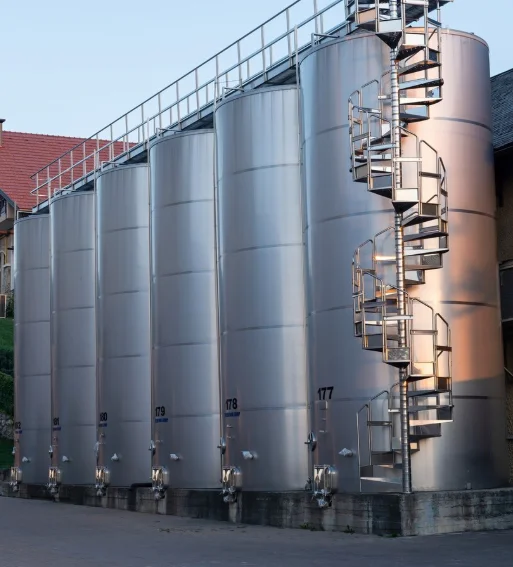
Designed to manage heavy thermal loads, corrosive mediums, and rapid pressure fluctuations, our custom-fabricated containment vessels serve critical operations across Italy’s heavy manufacturing, energy, and chemical infrastructure. Every industrial utility tank leaving our advanced manufacturing facility complies strictly with international directives, ensuring total regulatory alignment for domestic European facilities and global markets alike.
Compliance Notice for Italian & EU Operations: All Nordstone industrial utility tanks are engineered, fully tested, and certified in accordance with ASME Section VIII, API 650/620, and the European Pressure Equipment Directive (PED) 2014/68/EU.
Our engineering team works closely with local plant operators to ensure that custom configurations seamlessly integrate into complex local utility grids. From durable feed water reservoirs and high-pressure nitrogen surge drums to specialized gas accumulators, we prioritize material traceability and precision welding. This rigid quality framework guarantees an extended, leak-free operational lifecycle in the most demanding industrial environments.
To discuss your technical specifications, request a localized compliance review, or consult with our engineering desk on custom dimensions, please visit our Contact Us page.
Frequently Asked Questions
1. Which construction standards do Nordstone industrial utility tanks follow for installation in Italy?
All our utility tanks and pressurized vessels are fully certified under ASME Section VIII Division 1 and strictly adhere to Europe’s Pressure Equipment Directive (PED) 2014/68/EU. Depending on the media and storage parameters, we also manufacture in accordance with API 650 or API 620 for atmospheric and low-pressure applications.
2. Can you accommodate specific space constraints within existing Italian manufacturing facilities?
Yes. Our engineering department specializes in designing custom vertical and horizontal footprints, custom nozzle layouts, and specialized saddle or leg configurations. We match the structural and geometric constraints of your existing factory floor or skid system.
3. What types of materials do you use to combat aggressive chemical or water corrosion?
We build our tanks using premium-grade materials selected for the precise chemical properties of your storage media. This includes austenitic stainless steels (304L, 316L), duplex stainless steels (Duplex 2205), carbon steels with advanced internal linings (such as baked epoxy or rubber), and specialized nickel alloys for severe services.
4. Do your water systems tanks include provisions for thermal expansion and water hammer mitigation?
Yes. Our pressurized water storage systems and expansion vessels are designed with specific safety margins, surge allowances, and optional integrated bladder membranes or nitrogen blanketing controls to mitigate thermal expansion stresses and transient hydraulic shocks (water hammer).
5. How does Nordstone guarantee the structural integrity of its pressurized gas tanks?
We implement strict Quality Assurance and Quality Control (QA/QC) processes, including a comprehensive battery of Non-Destructive Testing (NDT). This covers 100% radiography (X-ray) on critical weld seams, ultrasonic testing, dye penetrant inspections, and formal hydrostatic or pneumatic pressure tests monitored by third-party inspection agencies.
6. Do you provide localized technical documentation for Italian safety authorities?
Absolutely. Every vessel is shipped with a complete technical dossier. This contains certified material test reports (MTRs), welding log books (WPS/PQR), NDT records, PED Declaration of Conformity, and all official ASME or CE marking documentation required for local commissioning and workplace safety approvals (such as INAIL clearances).
7. What is the maximum pressure and temperature rating your industrial utility tanks can handle?
Because we specialize in custom, heavy-wall pressure vessels, our operating parameters are engineered-to-order. We routinely manufacture systems rated for high-vacuum conditions up to extreme high-pressure thresholds exceeding 100+ bar, with thermal designs capable of handling cryogenic fluids or extreme process temperatures up to +400°C.
8. Can Nordstone integrate specialized instrumentation and control ports directly into the tank design?
Yes. We pre-engineer and fabricate exact placements for level indicators, radar sensors, temperature thermowells, pressure relief valves (PRVs), and automated sampling ports based on the automation architecture of your facility.
9. Are your tanks suitable for food-grade water or pharmaceutical utility systems?
Yes. For sanitary applications, we utilize ultra-low carbon stainless steel (316L) paired with precision mechanical grinding and electropolishing down to a surface roughness of less than 0.4 µm Ra. This eliminates bacterial crevices and ensures compatibility with Clean-in-Place (CIP) regimes.
10. How do you handle shipping and heavy-logistics delivery to industrial zones in Northern or Southern Italy?
We manage the entire logistics chain for heavy-haul, oversized industrial components. Our logistics network handles specialized route permitting, customs protocols, and heavy-crane transport coordinates to ensure secure, on-time delivery directly to your plant site.
11. Do you manufacture modular skid packages alongside your utility tanks?
Yes, we are highly experienced in producing fully integrated modular process skids. We can deliver your utility tanks pre-mounted, piped, wired, and tested alongside pumps, heat exchangers, valves, and control panels for a rapid plug-and-play installation.
12. What types of industrial gases can be safely stored in your gas systems?
Our vessels are engineered to safely contain a broad range of industrial gases, including compressed air, nitrogen (N2), carbon dioxide (CO2), oxygen (O2), hydrogen (H2), and various specialized process gas mixtures requiring strict gaseous emission controls and zero-leak tolerances.
13. What is the typical lead time for a custom-built industrial utility tank?
Lead times vary depending on the complexity of the engineering design, material availability, and current production capacity. Generally, custom engineered-to-order utility vessels average between 12 to 24 weeks, inclusive of detailed CAD/FEA design engineering, procurement, fabrication, and final testing.
14. Do you offer field installation or supervisor services on-site in Italy?
Yes. While the majority of our industrial utility tanks are fully fabricated, blasted, and coated within our controlled factory setting, we provide dedicated field engineering supervisors to oversee on-site erection, final leveling, piping connection integrity, and commissioning support.
15. How can I get an accurate engineering proposal and price quotation for my project?
You can initiate a direct consultation by sharing your data sheet—including operating pressures, temperatures, volume requirements, material preferences, and fluid details—directly through our Contact Us page. Our technical sales engineers will respond with a preliminary mechanical evaluation and pricing estimate.