With Italy rapidly expanding its small-scale LNG network, maritime bunkering terminals, and heavy-duty transport infrastructure, the demand for highly reliable, low-temperature storage is at an all-time high.
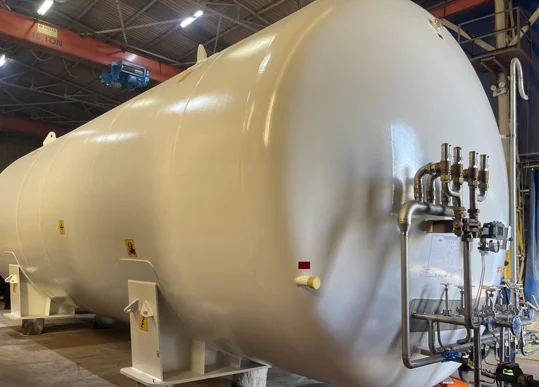
For over 20 years, Nordstone has been an industry leader in designing and manufacturing high-performance industrial vessels for critical, high-risk applications. As trusted LNG storage vessel manufacturers in Italy, we specialize in engineering double-walled, vacuum-insulated cryogenic tanks tailored to withstand the extreme pressures and deep cryogenic temperatures ($-162^circtext{C}$) essential for safe Liquefied Natural Gas containment.
By strictly adhering to international design standards like ASME Section VIII Div. 1 & 2 and the European Pressure Equipment Directive (PED) 2014/68/EU, Nordstone guarantees unparalleled safety, thermal efficiency, and structural durability for Italy’s transitioning energy sector, from terminal storage to industrial peak-shaving facilities.
Key Technical Configurations & Performance Metrics
| Parameter | Standard Range / Specifications |
|---|---|
| Design Standards | ASME Sec VIII Div 1/2, PED 2014/68/EU, EN 13458, ISO 21009 |
| Operating Temperature | Down to −196∘C (Cryogenic containment) |
| Max Working Pressure | Full vacuum up to 25+ bar |
| Insulation Systems | High-vacuum multi-layer insulation (MLI) or Perlite backfill |
| Materials of Construction | Inner Vessel: SA-240 SS 316L / 304; Outer Jacket: Carbon Steel SA-516 Gr 70 |
| Configuration Options | Vertical, Horizontal, or Modular Skid-Mounted Packages |
Frequently Asked Questions
1. What makes Nordstone a reliable LNG storage vessel manufacturer for the Italian market?
With 20 years of experience engineering high-performance industrial vessels, Nordstone provides specialized engineering that complies directly with both global and European regulatory standards. We supply custom containment systems designed for heavy-duty industrial, maritime, and transport infrastructure across Italy.
2. Which manufacturing codes do your LNG storage vessels comply with?
All our LNG containment units are built to meet the rigorous safety requirements of ASME Section VIII Division 1 or Division 2 and the European Union’s Pressure Equipment Directive (PED) 2014/68/EU. We also align with EN 13458 standards for static cryogenic vessels.
3. How do you prevent boil-off gas (BOG) in your LNG storage vessels?
We use advanced double-walled containment combined with high-vacuum multi-layer insulation (MLI) or expanded Perlite backfill. This state-of-the-art thermal engineering minimizes environmental heat leakages, keeping the liquefied natural gas stable at its liquid threshold.
4. What materials are used to construct the inner and outer vessels?
The inner vessel—which directly contacts the liquefied gas—is manufactured from premium cryogenic-grade stainless steel (such as SA-240 SS 316L or 304) to prevent low-temperature embrittlement. The outer vacuum jacket is typically fabricated from high-strength carbon steel (such as SA-516 Gr 60/70) with advanced protective coatings.
5. Can Nordstone manufacture customized LNG solutions for specific locations in Italy?
Yes. We specialize in custom-engineered solutions tailored to specific operational pressures, holding times, footprint limits, and local Italian seismic or environmental conditions.
6. What configurations do you offer for small-scale LNG terminals?
We offer horizontal and vertical static vessels, as well as pre-assembled, modular process skid packages. These skid solutions allow for faster site commissioning and reduced installation timelines at bunkering hubs or distribution networks.
7. What types of non-destructive testing (NDT) do your vessels undergo?
To ensure absolute reliability, our quality control team executes a rigorous suite of testing, including:
- Radiography Testing (RT) and Ultrasonic Testing (UT) on critical welds.
- Dye Penetrant Testing (DPT) and Magnetic Particle Testing (MPT).
- High-sensitivity helium mass spectrometer leak testing to verify vacuum integrity.
- Hydrostatic and pneumatic pressure tests.
8. Are Nordstone vessels suitable for maritime LNG bunkering applications in Italy?
Absolutely. Our engineering expertise spans complex maritime and oil and gas architectures. We custom manufacture type-C cryogenic tanks suitable for port infrastructure and ship-to-ship or ship-to-shore transfer operations.
9. What safety relief systems are integrated into your LNG storage vessels?
Every vessel is outfitted with a redundant, dual-line safety valve manifold. This layout features primary and secondary pressure relief valves (PRVs), thermal expansion valves, and integrated rupture discs to manage unexpected pressure surges without interrupting operations.
10. Do you provide validation and traceability documentation?
Yes, every unit ships with a comprehensive Manufacturer’s Data Report (MDR). This bundle includes raw material trace certificates, certified Welder Performance Qualification (WPQ) logs, Weld Procedure Specifications (WPS), and official third-party inspection approvals.
11. What is the typical operational lifespan of a Nordstone cryogenic vessel?
Thanks to our robust material choices, precision automated welding techniques, and resilient vacuum insulation engineering, our vessels are designed for a service life exceeding 20 to 30 years under standard operating conditions.
12. How does the vacuum insulation holding time impact logistics?
Our high-performance thermal insulation ensures an extended holding time, significantly delaying the point at which pressure builds up to trigger safety venting. This gives industrial operators and distribution networks maximum flexibility during periods of low product consumption.
13. Can your LNG tanks handle fluctuating external temperature ranges in Italy?
Yes. The outer carbon steel jacket is coated with highly reflective, weather-proof industrial epoxies engineered to resist atmospheric corrosion and balance extreme ambient temperature swings, from sub-zero winter conditions to intense summer heat.
14. Do your vessels support remote telemetry and instrumentation?
We integrate premium digital sensors, including magnetic or radar level gauges, precision temperature transmitters, and continuous pressure monitoring modules that seamlessly connect to standard industrial PLC or SCADA network hubs.
15. How can we request a detailed technical proposal or quotation from Nordstone?
To discuss your specific project parameters, material requirements, or capacity needs with our technical team, please visit our dedicated communication hub at our Contact Us page for direct engineering support.