For over 30 years, Nordstone has established decades of excellence in designing and manufacturing high-performance thermal process equipment. As premier boiler & steam pressure vessels manufacturers in Italy, we leverage our 20 years of experience in heavy industrial fabrication to deliver custom-engineered blowdown tanks and advanced deaerator (DA Vessel) configurations.
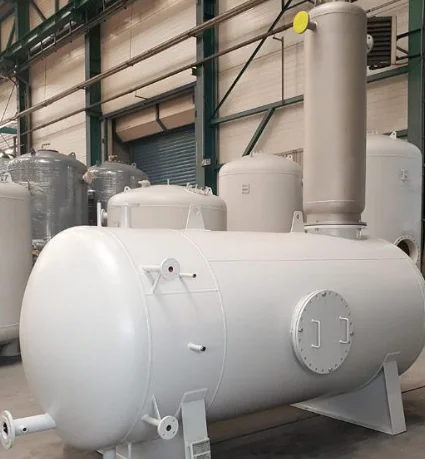
Our Italian manufacturing framework aligns specialized engineering with rigorous European and international code compliance, constructing durable atmospheric or pressurized blowdown vessels that smoothly handle high-temperature sludge drainage, flash steam distribution, and deep thermal shock isolation.
Every Nordstone DA vessel and blowdown unit is built within our state-of-the-art manufacturing facility utilizing premium-grade carbon steel (such as SA516 Gr. 60/70) or corrosion-resistant stainless steel (SS316L). Engineered to withstand extreme pressures up to 25 bar and severe thermal cycling up to 200°C, our industrial vessels cater to mission-critical operations across oil & gas, defense, power generation, and petrochemical plants. Backed by valid API, ASME Section VIII Div. 1, ISO, and PED (2014/68/EU) certifications, Nordstone guarantees uncompromising mechanical reliability, maximum energy efficiency through optimized flash steam recovery, and unwavering safety for high-pressure boiler infrastructure throughout Italy.
To discuss project specifications, calculate precise tank sizing, or request a technical quote for your facility, please visit our Contact Us page to connect with our regional engineering team.
Frequently Asked Questions (FAQ)
1. What are the primary functions of a blowdown tank in a steam boiler system?
A blowdown tank safely receives, cools, and neutralizes intermittent or continuous hot water and high-pressure sludge discharged during boiler blowdown operations. It isolates downstream sewage systems and personnel from thermal shocks, handles flash steam venting safely, and allows suspended solids to settle at the bottom of the vessel before the remaining water is discharged.
2. How does a Deaerator (DA Vessel) improve boiler plant efficiency?
A DA vessel removes dissolved gases, particularly oxygen (O2) and carbon dioxide (CO2), from the boiler feedwater stream. By heating the water and utilizing steam stripping mechanics, it drives these gases out to prevent heavy pitting corrosion inside the boiler tubes and piping networks, thereby extending equipment lifespan and maintaining optimal thermal heat transfer.
3. Which international design codes do Nordstone vessels comply with in Italy?
As global manufacturers supplying the Italian and European markets, Nordstone pressure vessels are engineered and fully certified according to ASME Section VIII Division 1, the European Pressure Equipment Directive (PED 2014/68/EU), API standards, and ISO quality frameworks.
4. What is the difference between an atmospheric and a pressurized blowdown tank?
- Atmospheric blowdown tanks operate at or near zero pressure, safely venting flash steam directly into the atmosphere; they are typically deployed for lower-pressure commercial or small industrial boilers. nordstonein.com
- Pressurized blowdown tanks are designed to operate at medium to high pressures (up to 25 bar), capturing and routing high-energy flash steam back into low-pressure steam headers or deaerators for heat recovery. nordstonein.com
5. What materials of construction does Nordstone utilize for corrosive steam environments?
We carefully select materials based on operational temperature, pressure, and chemical exposure. Standard builds include high-strength carbon steel plates like SA516 Gr. 60/70 or alloy steels like SA387. For highly corrosive condensate or chemical environments, we use stainless steel grades SS304/304L and SS316/316L, as well as specialized linings or coatings.
6. Can Nordstone integrate flash steam recovery systems into our blowdown setup?
Yes. Our engineering team specializes in configuring custom flash recovery blowdown packages. Instead of wasting energy, the flash steam generated during a high-pressure blowdown drop is separated and piped directly to heat the deaerator or feedwater system, noticeably reducing fuel consumption.
7. What standard capacities and operating parameters do you offer for Italian industries?
While we tailor dimensions specifically to your boiler capacity, our standard industrial range supports design pressures from 0.5 bar up to 25 bar, operating temperatures up to 200°C (higher on specialized alloy requests), and volume capacities scaling from 500 liters up to 20,000 liters.
8. Why is oxygen removal in a DA vessel critical for high-pressure boilers?
At high boiler temperatures, even tiny concentrations of dissolved oxygen become aggressively corrosive, causing localized oxygen pitting that can puncture thick steel tubes rapidly. A Nordstone chemical or steam deaerator achieves gas removal efficiencies between 95% and 99.9%, safeguarding critical assets.
9. What testing protocols do Nordstone boiler and steam vessels undergo?
To guarantee structural integrity under extreme conditions, every vessel undergoes exhaustive Non-Destructive Testing (NDT), including:
- Radiographic Testing (RT) and Ultrasonic Testing (UT) on critical weld seams.
- Magnetic Particle Inspection (MPI) or Liquid Penetrant Testing (PT).
- Mandatory hydrostatic pressure testing exceeding maximum allowable working pressures.
- Final third-party inspections (such as TÜV, Lloyd’s, or Bureau Veritas) if requested.
10. Does Nordstone offer vertical or horizontal configurations for blowdown vessels?
Yes. We manufacture both configurations depending on site spatial constraints. Vertical configurations minimize footprints in tighter mechanical rooms, while horizontal arrangements are typically optimized for high-volume, high-capacity industrial process configurations.
11. How do automatic bottom blowdown units compare to manual valves?
Automatic blowdown units utilize a timed or sensor-driven control loop to open purge valves at precise cycles. This prevents the human error of missing purges or over-purging (which wastes energy and treated water), keeping boiler TDS (Total Dissolved Solids) and sludge accumulations within strict, safe limits.
12. Are your deaerators and blowdown vessels available as modular skid packages?
Yes, we engineer and supply fully integrated, skid-mounted modular assemblies. These packages include the main pressure vessel, pre-piped manifolds, bypass valves, safety relief devices (PSVs), level indicators, thermal insulation, and integrated PLC control systems to ensure simple plug-and-play installation on-site.
13. What maintenance features are engineered into Nordstone vessels?
Our designs prioritize field serviceability by integrating heavy-duty manways or handholes for physical inspection, dedicated lower drain ports for total sludge removal, clean-out nozzles, and standard instrumentation ports that facilitate quick sensor replacement without system teardowns.
14. How do I accurately determine the size of a blowdown tank for my plant?
Sizing depends on several critical data points: the maximum operating pressure of the boiler, the total blowdown flow rate, the duration of the blowdown cycle, and the local environmental regulations governing effluent discharge temperatures into sewers. Our engineering team calculates these parameters to find the optimal volume for your plant.
15. How can we initiate a custom manufacturing project or request a quotation?
You can easily coordinate directly with our engineering department by visiting our specialized Contact Us page. Provide us with your design codes, volumetric requirements, and operating thresholds, and our technical sales engineers will construct a comprehensive mechanical proposal tailored to your facility.