
As a premier global authority with 20 years of engineering experience, Nordstone specializes in designing and manufacturing high-performance, pressurized buffer tanks tailored for Italy’s most demanding industrial sectors.
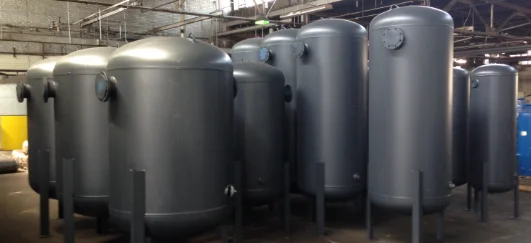
In complex thermal, HVAC, and industrial process setups, maintaining operational equilibrium is a major technical challenge. Fluctuating thermal loads often lead to frequent equipment cycling, which accelerates system fatigue and spikes energy consumption.
Our industrial-grade pressurized buffer tanks serve as essential thermal flywheels. By increasing the circuit’s fluid volume and storing thermal energy, they safely balance fluid volume variations, damp pressure surges, and eliminate destructive short-cycling in high-capacity chillers, heat pumps, and heavy process machinery.
Every custom-engineered tank is built within our state-of-the-art facilities to withstand extreme pressures and highly corrosive environments. Fully compliant with the European Pressure Equipment Directive (PED 2014/68/EU), as well as rigorous ASME Sec VIII and ISO benchmarks, our vessels deliver the structural integrity, heavy-duty insulation, and advanced anti-corrosion linings required by Italy’s Oil & Gas, chemical processing, energy, and defense sectors.
From custom internal baffles and multi-port balancing configurations to specialized alloy construction, Nordstone delivers robust, custom-tailored solutions that ensure long-term reliability, maximum safety, and optimized thermal efficiency for your critical infrastructure.
To discuss your specific engineering requirements or request a custom quote, please visit our Contact Us page to connect with our technical engineering team.
Frequently Asked Questions (FAQ)
1. What is the primary function of a pressurized buffer tank in an industrial process?
A pressurized buffer tank acts as a hydraulic and thermal reservoir. It increases the overall fluid capacity of a closed-loop thermal system, storing chilled or hot process water to smooth out sudden thermal load variations. This helps stabilize system pressures and temperatures while preventing heavy machinery from cycling on and off too frequently.
2. Why should industrial facilities choose Nordstone over local manufacturers in Italy?
Nordstone combines 20 years of proven manufacturing experience with deep technical expertise in custom engineering. While local suppliers often focus on standard, light-duty commercial tanks, we specialize in heavy-duty, highly customized pressure vessels capable of handling extreme pressures, temperatures, and corrosive media. Our global delivery capabilities and strict adherence to ASME and PED standards make us a trusted partner for critical industrial infrastructure across Italy.
3. Are Nordstone pressurized buffer tanks fully compliant with European and Italian regulations?
Yes. All pressurized buffer tanks delivered to Italy are strictly engineered and manufactured in full compliance with the European Pressure Equipment Directive (PED 2014/68/EU). Where specified by project criteria, we can also supply vessels carrying the ASME U-Stamp, CE markings, and ISO certifications to meet both regional and international safety mandates.
4. How does a buffer tank prevent compressor or chiller short-cycling?
When a facility’s thermal load drops below the minimum operating capacity of a chiller or heat pump, the cooling or heating source shuts down quickly, only to restart moments later as the limited fluid volume rapidly changes temperature. A buffer tank adds substantial thermal mass to the loop. This lengthens the time it takes for fluid temperatures to shift, ensuring the compressor runs for its optimal, manufacturer-recommended cycle time.
5. What design configurations do you offer for pressurized buffer tanks?
We design and fabricate both vertical and horizontal pressurized buffer tanks based on your facility’s layout and space constraints. Additionally, we provide custom configurations, including:
- In-line storage tanks: Installed on the return line to add pure fluid volume.
- Decoupling/balancing tanks: Equipped with internal baffles, anti-mix diaphragms, or internal diffusing pipes to separate the primary generation loop from the secondary distribution loop.
6. What materials of construction do you use for tanks deployed in corrosive environments?
Depending on the fluid composition and chemical exposure, we manufacture vessels using premium-grade materials. Options include high-tensile Carbon Steel (such as SA516 Gr. 60/70) with advanced protective coatings, Stainless Steel (SS304, SS316, SS316L, SS904L), and high-performance specialized alloys like Hastelloy, Monel, Inconel, or Titanium for highly aggressive process fluids.
7. What pressure and temperature ratings can your buffer tanks accommodate?
Because we specialize in industrial-grade pressure vessels, our engineering capabilities allow us to design custom tanks that operate safely from full vacuum up to and exceeding 100 bar. Our material selections and welding procedures are rated to handle extreme process temperatures ranging from cryogenic sub-zero levels up to +400°C.
8. Do you provide high-density insulation options for outdoor installations in Italy?
Yes. To maintain thermal efficiency and eliminate energy losses, our tanks can be configured with premium, high-density polyurethane or rockwool insulation. This insulation is protected by a weather-resistant external cladding (such as aluminum or stainless steel sheet metal) designed to withstand coastal marine environments, humid northern valleys, or exposed industrial sites across Italy.
9. What industries in Italy benefit most from Nordstone pressurized buffer tanks?
Our primary clients operate in demanding, high-stakes fields where system downtime is incredibly costly. This includes the Oil & Gas sector, chemical and petrochemical processing plants, power generation facilities, heavy defense manufacturing, pharmaceuticals, and large-scale district heating or cooling networks.
10. Can custom internal components be integrated into the tank design?
Absolutely. We specialize in custom internal engineering. We can integrate internal baffles to promote thermal stratification, specialized sparge pipes for uniform fluid distribution, vortex breakers, or internal heating/cooling coils (such as limpet or half-pipe jackets) to maintain precise fluid temperatures.
11. What quality control and testing procedures do you execute during fabrication?
Quality control is at the core of our manufacturing process. Every buffer tank undergoes comprehensive non-destructive testing (NDT), which includes:
- Radiographic testing (RT) or Ultrasonic testing (UT) of critical weld joints.
- Dye Penetrant Testing (DPT) or Magnetic Particle Testing (MPT).
- Hydrostatic or pneumatic pressure testing conducted at safety margins well above the rated design pressure.
- Complete material traceability and comprehensive Manufacturing Data Reports (MDR).
12. How does an industrial buffer tank differ from a standard domestic expansion tank?
While a domestic expansion tank uses a simple internal rubber bladder purely to absorb the physical expansion of water as it heats up, an industrial pressurized buffer tank is a much larger flow-through vessel. It is engineered to constantly handle high-volume fluid circulation, actively store large amounts of thermal energy, and manage continuous hydraulic balancing within a complex process network.
13. Can your buffer tanks handle glycol or other specialized chemical heat-transfer fluids?
Yes. Our engineering team selects internal linings, gasketing materials, and metal alloys based on the exact fluid chemistry of your system. Whether your process utilizes water, water-glycol mixtures, thermal oils, or aggressive chemical refrigerants, the vessel will be fully compatible and chemically resistant.
14. What is the typical lead time for a custom-engineered pressurized buffer tank?
Lead times vary depending on the volumetric capacity, material availability (such as specialized alloys), and the complexity of the internal components. Because we manage the entire engineering, FEM calculation, welding, and testing process in-house, we can offer highly optimized production schedules. Contact our team directly for a precise project timeline.
15. How do I get an engineering review and quote for a buffer tank project in Italy?
The best way to start is by sharing your process parameters—such as required volume, maximum allowable working pressure (MAWP), operating temperature ranges, fluid type, and space limitations—with our team. Please reach out through our Contact Us page, and one of our senior application engineers will follow up to review your design specifications.