When managing critical, high-flow process streams in aggressive industrial environments, processing equipment must deliver absolute reliability. For over three decades, Nordstone has stood as an elite benchmark among industrial bag filter vessel manufacturers in Italy, leveraging 20 years of dedicated engineering experience to deliver robust, high-performance liquid filtration solutions.
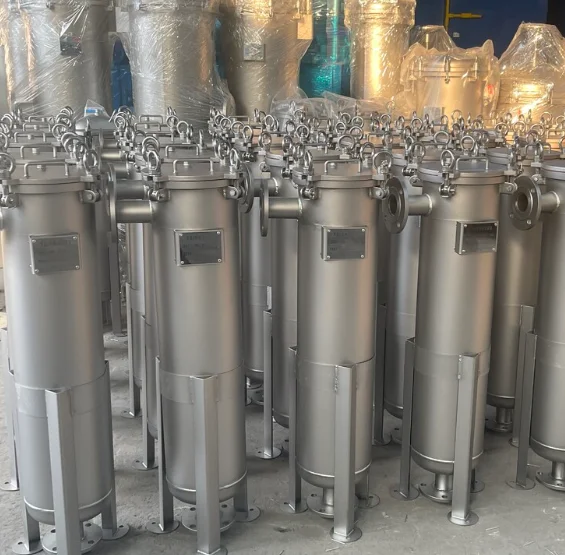
Engineered to handle extreme pressures, high temperatures, and highly corrosive substances, our industrial bag filter housings provide exceptional particulate retention across demanding sectors, including Oil & Gas, chemical processing, maritime, and defense. From single-bag housings designed for localized manufacturing lines to engineered multi-bag filtration systems for heavy-scale processing plants, we manufacture every pressure vessel to precise specifications.
Backed by state-of-the-art Italian fabrication facilities, an expert engineering team, and rigorous API, ASME Section VIII, and ISO quality controls, Nordstone guarantees uncompromised sealing integrity, minimal pressure drops, and extended operational lifespans for critical industrial applications worldwide.
To discuss your specific fluid dynamics, chemical compatibility, or custom pressure rating demands, connect with our engineering team directly through our contact-us page.
Frequently Asked Questions
1. What materials of construction do you use for your industrial bag filter vessels?
We manufacture our filter housings using premium-grade metals tailored to the chemical compatibility and temperature profile of your process fluid. Our standard offerings include carbon steel with advanced corrosion-resistant internal coatings, AISI 304 stainless steel, and AISI 316L stainless steel for highly corrosive or hygienic environments. For highly specialized critical applications, we also work with duplex stainless steel and super alloys.
2. Can Nordstone manufacture bag filter vessels according to ASME and European standards?
Yes. Our engineering and manufacturing processes comply with major international pressure vessel codes. We hold active ASME Section VIII Division 1, API, and ISO certifications. For vessels destined for the Italian and wider European markets, we design, manufacture, and test our equipment in strict accordance with the Pressure Equipment Directive (PED) 2014/68/EU, providing full CE marking and documentation packages.
3. What is the difference between single-bag and multi-bag filter housings?
- Single-Bag Housings: Best suited for low-to-medium flow rate applications (typically up to 40–45 cubic meters per hour depending on fluid viscosity). They hold one filter bag and feature a compact footprint.
- Multi-Bag Housings: Designed for high-volume process flows, holding anywhere from 2 to 24+ filter bags in parallel within a single pressure vessel. This allows for significantly higher flow capacities, larger dirt-holding volumes, and longer run times between bag changeouts.
4. How do I determine when an industrial filter bag needs to be replaced?
Filter bag replacement is determined by monitoring the differential pressure (ΔP) across the vessel using pressure gauges installed on the inlet and outlet nozzles. While a clean filter system typically operates at a ΔP of 0.1 to 0.3 bar, a saturated bag generally requires replacement when the differential pressure reaches between 1.5 and 2.0 bar. Exceeding this threshold risks bag rupture or bypass.
5. What closure options are available for quick filter bag changeouts?
To minimize process downtime, we offer several cover closure configurations based on your operating pressures and safety requirements:
- Swing Bolt Closures: The industry standard for reliable, robust sealing under high-pressure conditions while remaining easy to operate.
- Quick-Opening V-Clamp/Band Clamp Closures: Ideal for lower-pressure systems where swift, tool-free access is a priority.
- Davit Arm Assemblies: Fitted onto larger, heavy multi-bag vessel lids to allow operators to easily swing the heavy cover open safely and without mechanical cranes.
6. How does Nordstone prevent process fluid from bypassing the filter bag?
Fluid bypass is the primary cause of downstream contamination. We eliminate this issue through precision-engineered internal seating arrangements. Our vessels feature heavy-duty stainless steel support baskets that hold the bags perfectly in place, paired with specialized compression hold-down rings. These rings exert direct, uniform pressure onto the flexible plastic or steel snap-rings of the filter bags, creating a positive, leak-proof seal against the vessel’s internal flange.
7. What flow rates can your industrial bag filter vessels accommodate?
Flow capacity depends heavily on the specific gravity, temperature, and viscosity of the fluid, as well as the micron rating of the filter bag. However, our modular single-bag units can efficiently handle streams starting from 10 m³/h, while our custom-engineered multi-bag industrial systems can be scaled to manage massive industrial process flows exceeding 1,000 m³/h.
8. Are your filter vessels compatible with standard commercial filter bags?
Yes. We design our industrial bag filter vessels around standard global trade sizes (primarily Size 1, Size 2, Size 3, and Size 4 bags). This ensures you have total flexibility when sourcing replacement consumable filter media—whether felt, mesh, or melt-blown polypropylene—from any major international or Italian manufacturer.
9. What specialized non-destructive testing (NDT) do you perform on your vessels?
Because our vessels operate in critical environments involving high pressures and hazardous fluids, we maintain rigid quality control. Our in-house NDT capabilities include:
- Radiographic Testing (RT) for checking internal weld quality.
- Hydrostatic Pressure Testing (typically executed at 1.3 to 1.5 times the maximum design pressure).
- Liquid Penetrant Testing (PT) and Magnetic Particle Testing (MT) for surface defect detection.
- Ultrasonic Testing (UT) for thickness verification and internal flaw mapping.
10. Can you supply bag filter housings suitable for hazardous or explosive environments (ATEX)?
Absolutely. Operating extensively across Italy’s chemical and Oil & Gas sectors means explosive atmospheres are common. We engineer our vessels with appropriate electrical grounding lugs, robust structural materials, and ATEX-certified instrumentation (such as differential pressure transmitters or switches) to ensure full compliance with ATEX Zone 1 and Zone 2 directives.
11. Do you offer jacketed options for temperature-sensitive fluids?
Yes. For processes involving highly viscous fluids like polymers, resins, heavy oils, or food products that solidify or degrade if temperatures drop, we provide custom thermal insulation or steam-jacketed options. The outer jacket circulates steam or thermal oil around the main filtration chamber to maintain exact process temperatures during operation.
12. What types of inlet and outlet configurations do you offer?
We configure nozzle orientations to match your existing plant piping layout to reduce installation costs and space constraints. Standard options include:
- Side-Inlet, Bottom-Outlet: Common for standard floor-mounted single vessels.
- Top-Inlet, Bottom-Outlet: Maximizes fluid draining efficiency and ensures even distribution into the bag.
- Loop/Inline Configurations: Where inlet and outlet sit on the same horizontal plane for direct inline integration.
Nozzles can be supplied with ASME, EN/DIN, or UNI flanges, as well as threaded or sanitary Tri-Clamp connections.
13. How long is the typical lead time for a custom-manufactured Italian filtration vessel?
For highly standard, single-bag industrial housings, we maintain inventory or short-run fabrication schedules of a few weeks. For complex, engineered-to-order multi-bag vessels that require custom metallurgical sourcing, finite element analysis (FEA) design verification, and extensive third-party inspections (e.g., Bureau Veritas or Lloyd’s Register), lead times typically range from 8 to 14 weeks.
14. What surface finishes are available for your stainless steel vessels?
We offer a range of finishes depending on your sector’s requirements. Our industrial lines receive standard bead-blasting or pickling and passivation treatments to maximize corrosion resistance. For pharmaceutical, food and beverage, or fine chemical applications requiring high purity, we offer internal and external mechanical mirror polishing down to precise Ra limits, as well as advanced electropolishing.
15. How do I request a technical quote for a Nordstone bag filter vessel?
To get an accurate engineering proposal, please prepare your process parameters including: fluid type/chemical composition, maximum operating pressure and temperature, target flow rate, allowable pressure drop, and required particle micron rating. Once gathered, submit these details through our secure Contact Us link, and our senior engineering team in Italy will review your criteria and respond with a comprehensive technical specification.