For industrial applications requiring superior water treatment, turbidity reduction, and pre-filtration, Nordstone is among the leading engineering partners and industrial multimedia filter manufacturers in Italy.
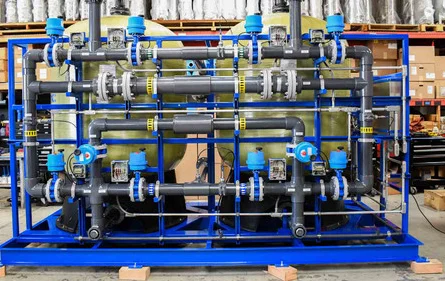
Backed by over two decades of precision fabrication experience, we manufacture heavy-duty multimedia filter pressure vessels engineered to withstand aggressive chemical environments, high temperatures, and high operational pressures. Industrial multimedia filtration relies on layered, high-density media beds—typically composed of anthracite, silica sand, and garnet—to trap suspended solids down to 10 microns throughout the entire depth of the bed rather than just on the surface.
To maintain optimal performance and structural integrity under constant pressure differentials, these systems require heavily reinforced containment vessels.
Our Italian and global clients across the Oil & Gas, desalination, and heavy chemical processing sectors rely on our deep engineering expertise to deliver robust, custom-tailored filtration housings. Operating from our advanced manufacturing facility, our expert engineering teams fabricate both vertical and horizontal multimedia filter vessels utilizing certified carbon steel, SS304, and SS316L stainless steel. Every unit we produce is meticulously aligned with stringent European and global safety frameworks, carrying full API, ASME Section VIII Division 1, and ISO certifications. From optimizing internal header lateral distribution systems to applying specialized corrosion-resistant internal linings (such as glass-flake reinforced coatings or specialized polymers), Nordstone ensures that your system achieves maximum solids-holding capacity, smooth backwash fluidization, and reliable, long-term operation.
To discuss your project specifics, flow rate configurations, or custom sizing requirements with our technical team, visit our specialized engineering division via our dedicated page to contact us.
Frequently Asked Questions
1. What materials does Nordstone use to manufacture industrial multimedia filter vessels?
We manufacture our pressure vessels using premium, certified raw materials accompanied by 3.1 material certificates of origin. Depending on your process fluid chemistry, temperature, and corrosion variables, we offer construction in high-tensile Carbon Steel, SS304, and SS316L Stainless Steel.
2. Which manufacturing codes and design standards do your vessels comply with?
Every multimedia filter vessel is designed, engineered, and tested in strict accordance with the ASME Section VIII Division 1 Code, API standards, and European CE/PED (Pressure Equipment Directive) regulations, alongside our corporate ISO quality management certifications.
3. What is the typical filtration rating of an industrial multimedia filter system?
Unlike standard single-medium sand filters, a multi-layered media bed configuration utilizes progressively finer, denser materials (anthracite, sand, and garnet) to achieve a deep-bed mechanical filtration rating typically ranging between 5 microns and 30 microns.
4. Why are Nordstone vessels preferred for harsh or corrosive environments?
We integrate specialized internal surface treatments tailored to the specific chemical composition of your source water. Our advanced coating capabilities include high-solid epoxies, ceramic-type linings, and glass-flake reinforced paints designed to combat aggressive chemical oxidation and premature wear.
5. How does a multimedia filter vessel handle pressure drops and backwashing?
As suspended solids clog the multi-layered media bed, the internal differential pressure increases. When it reaches a preset baseline (typically between 10 to 15 PSID), a reverse-flow backwash sequence fluidizes the bed to flush out entrapped particulate matter. Our vessels are engineered with 40% to 50% freeboard height space to accommodate this fluidization without media loss.
6. Can Nordstone build custom configurations for tight industrial footprints?
Yes. With 20 years of custom engineering experience, we design both vertical and horizontal vessel configurations. We can customize the internal diameter, plating height, wall thicknesses, and nozzle locations to precisely fit your existing facility spatial limitations and plumbing configurations.
7. What types of internal distribution systems do you integrate?
To guarantee uniform fluid distribution and prevent channeling during both filtration and backwash cycles, we engineer custom internal distribution assemblies. Options include high-strength stainless steel header laterals, hub-and-lateral configurations, or nozzle plate bases depending on your flow rates.
8. Are Nordstone multimedia filter vessels suitable for Reverse Osmosis (RO) pre-filtration?
Absolutely. Our multimedia filters serve as critical pretreatment units for industrial Reverse Osmosis (RO) lines, ultrafiltration systems, and granular activated carbon systems by lowering the Silt Density Index (SDI) and protecting delicate downstream membranes from particulate fouling.
9. What testing protocols do you perform during the manufacturing process?
Quality control is embedded into every stage of fabrication. We execute a comprehensive suite of Non-Destructive Testing (NDT) protocols, including 100% radiographic weld inspections (X-ray), ultrasonic testing, dye penetrant tests, and final certified hydrostatic pressure testing.
10. Does Nordstone supply skid-mounted, pre-piped filtration systems?
Yes, we offer completely modular, skid-mounted assemblies. The filter vessels can be delivered pre-piped with automated or manual face valve plumbing, integrated instrumentation, and PLC control panels, significantly reducing on-site installation and commissioning times in Italy.
11. Can these vessels support air scouring options during backwash?
Yes. For severe-duty industrial applications dealing with sticky or highly dense organic solids, we customize our vessel internals to include air scour distribution piping to assist in vigorously agitating the bed during the cleaning cycle.
12. What design pressures and temperatures can your filter vessels sustain?
Because each vessel is engineered from scratch, we build units tailored to your process parameters. We routinely manufacture systems operating at standard working pressures of 0.6 MPa, 1.0 MPa, and 1.6 MPa or higher, with temperature thresholds spanning from 4°C up to 120°C for steam-sanitizable applications.
13. How long do the internal components and vessel shell typically last?
By utilizing certified materials, precise mechanical calculations, and advanced anti-corrosion coatings, our pressure vessels are engineered for an industrial lifespan exceeding 15 to 20 years when maintained according to regular operational guidelines.
14. Do you provide validation documentation and certification books for the Italian market?
Yes. Every filter vessel shipped to Italy or internationally is accompanied by a comprehensive manufacturer’s data book. This includes welding procedure specifications (WPS), welder qualifications (WPQR), NDT reports, hydrostatic test certificates, design calculations, and CE/ASME stamping documentation.
15. How can I request an engineered quote or structural drawing for my project?
You can easily connect with our engineering team by sending your design parameters, required flow capacity, and material preferences directly to our specialists via our official page to contact us.