
In complex petrochemical and power generation facilities, managing two-phase thermal fluids requires highly specialized safety equipment. As premier industrial pressure vessel manufacturers, Nordstone designs and manufactures high-performance Knock-Out Drums (KO Drums) engineered specifically to protect flare stacks and downstream rotating machinery across industrial plants in Italy.
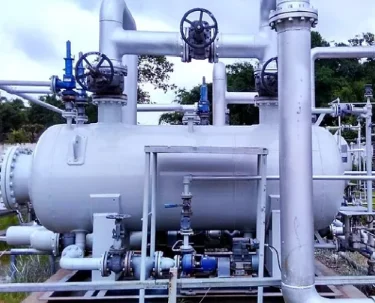
Operating as critical line safeguards, a flare knockout drum mitigates major overpressure risks by slowing incoming emergency relief gases, allowing entrained liquid droplets to drop out of the hydrocarbon stream via gravity-settling dynamics. Our custom-engineered vapor-liquid separators handle massive liquid surge capacities during unexpected plant upsets, preventing the dangerous phenomenon known as “flaming rain” at the flare tip.
Whether your facility requires a space-saving vertical arrangement or a high-volume horizontal knockout drum, our engineering team optimizes every vessel configuration to match your exact fluid velocity, droplet micron target, and operational footprint.
Technical Frequently Asked Questions (FAQs)
1. What is the primary function of a Knock-Out Drum (KO Drum) in industrial plants?
The primary function of a Knock-Out Drum (KOD) is to separate and accumulate free liquids, hydrocarbons, or water droplets from gas or vapor relief streams. By lowering the velocity of the gas flow, the vessel relies on gravity-settling principles to force liquids to drop out, ensuring that only dry, clean vapor enters the flare stack or downstream compressor suction lines.
2. Why is Nordstone considered a top-tier industrial pressure vessel manufacturer in Italy?
Nordstone blends over 30 years of manufacturing excellence with 20 years of dedicated technical experience in specialized metal fabrication. Our production ecosystem incorporates state-of-the-art robotic welding, precise thermal stress-relieving, and non-destructive testing (NDT). We serve critical operations throughout Italy, supplying customized, heavy-walled vessels built to handle the harshest chemical environments.
3. What design standards dictate the engineering of a flare knockout drum?
Industrial flare knockout drums are designed primarily under API Standard 521 (Guide for Pressure-relieving and Depressuring Systems) combined with the mechanical construction codes of ASME Section VIII Division 1 or Division 2. In Europe, they must also achieve strict conformity with the Pressure Equipment Directive (PED) 2014/68/EU.
4. How do you choose between a vertical and horizontal knockout drum configuration?
- Horizontal Knock-Out Drums: Preferred when handling massive liquid surge volumes, high vapor flow rates, or where a low pressure drop is required. They offer a larger vapor disengagement area.
- Vertical Knock-Out Drums: Selected when plot space is restricted or when the liquid load is relatively low. They integrate perfectly into the base of a flare stack structure.
5. What droplet size does a Nordstone vapor-liquid separator typically isolate?
In accordance with standard API 521 guidelines, our standard KO drums are sized to separate liquid droplets ranging between 300 to 600 microns in diameter. However, for specialized smokeless flare systems or advanced process limits, we can integrate high-efficiency internals to capture fine mist droplets down to 150 microns or less.
6. What are the operational dangers of liquid carryover in a flare system?
Failing to isolate liquid from a relief stream can lead to catastrophic safety hazards. Liquid carryover escaping through a flare stack can trigger “flaming rain”—a hazardous scenario where burning liquid droplets are ejected from the flare tip onto personnel and equipment below. It can also cause irregular combustion, dense black smoke, or extinguish the pilot flame completely.
7. How does liquid retention time affect the sizing of a horizontal knockout drum?
Liquid retention time determines the total storage volume needed to hold liquid accumulation during an emergency upset. API 521 recommends a minimum retention or holdup time of 20 to 30 minutes. Our engineers run precise calculations to balance this required liquid volume with the cross-sectional area needed to maintain low vapor velocities.
8. What specialized materials does Nordstone use to manufacture vessels for corrosive applications?
We work with a diverse metallurgical inventory to combat severe corrosion mechanisms like wet sour gas (H2S) service or hydrogen embrittlement. Material choices include heavy-duty Carbon Steel, Austenitic Stainless Steel (304L/316L), Duplex and Super Duplex steels, or custom corrosion-resistant alloy (CRA) claddings.
9. What testing protocols do Nordstone vessels undergo before delivery to site?
Every piece of industrial process equipment undergoes rigorous quality control. This includes 100% Radiographic Testing (RT) on critical load welds, Ultrasonic Testing (UT), Magnetic Particle Testing (MT), Post-Weld Heat Treatment (PWHT) to relieve residual stresses, and final hydrostatic pressure testing up to 1.5 times the maximum design pressure.
10. Can a Nordstone KO drum handle the Joule-Thomson effect during low-temperature depressurization?
Yes. Rapid gas depressurization events often cause a steep temperature drop due to the Joule-Thomson effect. Nordstone engineers utilize specialized low-temperature carbon steels (such as SA-333 or SA-350) or stainless steels that maintain high impact toughness and prevent brittle fracture at sub-zero temperatures.
11. What instrumentations are critical on a safely operated flare knockout drum?
A safely engineered KOD requires robust monitoring instruments, including:
- Redundant Liquid Level Indicators & Transmitters (guided wave radar or magnetic level gauges).
- High and low-level alarms linked to automatic drain valves or pump-out systems.
- Differential pressure transmitters to monitor internal fouling or baffle restrictions.
- Sump heaters to avoid fluid freezing or hydrate formation in cold climates.
12. What internal components can be added to improve liquid separation efficiency?
To minimize vessel sizing or optimize droplet removal, we can integrate custom internals such as inlet deflector baffles (for initial fluid momentum dissipation), slosh baffles, vane packs, or multi-layer wire-mesh mist eliminators that force fine droplets to coalesce and drop out.
13. How does a compressor suction knockout drum differ from a flare knockout drum?
While both utilize gravity separation, a compressor suction drum is installed directly upstream of a gas compressor to eliminate even trace amounts of liquid. Because compressors are highly sensitive to liquid slugging—which can destroy internal pistons or impellers—suction drums feature much tighter droplet separation requirements (often down to 10 microns) via heavy use of mist eliminators.
14. How does Nordstone customize vessels for specific plant operating parameters?
We use advanced process simulation and Finite Element Analysis (FEA) software to model your plant’s worst-case relief scenario (e.g., total power failure or blocked discharge). We then customize the length-to-diameter (L/D) ratio, nozzle placement, wall thickness, and internal design to deliver optimal fluid dynamics.
15. How can I request a technical quote or engineering consultation for a project in Italy?
You can easily collaborate with our technical engineering team to review your process datasheets, custom dimensional requirements, and certifications. To get started, submit your project details directly through our centralized communication page at Contact Us.